New organization says regional task force, more immediate response is needed.
Note: Content in this article may be emotionally challenging.
Every day is a struggle for Laynee Westbrook’s family — a struggle to hold on to hope that the Anacortes woman, missing since 2020, will be found, countered by the growing likelihood she will not be found alive.
“Continuing to follow up on leads and do what we can is so important because every day is hard,” said Emily Pepper, Westbrook’s sister-in-law. “When you don’t have the answers that are needed for closure, it’s hard — and not knowing is even harder.”
Westbrook’s family is not alone.
Families of 29 missing persons and 14 homicide victims in Skagit, Whatcom and San Juan counties await answers. For many, the wait has been excruciatingly long: the oldest unsolved homicide case dates to 1979, while six others date to the 1980s. Five missing person cases also date to the 1980s.
Those early investigations were hampered by lack of training — an Anacortes police officer told The Seattle Times in 1993 that the department was inexperienced in homicide investigations at that time — and by lack of tools that are available today, such as DNA testing and digital technology.
“When DNA was first available as a tool, you had to have a decent sample size for it to really be effective,” Anacortes Police Chief Dave Floyd said. “Now, even trace amounts are enough for scientists to do their work and make a match.”
And teamwork — multijurisdictional and grassroots — may help turn the tide.
Families of missing persons in Skagit County are pushing for changes in how missing person cases are managed by law enforcement — and keeping hope alive that their loved ones will be found.
They formed Families of Missing People in Skagit County in 2023 and maintain a Facebook page by that name.
Pepper, whose sister-in-law has been missing since Sept. 10, 2020, said the organization is calling for changes in how law enforcement investigates missing person reports. The organization’s current goals, according to its Facebook page:
- Change laws at the state level enabling law enforcement to get search warrants under special circumstances when “evidence of a crime” is not readily available.
- Raise funds to erect a digital billboard featuring missing people in Skagit County.
- Provide links and resources for members and supporters to assist in their search efforts.
- Establish a missing persons task force for Skagit County.
Time matters
Time is crucial when a person is reported missing. According to the FBI, about 70% of all reported missing persons in the U.S. are found within 48 to 72 hours. The more time that passes, the more leads and evidence can disappear and details and information can be forgotten, Pepper said.
There is a person of interest in Westbrook’s case, a male friend she was seen with on security camera footage at the San Juan Motel, where she was staying, and later that night at the Swinomish Market gas station on Highway 20. He has convictions for domestic violence assault, assaulting a police officer, assaulting a cellmate at Skagit County Jail and being a felon in possession of a firearm.
Despite his record, “Nobody put eyes on him until 19 days into the investigation, which is plenty of time for superficial wounds to heal and evidence to disappear and all sorts of things,” Pepper said. “He was the last person seen with her. With his criminal record, why someone didn’t go knock on his trailer door the same day she was reported missing, I don’t know.”
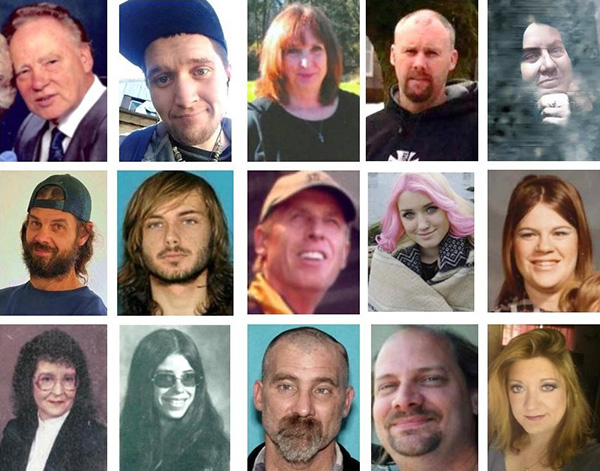
Pepper said there can be delays in an investigation if the missing person is known to law enforcement for alcohol or drug abuse.
“They’re, you know, maybe homeless or transient, maybe have some addiction problems, and because law enforcement is familiar with their name, they might assume that maybe they’re out on a bender,” she said. “It’s reasonable to think that, but at the same time, there needs to be protocol for handling these cases. … It takes weeks of ‘They haven’t used their cell phone and they haven’t used their credit card and they haven’t called anybody, so I guess they must be missing’ and maybe they should take this seriously. In the meantime, a whole bunch of evidence can be fumbled right from the get-go.”
Support for investigators
Families of Missing People in Skagit County is seeking nonprofit status so it can apply for grants to help law enforcement obtain the tools and training it needs for investigating missing person cases, Pepper said.
A multijurisdictional missing persons task force would be an effective tool, she said. There are multiagency task forces that attack narcotics trafficking and investigate deadly use of force by officers. On a broader scale, the U.S. Marshals Service teamed with federal, state and local agencies in a six-week national operation in July 2024 that resulted in finding 200 missing children, among them endangered runaways and those abducted by noncustodial persons.
Such multijurisdictional efforts can bolster efforts to solve cases quickly. “Departments like Sedro-Woolley and Anacortes and Burlington have limited resources,” said Bonnie Bowers, a retired Anacortes police chief now serving on the Anacortes Port Commission. “Let’s face it, we’re not big players in Skagit County, but when we band together and pull in resources from the State Patrol, then that’s a force multiplier and a game changer that can really help.”
Floyd said the investigations division chief of the Skagit County Sheriff’s Office is proposing a multiagency technology task force, with members who have expertise in digital evidence and forensics.
“Having a team of people that can carry out various technology-based tasks quickly would be a huge asset,” Floyd said. “Those first few weeks are pretty important and you want to get all the technology that’s out there that can be used for evidence before it disappears.”
Meanwhile, the Anacortes Police Department is adding officers, thanks to a local ballot measure approved in November. Proposition 1 will give the department funding to increase its ranks from 28 to 33 commissioned officers and assign a third detective to the general crimes unit, Floyd said. That would put the department close to the average number of officers per 1,000 population in Western states, according to data from the Center for Public Safety Management, which provides public safety technical assistance for the International City/County Management Association, a nonprofit professional group.
DNA, technology bolster investigations
In the 1993 article in The Seattle Times, reporter Eric Nalder wrote about mishandling of evidence and other blunders in the investigations of four murders in Anacortes in the 1980s. Anacortes police later reinvestigated those cases. One is still unsolved — that of Anthony Palumbo, a New Jersey native with suspected ties to organized crime, who was found stabbed to death in his Anacortes apartment on Feb. 5, 1981. Another case, believed to be a homicide, from January that year also remains unsolved.
Missing person cases, too, can become more difficult to solve as time marches on.
Judith Gail Taylor of Anacortes was reported missing in 1985. Thirty-five years later, a former neighbor told a hospital nurse and police that he had suffocated her and dropped her body off Deception Pass Bridge. The former neighbor was among those interviewed in the initial investigation into Taylor’s disappearance, the case file shows.
In 2021, the man was terminally ill. He told police he felt bad about what he had done and wanted to get right with God. But Chief Criminal Deputy Prosecuting Attorney Rosemary Kaholokula determined she could not prove murder beyond a reasonable doubt based solely on his confession — she noted some discrepancies — and no charges were filed. The man died, and Taylor is still listed as a missing person.
Bowers said homicide and missing person investigations have been helped by advances in technology.
“Our digital footprint is tremendous now,” she said. “The GPS on people’s phones is the best way to track their last-known location and most of us carry that little device with us most of the time. So that’s a huge tool for law enforcement. Most public buildings and many private buildings have security footage, which is usually made available to law enforcement. That’s very helpful in confirming suspects. And DNA has been a game changer.”
DNA collected from a murder scene in 1987 in Alger led to an arrest and conviction 30 years later when a DNA match was found on a genealogy website.
In 2016, a police detective in the Kitsap County town of Poulsbo used social media to track down a fugitive hiding in plain sight in Oklahoma. The fugitive had escaped trial for rape in 1987.
And in February 2024, online messages and rideshare records helped investigators find a 14-year-old Mount Vernon girl — and arrest her 30-year-old suspected abductor — in Michigan three weeks after she was reported missing.
To families: ‘don’t lose hope’
Floyd was a captain with the Anacortes Police Department when Laynee Westbrook was reported missing. He believes someone has information that could lead to an arrest and conviction.
“I think that for various reasons, fear of retaliation probably being one of the primary concerns, they’re reluctant to give up that information,” he said. “If we were able to get that information and make an arrest, the person convicted would be in custody in a state facility for decades. Anybody that did provide information that helped lead to some closure in this case, that would be something that would give them peace of mind, knowing that there would be no chance for retaliation because this person is going to be gone for a long, long time.”
Westbrook’s family continues to keep her story in front of the public. There have been several searches with private dog teams. A medium pitched in, but could only offer that Westbrook was near woods and water. “Where we live, that’s minimally helpful,” Pepper said.
She gives high credit to Anacortes Detective Sgt. Jackie Nations, lead investigator in the case.
“There’s a lot that goes on behind the scenes that the average Joe would never know, and we would never know unless I was in communication with her — from creating DNA profiles to tracking someone down in Thailand and doing an interview over Zoom at midnight while the guy’s in custody,” Pepper said. “You know, it means a lot to her to get this solved. There isn’t a whole lot of new information to follow up on, but she is still interviewing people and actively working on it.
“The primary person of interest in her case is still local, but I know that when it comes to (Anacortes police), they want to make sure they have enough evidence to hold him and keep him and have charges stick.”
Floyd said that the cases do evolve over time. Reluctant people work up the courage to speak. Technology advances. Criminals let their guard down.
“There are some good things that happen as time goes along,” he said, “and so I would encourage folks that have missing loved ones or unsolved cases, don’t lose hope.”
A list of unsolved cases [PDF] is compiled from records of the Anacortes Police Department, Washington State Patrol, Skagit and Whatcom county sheriff’s offices and the National Missing and Unidentified Persons System.
— By Richard Arlin Walker