
The essays, analyses and opinions presented as Community Voices express the perspectives of their authors on topics of interest and importance to the community, and are not intended to reflect perspectives on behalf of the Salish Current.
Commentary: Rod’s content being homeless, says Rayanna keeps him young
I met Rod at their small encampment outside Rite Aid on Northwest Avenue. He is 60 years old, overweight with a scraggly beard. With him were his girlfriend, Rayanna and a friend Luis, a younger, clean-cut man.
[Ed.: Only first names have been used to respect the privacy of those interviewed.]
Rod grew up in Bellingham on Meridian Avenue and has spent his adult life in the Birchwood neighborhood. He had been homeless for about nine years since he and a previous girlfriend were evicted by a landlord over a disputed electric bill. He had been supporting himself with odd jobs and her income. But after she left him, he did not have enough money for another apartment.
He had been homeless once previously for a couple of years. Now he is quite content being homeless and would not accept transitional housing, even if it were offered. He said that his life has meaning because he can help other homeless people that he knows, especially his girlfriend, Rayanna. With a gleam in his eyes, he said she kept him young.
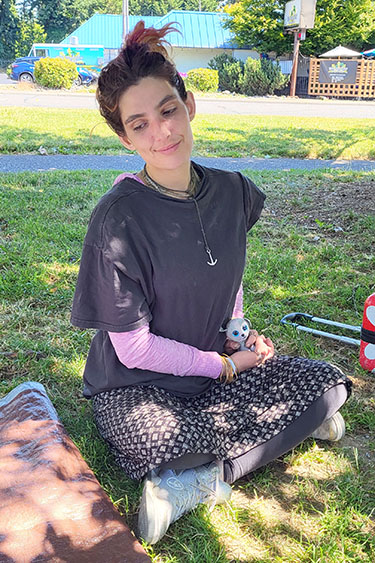
She is 27, much younger than Rod, but wild-eyed. They have been together for four years, and he warned me that I would not be able to make much sense of what she said. Indeed, her thoughts seemed to run wild and rarely conveyed anything that I could understand. She often talked aimlessly without prompting, often accompanied by a strange smile suggesting untreated, or at least inadequately treated, mental illness.
When asked about drug use, she said she had taken Abilify, a powerful antipsychotic medication. It was unclear whether this was part of psychiatric treatment or street use. She was born in Bellingham but raised somewhere near Mount Baker by drug-abusing parents whom she described as “crazy.” She does not recall any time when she was not homeless. She and Rod support themselves with handouts from the Opportunity Council, food stamps and the Bellingham Food Bank.
Both readily acknowledged that they used drugs, Rod much more than Rayanna. He said that he used “everything,” although when questioned more closely, he clearly preferred opioids, particularly fentanyl. He said he tallied 23 overdoses and managed to pull through them all. He keeps a large supply of Narcan available. However, Narcan did not revive him the one time he overdosed on “tranquilizers.” (It only works on opioids). Rayanna likes to smoke crack [cocaine], Rod said but has only overdosed three times that he knows about.
I took a lunch break and when I returned, Rod was in tears. Rayanna had suddenly left with another man and taken her things with her. He did not understand why she left and was heartbroken. He doubted she would ever return. It was clear that he loved her and that caring for her had given his life meaning.
While I knelt beside Rod trying to console him, a well-groomed man, casually dressed in shorts and a gray T-shirt, approached. He said that he was a friend of Rod’s and was checking up on him. He wanted to know who I was. He was oddly defensive about how he had befriended Rod, although he did acknowledge that he had been homeless once and felt an affinity for the homeless. He was holding an e-cigarette case in such a way that most of it was concealed in his hand. Rod continued to sob and seemed to pay no attention to the man. Nor did the man ask why Rod was crying, certainly odd behavior from someone who supposedly was checking on a friend. I thought most likely he was Rod’s drug dealer.
As that man was leaving, two men wearing yellow City of Bellingham vests approached the adjacent encampment and told them that there was no camping inside the city of Bellingham and that they had to clear out. But when they talked to Rod, they only asked him to clean up the fentanyl oil scattered around his camp. Still crying, Rod began to clean his area. He was alone when I left.
When I returned the next day, Rayanna was back and the two of them were snuggled under blankets. Their enclosure was now covered with the same tarp that had made the adjacent camp illegal under the City’s rules but which now afforded them a degree of privacy. She could offer no explanation for her abrupt departure.
— By John Dunne
We welcome letters to the editor responding to or amplifying subjects addressed in Community Voices. If you wish to contribute to Community Voices, please send an email with a subject proposal to Managing Editor Mike Sato (msato@rockisland.com) and he will respond with guidelines.
Help keep the local news flowing — support nonpartisan, fact-based, no-paywall local journalism
with a donation to the Salish Current — news for people, not for profit.