
Accessibility advocates celebrate making the White Rock Pier inclusive and accessible to all
The city of White Rock, British Columbia, installed an accessibility mat in late August that stretches along the east side of the city’s landmark seaside pier, thanks to the tireless efforts of a Canadian accessibility advocacy group.
The 470-meter-long, all-wood pier was built in 1914–15 and restored in 1977. The pier was severely damaged in a December 2018 storm and re-opened five years later.
The accessibility mat will make the pier’s uneven planks safer for people who use mobility aids like wheelchairs, walkers and canes, and for those with visual impairments.
Kiran Aujlay, founder of the Equal Access Collective from Surrey, B.C., recalled her first journey in August along the pier’s accessibility mat.
“As I began to push on the mat, the first thing I noticed was that I could actually look up and see everything that surrounded me,” she said. “I wasn’t looking down to ensure that my wheels weren’t slipping through the gaps between the planks, or that I hit an uneven plank that could pitch me forward out of my chair. It was a smooth, effortless push. Because of this, I was able to see Mount Baker from an angle I have never seen before.”
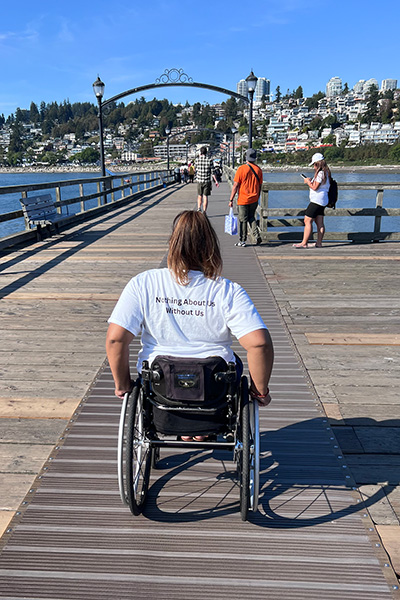
While she soaked up the sun and gazed out at Semiahmoo Bay and the beach at low tide, Aujlay said she noticed many people choosing to stroll on the five-foot-wide mat instead of on the bare planks. She also spotted a walker placing her cane on the mat. Then, a woman tapped on her shoulder and asked her how it felt to have the mat on the pier.
“It was an emotional moment as I realized just how much I had missed out on in the last 20 years,” Aujlay said. “I saw so many smiling faces, as many of those people supported this endeavor to make the pier accessible.”
Obstacles and challenges
The journey to install an accessibility mat on Canada’s longest pier was years in the making. Susan Bains, an advocate with the Equal Access Collective from White Rock, spearheaded the campaign to the White Rock city council. She said she continually faced pushback from the city about the cost.
“In advocacy, we face both physical and attitudinal challenges,” Bains said. “While the physical obstacles — such as gaps and uneven planks — have been effectively addressed by the mat, overcoming the attitudinal barriers prove to be much more complex. These barriers are deeply ingrained and systemic.”
The city council initially voted in May 2024 against funding an accessibility mat for the pier. Councilors decided then to look into possible grants to pay for the mat rather than approve a one-time $100,000 Canadian investment of city funds.
Bains said she conducted research for grants on behalf of the city. A CA$25,000 grant from the Social Planning and Review Council of British Columbia, a commitment of CA$5,750 from a clothing sale held by the Self Advocates of Semiahmoo, and a CA$2,000 donation from the Soroptimists International of White Rock made the accessibility mat possible.
“Accessibility needs should not be sidelined or deferred — they must be addressed immediately and without relying on fundraising or donations,” Bains said. “Instead of admiring us for fighting for our rights, we should focus on a world where we don’t have to fight so hard.”
The council unanimously approved the purchase of the accessibility mat in July 2024, and amended the city’s heritage site bylaw to authorize the structure’s alteration.
“The City of White Rock is proud to unveil the new pier accessibility mat, a project that represents our commitment to ensuring that everyone, regardless of their mobility, can experience the joy and beauty of our pier,” said White Rock Mayor Megan Knight in a statement. “It’s wonderful that it was completed before the end of summer, allowing everyone to enjoy it.”
The AccessRec mat now on the White Rock Pier is the same type as that in use on the pier in Santa Monica, California.
“I supported the accessibility mat from day one,” said Ernie Klassen, White Rock city councilor and accessibility advocate. Klassen’s son has lived his entire life in a wheelchair.
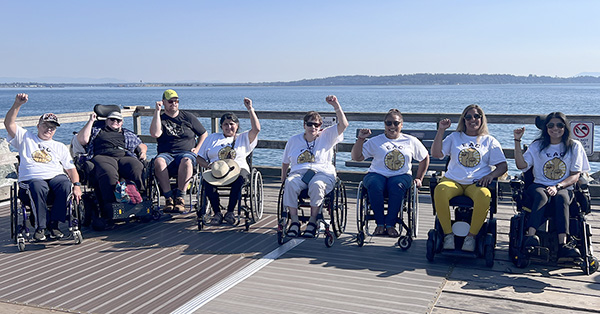
“I am proud to join to do whatever we can do to make this world a better place,” he said. “Sometimes we have to fight, sometimes we have to persevere. Persevering has made White Rock a better place for all of us.”
Healthy seniors, healthy communities
Around 15% of the world’s population — or more than 1 billion people — live with a disability, according to the World Health Organization.
“This is a group that any one of us can join at any time in our lives,” Bains said. She once jogged along the White Rock promenade and pier. “As our population grows and ages, the demand for accessibility will continue to increase.”
White Rock is home to an aging population, with more than 37% of residents over the age of 65, according to Statistics Canada. Residents between 55 and 64 years make up around 17% of its population.
As the population is aging, said Karan Bola, a member of the Equal Access Collective from Surrey, “these issues are going to affect more and more people.”
One in four Canadians will be 65 years of age or older by the mid-2040s, according to data by Environics Analytics for CTV News in Canada.
The accessibility mat in White Rock will now encourage people with disabilities — no matter what age — to get outside and socialize with their friends, Bola said. Now that a barrier is lifted, social activities on the pier will benefit their mental, as well as their physical health.
“Our work has only just begun,” said Kim Egger, co-founder of advocacy group South Fraser Active Living from Surrey. “We believe in equal access for everyone. Other municipalities and politicians will learn from this example. We look forward to a world where all people can go anywhere — especially in a country like Canada.”
—By Catherine Skrzypinski