
The essays, analyses and opinions presented as Community Voices express the perspectives of their authors on topics of interest and importance to the community, and are not intended to reflect perspectives on behalf of Salish Current.
Burning rubber on the new I-5
There wasn’t a single thought in anyone’s head about the risk or wisdom of it. Teenage hasn’t changed that much. The lure of ten miles of empty, open concrete freeway … four lanes, built for speed … put impish smiles on our rear-view reflections. Interstate 5 from Ferndale to Blaine was due to finish up in 1963, but things like signage and striping were not yet ready for traffic.
Having discovered that DOT (the Department of Transportation) wasn’t taking their barricades seriously, we skirted them and entered. Some immediately took to laying long black lines of rubber on the pristine surface. Others just toured the new road at rubber-necking speed. My dad’s 1959 Ford Fairlane 500 sped me to 100 mph for the first time, for no good reason. When it snowed, the cars and trucks first made pulling 180s and donuts a competition, then settled into towing sleds, toboggans, inner tubes, plywood, and skis, et al, loaded with laughing figures in toques and wool coats.
The word got out that the hot-car locals around town were going to gather just south of Dakota Creek to settle any argument about who had literal street cred and who didn’t. On the day, a small audience began forming off to the side. Groups of two or three stood Norman Rockwell-like around open hoods, talking about displacement, Isky Cams, gear ratios, bores, and strokes, and such. As the drivers each put their pride on the starting line, we all knew that Jack’s ’54 Chev was the car to beat. Whether our prediction proved true is lost in the 60 years since.
Racing two by two, the powerful machines leapt off the line with a roar amid acrid smoke, screeching tires, and the feeling something was going to break. Ten or 12 seconds later the racers typically crossed the quarter-mile mark at around 70 miles per hour.
As the crowd dwindled and the big guys finished their races, the family sedan set moved in with nothing to prove to anyone. Wes had his dad’s ’59 Chevy Impala, Paul was in the shipyard’s pickup, and the lumbering four-door 1959 Ford Fairlane 500 quivering under my foot was my ride.
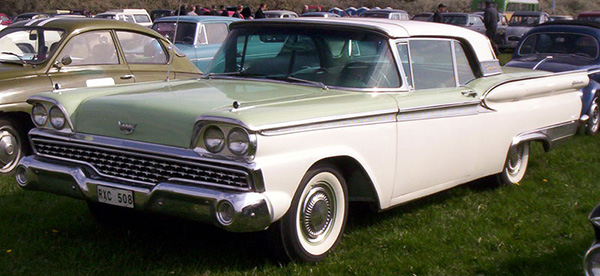
This was not the first time we had tested the cars and our skills on the road. One of our favorite races was around the gravel roads on Birch Point. Now lined with upscale housing, Birch Point Road was graveled for three miles in the ’50s, and nearly deserted most of the time. At speeds beyond any concept of safety, once in snow, we raced through the woods thinking only of how thrilling it was.
Rolling slowly up to the quarter mile starting line, I knew both my classmates were more practiced, especially on the starts with the advantage of a stick shift. A quickly dismissed thought about consequences, and shifting into Park, my foot pressed hard on the gas until every cubic inch of that motor screamed for mercy. Slamming the shift lever into Drive (I cringe), the Ford made a sound like gear teeth stripping, but lurched ahead with a little cheep of rubber on pavement. The pedal was on the metal for the entire race, but alas, my automatic transmission could not compete with the clutch-popping leap forward afforded by the standard shifts. Even losing by half a length, it was gratifying that the Ford surprised us all by coming close. Our time in the quarter mile? Forgettable.
The “Blaine Freeway” section of I-5 from Ferndale to the Canadian border was opened in two stages, beginning on Oct. 29, 1963, with the 11 miles from Ferndale north to Dakota Creek, Blaine’s southern boundary. The final stretch through Blaine was delayed by construction issues but eventually opened on Nov. 23, 1965, with a dedication ceremony at the Peace Arch.
— By Don Montfort
Ed.: A version of this article appears in the December 2024 issue of the Journal of the Whatcom County Historical Society.
• • •
We welcome letters to the editor responding to or amplifying subjects addressed in Community Voices. If you wish to contribute to Community Voices, please send an email with a subject proposal to Executive Editor Mike Sato and he will respond with guidelines.
Help keep the local news flowing — support nonpartisan, fact-based, no-paywall local journalism
with a donation to the Salish Current — news for people, not for profit.