
The essays, analyses and opinions presented as Community Voices express the perspectives of their authors on topics of interest and importance to the community, and are not intended to reflect perspectives on behalf of Salish Current.
Commentary: Orcas Power and Light Co-op can fix the inequality of its rate structure
Our customer-owned electric utility, OPALCO, has voiced with increasing alarm: “Blackouts are coming.” Why? Coal and natural gas-fired power plants are being retired faster than we can add new wind and solar energy, and electric load is growing with the addition of new electric vehicles and power-hungry data centers. We are entering a new reality where electricity will be in short supply and the consequences for our electric bills may be painful.
For OPALCO, the biggest crunch time is when the mercury dips well below freezing and our heaters work extra hard to keep us warm and pipes from bursting. A cold snap in December 2021 led to a spike in power consumption that resulted in a $300,000 penalty imposed by OPALCO’s wholesale power supplier, the Bonneville Power Administration (BPA), for peak consumption exceeding the normal range. This past January cold weather triggered a similar penalty.
To make matters worse, when demand spikes, BPA has to scramble to find extra supply in the spot market, where prices can be very volatile and can surge to 25 times the normal wholesale price.
A problem is that there is a gaping mismatch between who causes the demand spikes and how much they pay to cover the system costs associated with peak demand. On Jan. 12 when OPALCO’s system demand peaked, top 10 residential customers (“mansions”) were consuming as much as the bottom 19% or 2,308 customers! Similarly, the top 100 contributed as much as the bottom 29% or 3,489 homes. (See graph.)

Despite the deeply unequal contribution to the system peaks, OPALCO imposes the same fixed charge of $56/month that every other residential customer pays. If OPALCO’s fixed costs were allocated based on peak usage, the top 10 residential customers should have been charged fixed costs of $167,000 per year, instead of the $6,720 OPALCO collected from the flat $56 per month access charge — an underpayment of $160,000. Similarly, the top 100 customers collectively underpaid by $547,000. OPALCO recovers this shortfall by padding everyone’s energy charge. We, the 99%, have been unwittingly subsidizing the uber-rich.
OPALCO has some tools at its disposal to address this. The fairest way to allocate costs associated with the peak consumption would be to use demand charge: the more one contributes to the system peak, the more they pay. Demand charge ($/kW) is a better way than energy charge ($/kWh) to cover OPALCO’s fixed costs like the wires and transformers that have to be sized for maximum power flow. In current OPALCO rates, large commercial customers pay $4.62 per kW for demand up to 300 kW and $6.93/kW for the portion that peaks above 300 kW. This demand charge is based on the maximum consumption over any 15 consecutive minutes in a billing month. OPALCO could (and should in our opinion) impose a demand charge for residential customers, while making appropriate adjustments to lower kWh charges. In fact, residential customers already have a demand charge line-item in our monthly bills but it is set to $0.00/kW (see OPALCO’s residential tariff schedule below). Setting this to a reasonable (non-zero) level is one way to help incentivize behavior that reduces penalties that OPALCO pays to BPA or, at least allocate costs better to the customers based on how much they contribute to the problem.
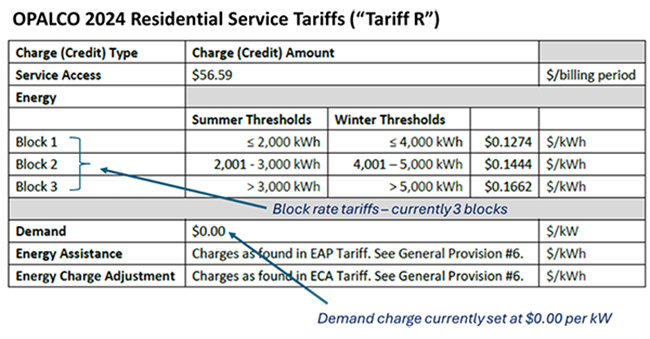
In addition, OPALCO can incentivize lower consumption by high-usage consumers by adding another block to their residential tariff. In the winter, customers pay $0.1274/kWh for the first 4,000 kWh; for consumption of the next 1,000 kWh it’s $0.1444/kWh, and beyond 5,000 kWh per month electricity costs $0.1662 per kWh. We think that a 4th block set substantially higher (e.g. at least $0.20 per kWh) for consumption beyond, say, 6,000 kWh in a month could help level the scales. This sends the price signal that electricity is a precious, limited resource, and if you use a huge amount of electricity, you’ll pay more for it.
A third tool in OPALCO’s tariff toolbox is adjusting the monthly service charge based on meter amperage rather than applying a flat rate for everyone. Currently, 95% of residential customers use a 200-amp service, while only 2.9% are connected at 400 amps, and just 1.7% exceed 400 amps. Doesn’t it make sense for consumers with higher service needs to pay a proportionally higher service charge?
A fourth tool OPALCO has is the Time of Use (TOU) rates. Peak consumption tends to happen in the morning (when people wake up and the heaters get cranked up) and evening (after the sun is down and the temperature drops). OPALCO tends to get dinged by BPA for excessive usage on exceptionally cold mornings when everyone turns on heaters. If consumption could be spread toward the middle of the day or the middle of the night, it would help OPALCO. A TOU rate incentivizes off-peak consumption by charging higher tariffs during peak periods and lower tariffs off-peak. OPALCO already offers TOU rate as an option; it could perhaps require this rate for very large users.
Whether it is a demand charge, a new block rate for profligate users, a service charge based on amperage needs or TOU rates — or a combination of some of these options — mansion owners need to pay their fair share and be given incentives not to squander our limited collective energy resource while driving up the price for everyone.
— By Chom and Chris Greacen
• • •
We welcome letters to the editor responding to or amplifying subjects addressed in Community Voices. If you wish to contribute to Community Voices, please send an email with a subject proposal to Executive Editor Mike Sato and he will respond with guidelines.
Help keep the local news flowing — support nonpartisan, fact-based, no-paywall local journalism
with a donation to the Salish Current — news for people, not for profit.