
New director to leave the other Washington for role in Friday Harbor
Removed from his position by President Donald Trump in 2020 and rehired by President Joe Biden six months later, one of the nation’s top climate scientists has embarked on a new chapter: leading the small nonprofit in Friday Harbor known as the Whale Museum.
Michael Kuperberg served last as the executive director of the U.S. Global Change Research Program for the White House Office of Science and Technology Policy, a federal initiative focused on the science of climate change and its impacts on the environment, society and economy.
Currently working remotely from his home in the 100-person village of Claiborne, Maryland, Kuperberg and his wife, Jeanne, plan to arrive on San Juan Island in May.
A storied career
Kuperberg’s career as a scientist progressed from a grant-funded field researcher in the 1970s to becoming a manager of program managers, where at the White House he helped direct more than $4 billion worth of annual investments to the area of global change research. Kuperberg worked for the Obama, Trump and Biden administrations.
The U.S. Global Change Research Program was established in 1990 by George H.W. Bush to coordinate climate research among 15 federal agencies.
The law establishing this agency requires a National Climate Assessment , preeminent reports on climate change impacts, risks and response, to be completed every four years, although only five have been completed in 35 years. The assessments provide the scientific foundation for informed decision-making across the United States.
With Trump back in office, the continuation of these reports is uncertain. When Climate Assessment Five, the most recent report, was released in 2018, Trump didn’t “believe it.”
The new chapter
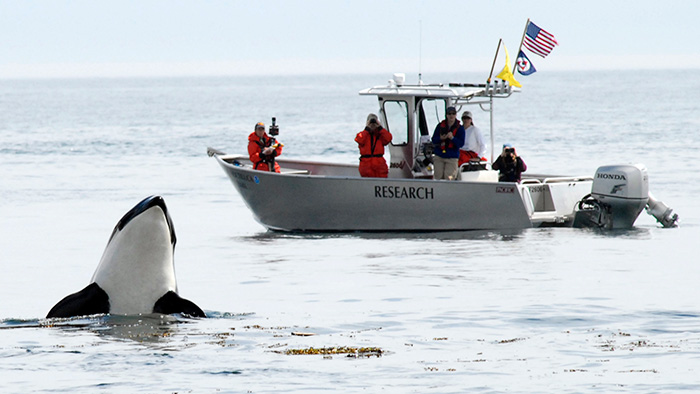
The Whale Museum is the first museum in the world dedicated to interpreting wild whales as opposed to whaling or captive whales.
Grown from humble beginnings in the old Masonic Lodge Hall on Second Street, built in 1892 on the hill overlooking the harbor, the budding museum was initially leased from Lee Bave for $75 a month.
“A growing army of enthusiastic volunteers began working miracles to refurbish the building and create exhibits for an ambitious grand opening in July of 1979,” wrote former Board President Rich Osborne regarding the museum’s history.
Osborne’s connection with the museum spans 34 years, as a founding volunteer, 18 years as research director, three years as executive director and 13 years as a board member. Most recently he led the hiring process.
Some of the key programs that the museum operates are the Marine Mammal Stranding Network, the boater education program Soundwatch, the Marine Naturalist Training Program and others.
The Trump administration impacted more than Kuperberg’s previous position. Osborne said approximately 40% of the museum’s budget comes from federal grants, and while “they seem to be honoring their current contracts,” no new applications are being accepted, and it “remains to be seen” what will happen.
“We’re rapidly trying to figure out some additional private funding,” Osborne said.
To Kuperberg, directing the Global Change Research Program was “the best job in the world,” but two factors influenced his decision to leave the White House for the nonprofit: after a decade, he felt he’d put in his time — and much of his extended family has settled in the Pacific Northwest.
“This is not a political statement,” he added, despite Trump sending him back to his former job at the Department of Energy just for Biden to bring him back to the White House six months later.
His ticket out of government came in the form of an email.
In January, eight days into Trump’s second term, Kuperberg received an email entitled “Fork in the Road” that was sent to the approximately two million federal employees by the Office of Personnel Management. This email offered a Deferred Resignation Program, allowing eligible employees to resign effective Sept. 30, while remaining on full salary and benefits until that date. Kuperberg took the fork in the road and resigned.
Kuperberg recalls being on Vashon Island years ago when his mother received word that orca whales were at Point Robinson. They hurried there, along with many others, to watch “these magnificent creatures as they rounded the tip of (Maury).”
Kuperberg’s parents moved to Vashon 40 years ago, where his 98-year-old mother, Yvonne, is an active community member. One of his daughters attended the University of Washington and is now an attorney in Seattle. His other daughter is a nurse in Portland, and his brother resides in Winthrop.
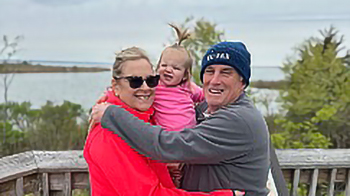
Perhaps the biggest pull is Kuperberg’s two-and-a-half-year-old granddaughter, Poppy.
Finding the right fit
The position of the Whale Museum executive director has been vacant since last May. Osborne said that interviews were completed by mid-November, and “(Kuperberg) stood out as everyone’s first choice.”
Osborne said Kuperberg’s background in coastal ecology and environmental toxicology are “extremely relevant to the museum’s mission of research and education on whales and the Salish Sea ecosystem,” and are disciplines common among scientists who study whales.
Kuperberg said he saw “absolutely a direct connection” to the museum’s goals and that “whales, the salmon, streams — they are all connected.”
He said he is looking forward to collaborating with other organizations and raising funds for science.
With the uncertainty of the federal government posing threats to grants the museum’s program’s such as Soundwatch rely on, board president Dante Aubert wrote in an email that he is very excited to have Kuperberg as the executive director.
“We will need all of his talents as he will have to hit the ground running to face challenges in our current environment,” he said.
Kuperberg’s experience in research and governmental relations drafts a new chapter of the museum’s history, Aubert said, which may strengthen partnerships with government and fellow nonprofit organizations “to help save the Southern Resident killer whales and promote a healthy Salish Sea.”
— By Nancy DeVaux