
Kulshan Carbon Trust proposes ‘ecosystem service credits’
Updated May 4, 2025
Losing a four-year, $900,000 grant, according to Kulshan Carbon Trust, or KCT — a Bellingham-based nonprofit focused on conserving carbon and other climate solutions — means returning to the drawing board.
The grant, awarded by the National Association of Conservation Districts to the Snohomish Conservation District in partnership with the carbon trust, was for measuring the results of a larger project to make forests more productive. KCT president Howard Sharfstein said this would have provided the job security sometimes elusive in the field of nonprofit climate action.
In the coming weeks, the Snohomish Conservation District will receive guidance from the federal government for a new proposal due in June for the same pot of money, which will have a new name and amended focus, said executive director Linda Lyshall.
“We’re going to resubmit this proposal and slightly different flavor of it and hopefully get funded through it,” she said, “so we’re trying to stay on good terms, if you will.”
The new grant will be called the Advancing Markets for Producers Initiative with the money reallocated to agroforestry producers.
Lyshall said, if awarded, she still anticipates a partnership with KCT over this project, but it is too early to say what that will look like.
For KCT, the news came right before a board meeting in late March where the nonprofit elected two new board members and appointed an executive director — the conversation quickly shifted from a sustaining funding structure to a mission prioritizing grassroots change.
“It’s not all bad news,” Sharfstein said. “It requires us to go back to our roots.”
Finding climate balance
KCT formed in 2021, when co-founder Steve Hollenhorst, dean of Huxley College of the Environment for nearly a decade, joined forces with Sharfstein, who was working to help corporations find climate balance. The two looked to land trusts as a successful model for using legal tools to protect land; they decided they could do the same for carbon resources.
An early project was using volunteer carbon credits, incentives for landowners to reduce carbon emissions and to give market value to the carbon sequestered with the land.
Essentially, companies and organizations could buy and sell permissions to emit greenhouse gases based on the carbon levels offset by those who are selling the credits.
“Those suffered some ill reputational damage,” Sharfstein admitted about the concept in general. “There were some bad actors and bad projects, and when we first started carbon credits were a way to signal virtue. They showed the world that you cared about the climate.”
The Friends of the Earth nonprofit called carbon credits a “license to pollute,” claiming that the concept is ineffective. Big polluters such as oil and gas companies will continue their practices while paying farmers and foresters to offset their greenhouse gas emissions by trapping carbon in soil and trees. Friends of the Earth claims that carbon markets are plagued by fraud among a suite of other problems such as perpetuating environmental racism, compromising human rights and undermining otherwise resilient communities. The nonprofit instead argues for absolute carbon reductions as opposed to offsets.
Other critics have said that people are getting paid for carbon reductions that would have happened regardless. Climate scientists have concurred that it’s a superficial fix as opposed to deep decarbonization.
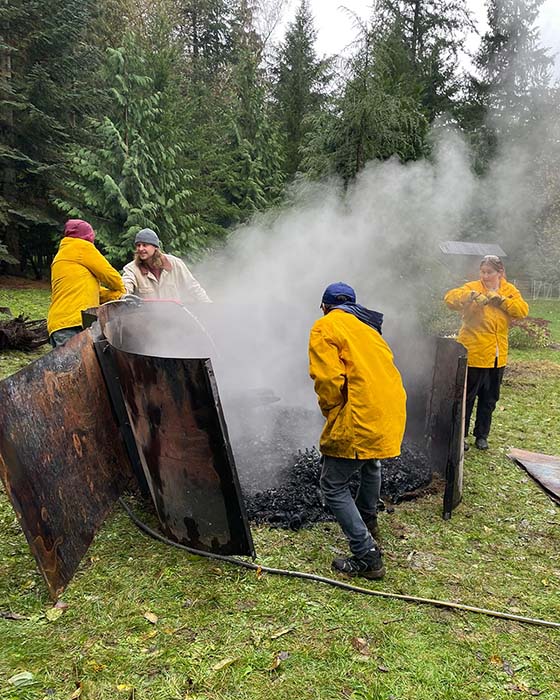
For KCT, this went in hand with the biochar pilot project.
Soil vitality
Biochar is a porous, carbon-rich material that is made from organic matter through a thermochemical conversion process known as pyrolysis.
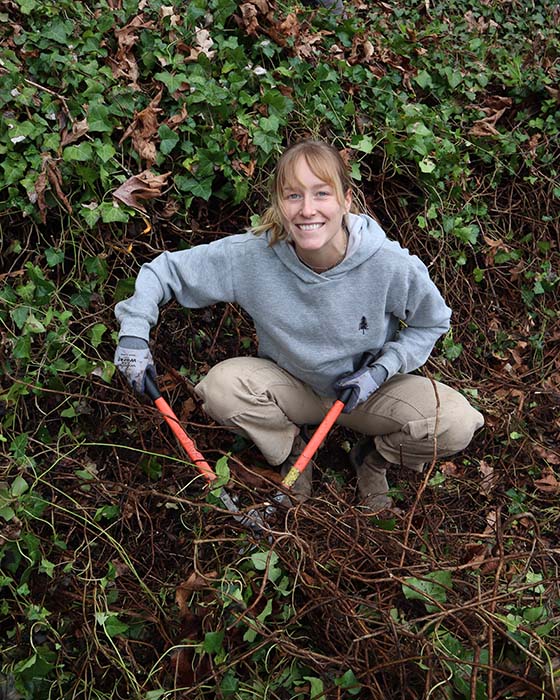
Sharfstein described biochar as a force multiplier. Biochar creates a favorable habitat for soil microbes by enhancing moisture retention, nutrient availability and microbial stability. [Ed.: Edited for clarity re the role of biochar in soil.]
Through field trials, KCT found that adding biochar to soil caused a 727% increase in nitrate and total rise in nitrogen. It also caused about 12% decrease in the carbon to nitrogen ratio, indicating enhanced compost stability and better microbial access to nutrients.
Biochar additives also showed significant gains in essential nutrients, a 33% growth of magnesium, 31% increase in phosphorus, 9% increase in calcium and 8% increase in potassium. Biochar showed promise for carbon sequestration soil structure and health improvements.
Quickly, KCT staffers found that biochar has potential beyond carbon sequestration. Biochar improves soil structure, increases water and nutrient retention, reduces soil acidity, enhances plant growth, creates fuel, filters pollutants and more. According to Sharfstein, this could help combat recent climate concerns. [Ed.: An earlier version of this article listed shielding electromagnetic radiation among effects of biochar; this is considered a potential effect as yet.]
“We’ve had the drought since, we’ve had the floods,” he said. “We’ve had the fires locally, and we’ve had them globally all over our country and the world to a much greater degree now than when we started.”
With the success of biochar production, carbon credits didn’t encompass the possible advantages — KCT needed a new incentive framework to position biochar as an integral part of regenerative agriculture.
Sharfstein began thinking even bigger — not just conserving carbon but building climate reserves.
In bloom
The goals seem simple enough.
“We need resilience in the soil,” he said. “We need resilience in the plants. We need resilience in our water management, and (that’s where) we’re focused first.”
A key part of this, he said, is community.
“Working with neighbors, having a feeling that you have an agency to protect,” he said. “Yes, the defensible area around your individual homes, and more broadly, we need to organize working with the conservation districts. We need to organize community. We want to value that work in a way that people will support each other.”
With biochar, KCT is creating a new kind of credit, beyond carbon. Ecosystem Service Credits measure improvements to the ecosystem, like increasing soil carbon, restoring soil vitality, enhancing water retention and boosting biodiversity.
Land stewards or organizations can earn these credits by investing in regeneration projects. Neighborhoods don’t need a permit to participate, but they can collaborate as a community and adopt approved practices like hazardous fuel thinning, use of biochar kilns, application of biochar and more. Those credits can be sold to organizations or individuals through a registry like Regen Network.
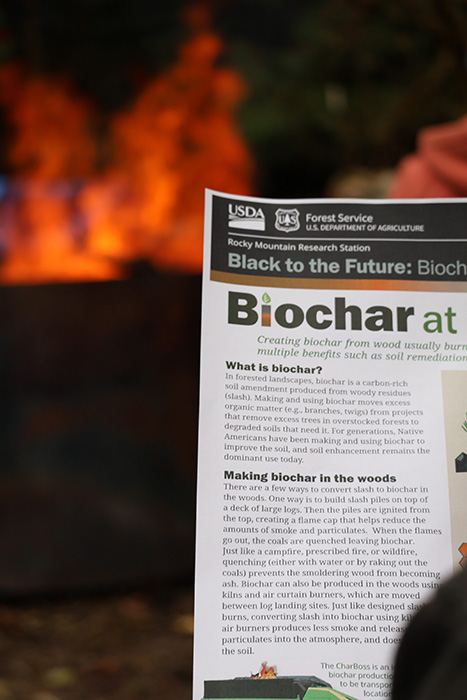
In coming weeks, KCT will announce when the pending “eco-credits” are approved by and listed on the Regen Network.
A battle of philosophy
Eco-credits mean community buy-in, not federal grants.
While people tend to disagree about best environmental practices, biochar can help all regardless of background or political beliefs, Sharfstein said.
People who don’t believe that humans are responsible for climate change can still take the same action on their property to make it safer and more resilient against drought and wildfires.
“We all have in common a desire for our children to inherit something better than we are leaving,” he said.
The same practices that will help protect against climate change will slow down the flow of water across the landscape, so in the event of a flood, homeowners don’t have erosion sedimentation of a farmer’s crop well. Plants grow better in thicker, retentive soil — and can generate some revenue in the process.
“You want your kids safe, you got to protect against fire,” he said. “That’s not hard.”
Biochar helps on small and large scales, he said.
“If (land stewards) look across the fence and see something that’s working for their neighbor, they don’t really care which political sign is in front of their house,” he said. “They realize there’s common interest in their common conditions and working through the conservation districts and using wildfire harvesting, hazardous wildfire fuel as our easiest way to explain this.”
See KCT in action at a wildfire community awareness event at the Guemes Island Community Center on Saturday, May 3, where tablers will share information on biochar and chipping. According to Gabe Travis, program manager, small-scale biochar production is a promising alternative to traditional chipping, with the added benefit of creating a soil amendment.
— By Sam Fletcher
Also read in Salish Current:
• “How islands respond to threats of climate change,” Oct. 7, 2024
• “Making charcoal as a first step to facing climate change,” June 2, 2023
• “Back to the land in the islands: Locally growing,” March 24, 2023
• “Commentary: Local team launches innovative approach to help curb climate change,” May 12, 2021