
Creating thriving mini-forests in small spaces.
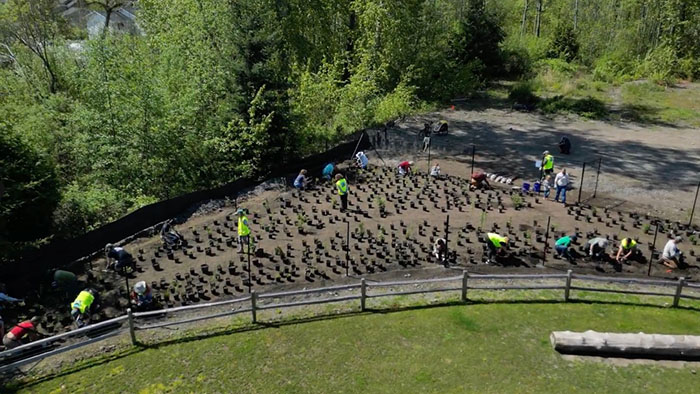
On a recent cool but clear Saturday — perfect planting weather — 43 volunteers gathered at Barkley Village in Bellingham to create a forest from scratch. By late afternoon, they had planted over 800 seedlings of 25 native species in a 3,500-square-foot site. A week later, more volunteers spread a thick layer of mulch to protect the new arrivals.
Spearheaded by the Whatcom Million Trees Project, in partnership with the Talbot Group — owners of Barkley Village — and funded by a grant from the Washington State Urban and Community Forestry Program, this new mini-forest is adjacent to the Scramble Nature Playpark.
In a few short years, this collection of tree, shrub and ground cover seedlings will grow into a mini-forest, enhancing the park and providing other benefits:
- Shade canopy
- Storm buffering
- Wildlife habitat
- Carbon capture
- Pollution filtering
The man behind the method
Growing forests normally takes lots of time and space — both of which are increasingly limited resources. The Miyawaki Method, developed in the 1970s by botanist Akira Miyawaki, accelerates forest evolution with a process he perfected while planting thousands of mini-forests in Japan and other countries.
Early in his career, Miyawaki mapped out the vegetation of the entire Japanese archipelago with a team of research students. During this 10-year process, he gained a deep understanding of the relationship between soil, topography, climate and human disturbance on a given site’s vegetation.
This knowledge informed his methodology for natural forest regeneration: identifying native plant species, enhancing soil quality and densely planting seedlings to simulate natural forest conditions. By encouraging intense competition among plants for sunlight and resources, forest growth and biodiversity restoration happen quickly.
For Miyawaki, planting a mini-forest was meant to be a joyful, intergenerational experience. At the beginning of each “planting festival,” as he called them, volunteers gathered for a naming ceremony. Plants were held up, species names called out, then repeated three times by participants. He felt it was an important way of connecting the people to the forest.
When accepting the Blue Planet Prize for environmental conservation in 2009, Miyawaki said, “I myself am resolved to continue planting trees, starting from where I am and spreading to the whole world, so long as I have life left in my body.” He attended planting festivals into his late 80s before passing away in 2021.
A worldwide movement
Miyawaki shared his expertise and guided planting festivals around the world. His followers have carried his legacy forward, and there are now mini-forests — also called pocket or tiny forests — in many countries.
In the Netherlands, over 200 mini-forests are planted at or near primary schools. Forest ecology is built into their curriculum and students do the planting and maintenance themselves.
There are several mini-forests in the Pacific Northwest, including Seattle, Tacoma and beyond. On the Yakama Nation, a mini-forest in the shape of a medicine wheel contains native plants traditionally used for sacred and medicinal purposes, providing tribal members a cultural and spiritual connection to the forest.
Planting a mini-forest
How much space does a mini-forest need? While sizes vary greatly from site to site, most agree that 1,300 square feet — the size of eight parking spaces — is a minimum starting point.
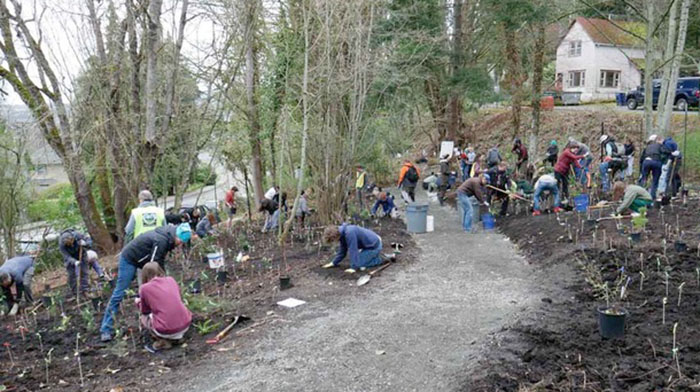
- The soil is loosened and amended with a compost planting mix, stimulating biological activity in the soil and fostering symbiotic relationships between plants, fungi and soil microbes.
- Native climax species are selected. “Climax” species are those that typically survive as a young forest matures. A mix of large and small trees, shrubs and ground covers mimic the layers found in a natural forest, such as Douglas fir, Western red cedar, hawthorn, serviceberry, flowering currant, mock orange, salal, sword fern and penstemon, to name a few.
- Seedlings are planted closely together, about three plants per square meter. Without taller trees to shade them out, the seedlings will grow quickly, competing for sunlight. Not all will survive, but those that do will create a resilient forest.
- A thick layer of mulch is laid around the seedings to help retain water and protect them from non-native weeds.
- The site will need to be watered and maintained for a few years while the forest takes hold. In the Pacific Northwest, deer/rabbit fencing will also be required during this time.
Fast-forward to a forest
How long does it take for a mini-forest to mature? A good measuring stick is the WWU Miyawaki Mini-Forest, planted in 2023. The half-acre site on the north edge of campus — adjacent to the Sehome Hill Arboretum — was covered in non-native invasives until L.E.A.D., WWU’s student-run ecological restoration organization, began to restore it. In partnership with the Whatcom Million Trees Project and the City of Bellingham, 200 volunteers planted over 1,000 seedlings.
Just two years later, many of the taller trees are now over six feet, and all the species appear to be thriving. The site still has deer fencing and regular watering and weeding is provided by students to help the plants survive. This is a critical step in the Miyawaki Method and why community involvement is key to the success of a mini-forest. Without tending, invasive weeds can take over and too many of the saplings can die.
With another year or two of regular maintenance, the WWU Mini-Forest will begin to retain moisture on its own, and the growing canopy will shade out the weeds.
Where to plant
Their compact size makes mini-forests an ideal fit for urban areas. The two in Bellingham are the first north of King County, but even the smaller cities in Whatcom and Skagit counties can reap the environmental rewards they provide.

Michael Feerer, Whatcom Million Tree Project’s founder, hopes this project will encourage more mini-forests locally. “Nooks and crannies of existing or new school sites, campuses, religious facilities, civic (or) public parcels and more can all be prime candidates for such plantings,” he said in an interview.
Ben Thompson, urban and community forestry program manager for the Department of Natural Resources, agrees. “The more we densify and build out our cities and towns, the less space there is for nature. Traditional landscaping often fills these spaces but mini-forests, which use native plants and support wildlife habitat, can be a better alternative in some cases. Even though the forests are small, their benefits will have a big impact over time. More cities and towns should consider Miyawaki forests as a strategy to improve the quality, health and character of their communities,” he said.
Growing forests and community
At the recent Scramble Mini-Forest planting festival, Miyawaki’s influence was evident not only in the meticulous planting methods, but also in the prevailing spirit of community. Native species names were called out and repeated back by the multi-generational participants, extreme care was given to each tender seedling, and the feeling of connectedness — to the land and each other — was palpable.
“Community engagement is a big part of the Miyawaki Method,” said Susan Hutton, Whatcom Million Trees Project executive director, “and it’s been a big part of this project from the beginning. We have a strong partnership with the Talbot Group, the neighborhood around us and with the phenomenal volunteers who will help us nurture this new forest. It’s our mission to plant and protect trees in Whatcom County and to create opportunities for people to connect to one another. This project is a great example of that.”
— By Lauren Fritzen
Also read in Salish Current:
“It’s ‘time to warrior up for trees’,” May 7, 2025
“Under new management: our forests,” April 1, 2025
“Bellingham strives to protect trees on public, private land,” July 24, 2024
“City seeks balance: housing needs and forest benefits,” May 5, 2023