
As Washington and 23 other states sue the Trump administration over the termination of AmeriCorps grants and 85% of the agency’s workforce in April, former members and local organizations worry about what lies ahead.
On Monday, April 28, many AmeriCorps members had a rude awakening when, upon showing up to work, they learned they had become unemployed.
That previous Friday, the federal government announced it had cut $21.6 million in AmeriCorps grants for the state, funds that have allowed hundreds of organizations to benefit from the support of volunteers in addressing issues such as food insecurity, environmental degradation, barriers to education and more.
Two days before that, 23-year-old Mallory Schaefbauer quit her second part-time job at the Boys and Girls Club, hoping to take a break from the 45-50 hour weeks that had been taking a toll on her body. While continuing to work as a part-time program coordinator at the Community Service Center, a hub for student volunteers attending Western Washington University, she was going to look for a full-time job to keep her bills paid after the end of her service period in June.
‘A 2020 cost-benefit study found that, for every tax dollar
invested in AmeriCorps, $17.30 is returned to society.’
But in a “jarring” turn of events, she was left without a source of income, unsure of how she was going to pay for rent after she had made barely any money in the previous nine months. Following weeks of stress, she finally started another job in mid-May.
While her time as an AmeriCorps member came to an abrupt end, leaving students without someone to connect them to volunteer opportunities on and off campus, Schaefbauer and other members alike walked away with valuable experiences and skills that would otherwise be difficult to build after graduating from college, when employers tend to favor more experienced candidates. Those coming after them, on the other hand, may not get the same opportunities.
Whatcom impacts
The City of Bellingham Parks Volunteer Program’s sudden loss of its two AmeriCorps members “has drastically reduced” capacity in the School Stewardship and Saturday Community Work Party programming, leaving their future uncertain, Acting Stewardship Supervisor Freya Fradenburgh wrote in an email.
The grant cuts have not affected the five AmeriCorps VISTA members at the Opportunity Council, a nonprofit that serves Whatcom, San Juan and Island counties, according to Volunteer and Outreach Coordinator Genevieve Quigley. However, she said, the lack of communication has caused such uncertainty that she has to warn candidates — especially those based out of state — that the position they’re pursuing is not guaranteed.
Curt Hart, a spokesperson for the Washington Department of Ecology, said that the terms of the agency’s 262 stipended volunteers who serve under the Washington Conservation Corps have been affected by the cuts. According to Hart, AmeriCorps funds 14% of Ecology’s WCC budget.
The WCC is an AmeriCorps program that helps young adults and military veterans jumpstart their careers in an environmental field, involving them in restoration projects; at the same time, its members may be deployed to support disaster relief efforts in and out of state, Hart said.

While waiting for more answers and developments, Ecology has had to delay the start date for prospective volunteers amid funding uncertainties, and it’s unknown how many positions will be retained by fall, he said. However, since the funding has stopped, Ecology expects it will no longer deploy WCC crews to respond to natural disasters outside of Washington, he said.
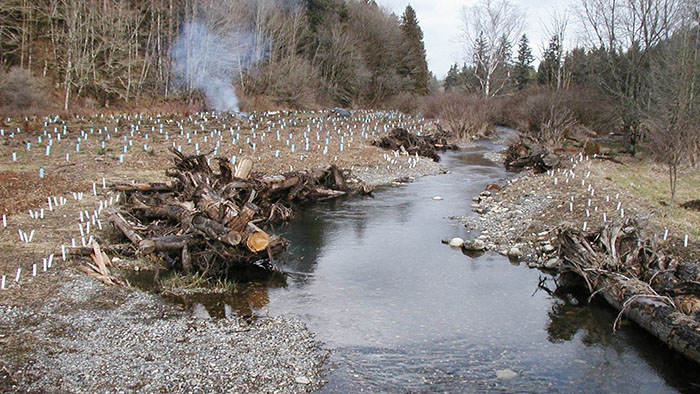
Six of Ecology’s WCC volunteers work for the Nooksack Salmon Enhancement Association, or NSEA, and Whatcom County Public Works, building and improving trails, removing invasive species, restoring in-stream habitats, planting native plants, improving campgrounds and more.
After their term of service — due to end on Sept. 1 — was abruptly suspended in April, Ecology stepped in to fund those positions through June 30, though it’s unknown what will happen after that date, said NSEA Executive Director Annitra Peck.
Faced with several funding challenges — including the recent state budget cuts that ended funding to NSEA programs like Students for Salmon that was offered since 1999 at no cost to schools — Peck said the nonprofit won’t be able to afford replacing the lost volunteers with full-time staff, which cost more than the stipended volunteers.
“It’s going to be an uphill battle just to maintain staff retention for what we have currently,” she said.
Ecology’s temporary band aid also granted some extra time to five WCC volunteers at the Skagit Fisheries Enhancement Group, who over the course of a year help plant trees, survey the Skagit River and remove invasive species like the Japanese knotweed, according to Executive Director Alison Studley.
“Lots of other rivers around here have been taken over by this invasive weed, but not the Skagit,” she said. “Because we’re out there every summer with our team of AmeriCorps members looking for it and making sure it doesn’t continue to grow and infest our rivers.”
Sudden goodbyes
Others, however, were sent home immediately. On April 28, the Enhancement Group had to bid teary-eyed goodbyes to its education associate and the restoration associate, who were respectively tasked with helping with the implementation of educational programs in local schools and training volunteers to collect data from restoration sites, among other responsibilities, Studley said.

Both associates had planned a successful Earth Day event, she said, and were shocked to be let go just two days after the celebrations — a consequence of the government’s decision to stop funding the program they served under, the Washington Service Corps.
To Studley, sending young adults with little to no savings in their bank account home felt “really cruel.”
Now, the nonprofit has to brainstorm ways to keep these positions funded despite the higher price tag associated with hiring full-time staff not associated with AmeriCorps and without the government’s support, Studley said.
WCC volunteers, for example, work fulltime for a small stipend, which Hart from Ecology said equals to at least the state minimum wage, though they do receive medical benefits as well as paid sick and vacation leave.
San Juans temporary fix
The San Juan Islands Conservation District is also looking at ways to cope with the loss of grants, according to a press release shared by Executive Director Paul Andersson.
In an effort to save the Islands Conservation Corps training program, or ICC, the district decided to retain all of its nearly 20 AmeriCorps members by enlisting them as employees. The temporary solution will cost the district about $20,000 per month and be in place until mid-July, the press release states.
Since 2020, ICC has been successful in helping young adults launch their careers in natural resource management and in stewarding the ecosystem in the San Juan Islands.
In Whatcom County, Emma Magnuson’s job consisted of supporting AmeriCorps members that the Washington Campus Coalition for the Public Good placed across numerous K12 and higher education institutions across Washington and Idaho.
As the AmeriCorps member engagement coordinator, Magnuson helped members succeed in their work as well as their future careers, creating personalized plans based on the member’s interests and holding monthly professional development events. But like her peer Schaefbauer, she was sent home two months before the end of her contract, which put an end to an important resource for many young adults preparing to launch their careers.
‘We really are the backbone of work that the government’s not doing.’
Both Magnuson and Schaefbauer were also counting on an education award to help pay for future schooling and student loans, money that Amy Brown, the AmeriCorps program director at the Coalition for Public Good, said members are eligible to receive after serving a full term.
For full-time workers, the education award would normally amount to $7,395. Since members were terminated early, they are now entitled only to a smaller amount to reflect the shortened period of service, Brown said.
Halted or on hold
Brown oversees the Civic Leadership and Engagement Corps, a program whose volunteers seek to improve access to education, food and health in higher education institutions in Washington and Idaho, as well as to build strong campus-community partnerships and foster environmental stewardship.
In the Evergreen State, the program had to halt the service of 24 members, including Schaefbauer and Magnuson in Whatcom County, she said. While it is a significant number, it is a fraction of the 337 members who served across Washington and Idaho at different points of the year, though most of whom did not get their time cut short because the grant was terminated when the program year was drawing to a close, she said.
While the health insurance of members who were active was extended through the end of May, Brown said they were owed more advance notice before being terminated.
“These are people that have rent due,” she said.
With the program development and volunteer recruitment processes on hold, Brown believes an injunction requested in the multi-state coalition’s lawsuit wouldn’t help make up for the lost time as the start of the new year is less than three months away.
“Even if there’s an injunction now, the damage will be incredibly severe, like it will be really hard to just get the program going,” she said. “It will be an absolute scramble.”
Already faced with the loss of $92,000 in obligated expenses that the government will no longer reimburse, the coalition is looking for alternative funding sources. If the effort proves unsuccessful, Brown believes she and her colleagues at the coalition could see their jobs on the chopping block as well.
Brown cited a 2020 cost-benefit study, released by Voices for National Service, which found that, for every tax dollar invested in AmeriCorps, $17.30 is returned to society.
Magnuson, who later found employment at Whatcom Community College, said the agency drew many who were driven by a desire to make a positive impact despite earning less than a livable wage, providing an important service to their communities.
Schaefbauer estimated making about $15.75 an hour, or about three dollars less than the minimum wage in Bellingham. Echoing the opinion of her peer, she said that if there are people willing to serve for little money, they should be allowed to do that.
Peck said she wishes the federal government recognized the importance of the services that volunteers and nonprofits provide.
“We really are the backbone of work that the government’s not doing,” she said. “We make up these large gaps to create a healthy, equitable society.”
— By Luisa Loi
Also read in Salish Current:
• “How islands respond to threats of climate change,” Oct. 7, 2024
• “Shaw Island project restores beach to natural state,” March 1, 2024