
Peaceful rallies carry messages of support for constitutional protections, justice, respect.
In Anacortes, demonstrators spoke of resistance, fear — and joy. In Everson, a handful of counter-protestors laid out their conflicting viewpoints in sometimes heated conversations. Friday Harbor demonstrators recalled a long history of protest in the islands, and Bellingham’s downtown core swelled with several thousand demonstrators demanding an end to king-like behavior on the part of the administration, and respect for the constitution.
The rallies were among some 2,000 across the country on Saturday, June 14, including locally in Burlington and Eastsound and on Shaw Island.
In Anacortes, Coast Guard vet Gabriel Olmsted said Saturday’s parade in Washington, D.C., and Trump’s rally at the Fort Bragg Army base in North Carolina last Tuesday were partisan when, as stated by the Department of Defense Standards of Conduct Office, all members of the Armed Forces should always avoid actions that could be interpreted as the Department of Defense endorsing a political party.
Jeanne Olmsted, his wife, said she feels disappointed that Congress isn’t doing enough to hold the president accountable. Despite the frustration, she still engages in her own idea of resistance, which looks like contacting elected officials, making donations and even showing support to the Republicans who “stand up for what is right.”
On top of protesting peacefully, Gabriel said, resistance is also about educating oneself about what is happening and understanding the implications.
At the downtown Anacortes No Kings event, the couple were joined by friends including Caroline Buchanan, who recalled living during World War II and feeling afraid as she saw images from Adolf Hitler’s parades.
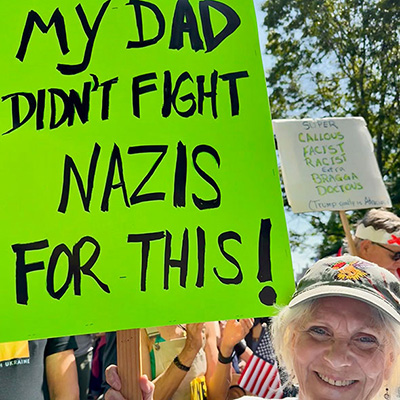
“We were so joyful that we saved democracy for the free world,” she said. “To see it threatened in this way and to have a dictator’s army parade on his birthday is a very frightening thing.”
When asked about her idea of resistance, Buchanan mentioned Mary Dyer, her ancestor who is remembered for being hanged in 1660 for being a Quaker in Massachusetts, where Quaker beliefs were banned under Puritan law.
Dyer is believed to have had an influence on religious freedom and the separation of church and state that the Founding Fathers included in the First Amendment. Buchanan is reminded of this when she feels hopeless.
“We each have to feel that we can make the difference that Mary Dyer did, and combined, we can,” she said.
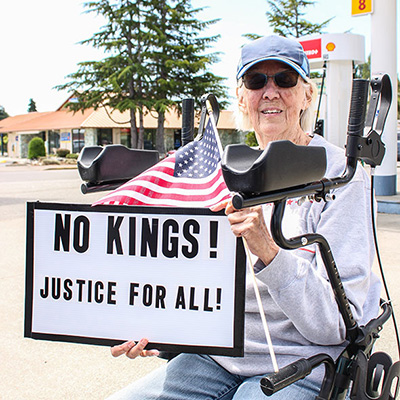
After holding peace signs with fellow Quakers and marching against different wars for many years, Jan Gray’s resistance today looks like showing up with her walker and a sign in hand. Back at the retirement community where she lives, she keeps a “Resist” sign on her window.
Though she has always advocated for what she thinks is right, she now feels like being vocal comes with more risks.
“If I were young and just starting out in a career, or even worse, had small children… I’d be more cautious about what I said,” she said. “But now? Uh-uh. I’ve got nothing to lose. I can say what I want, do what I want.”
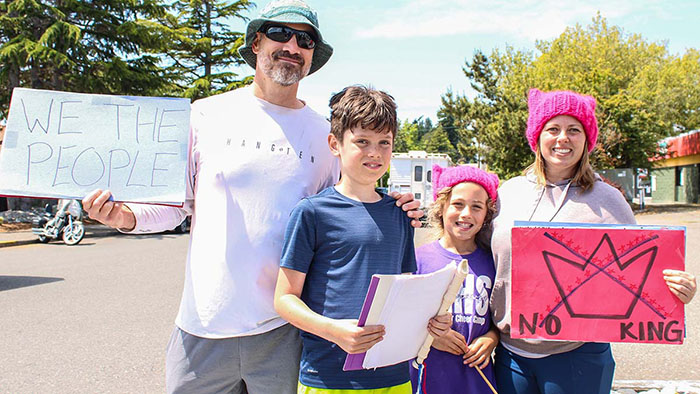
Amid the sound of honking cars and cheerful people, 10-year-old Matthew Regh played “My Country, ’Tis of Thee” or “America” on his recorder.
To add a patriotic touch to the performance, he removed the colorful belts that hung from the instrument and symbolized the songs he’s learned, only leaving the red, white and blue ones in honor of the American flag.
His parents took him and his 8-year-old sister, Addison, to the parade to teach them the importance of being loud when the will of the people is not being heard, said Julie Regh, his mother.
Resistance, she said, “looks like hundreds of people outside, protesting, people of all shapes, colors, ages, abilities, outside expressing themselves and saying ‘no, this is not what we want,’ and expressing ourselves peacefully and lovely.”
Her husband, Eric, added that resistance should also include all branches of the government “doing their part” and upholding the rule of law.
The son of an Air Force veteran, he believes most people are “detached” from the sacrifices that military members and their families make. Still, he said, the parade wasn’t the right way to support service members.

“That would look like increasing veteran benefits, getting veterans off the streets, getting them homes and housing,” he said. “It doesn’t look like wasting money to fulfill one man’s ego.”
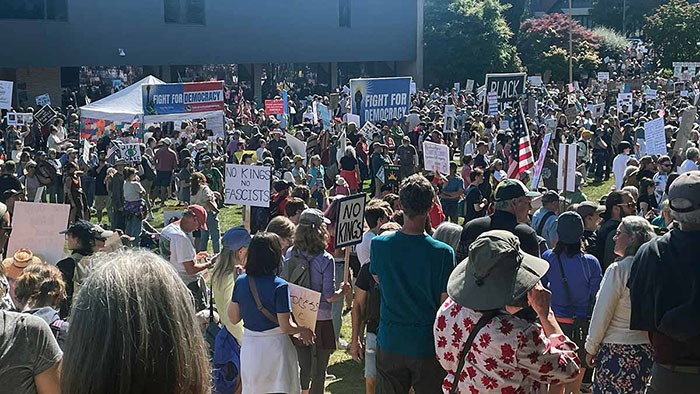
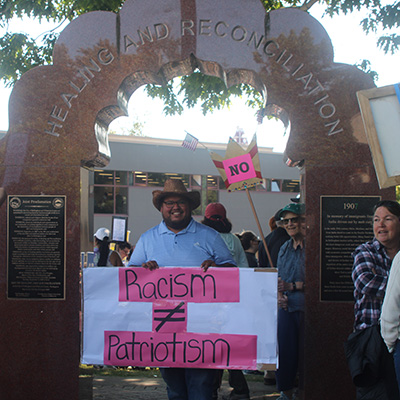
In Bellingham, among those crowding into the Bellingham Public Library Central Branch courtyard and spilling out into the streets around the Whatcom County Courthouse and Bellingham City Hall, Lacey Padgett held signs and wore matching Burger King crowns with her wife and friend.
Padgett, who recalled protesting against former president George W. Bush back when she was a teenager, said she showed up to advocate for the LGBTQ+ community and for immigrants. Surrounded by a diverse blend of fellow concerned locals, she felt hopeful for the future.
“Resistance … looks like living everyday life despite the people who are out there voting against you and speaking horribly against you and trying to get your rights away,” she said. “Living proudly every day and coming out and congregating like this and saying that this is wrong. That’s resistance to me.”
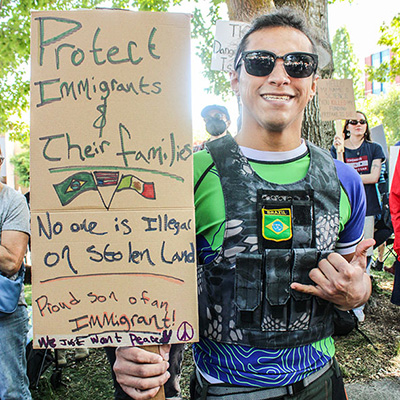
“We are here to protect our immigrant communities which helped build the United States of America,” said Nicholas Avilancia, who came to the United States from Brazil at the age of 2 along with his mother, who was 13 at the time.
After spending many years in the foster care system following his mother’s passing, Avilancia returned to Brazil and later back to the U.S. to get a better education and use it to support his community here and in Brazil.
“Resistance is showing up for your communities when something is wrong. Resistance is listening to the people and understanding what they’re trying to say,” he said.
After five years of short haircuts, Gray Dean decided to grow out their hair out of fear of being attacked for being trans.
The 18-year-old said they worry about the growing hostility towards trans people, but joined the protest in hopes of helping make a positive difference.
“‘Resistance’ looks like people standing up for what they believe in,” they said. “Hopefully what they believe in is people should be allowed to be people and be alive and thriving, no matter what, no matter who they are, no matter what their color is … they should be able to be themselves and be able to live true to themselves.”
Jane Hall, in Friday Harbor, talked of close personal impacts of current health policies and funding cuts.
“This is my nephew,” she said, showing a young boy with a huge smile … and bandaged arms. “He has a very rare disease called epidermolysis bullosa. He’s called a butterfly child, because his skin does not stay attached to his body. He has to be bandaged like a burn victim every day. He was the poster child for Stanford University’s clinical trial, but Medicaid cuts have taken away his cream that they put under the bandages. They’ve already taken that away from him, and the bandage that covers the main part of his body has already been taken away.”
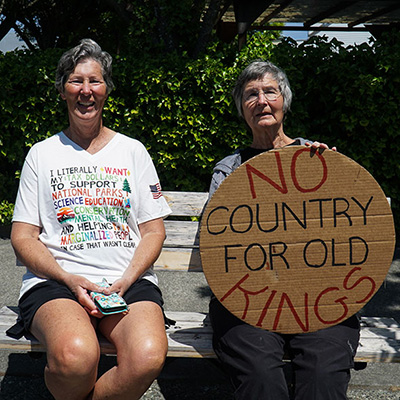
Karen Asbridge and Nancy Hasler said they came to protest, as Hasler said, for the “same reason that brought us out for the Hands Off [protest], same reason we marched for four years for the Women’s March, same reason I was against the Vietnam War and protested then. It’s been a long life of protest. The island needs to feel the presence. Our immigrant community that wanted to be here and is afraid to be here need to know that they have people that have their backs.”
The situation, per Karen Schonberg, is such a mess that “even the introverts are here. We can’t ignore it anymore. This is my first protest I’ve done in years because it gets to be too much.”
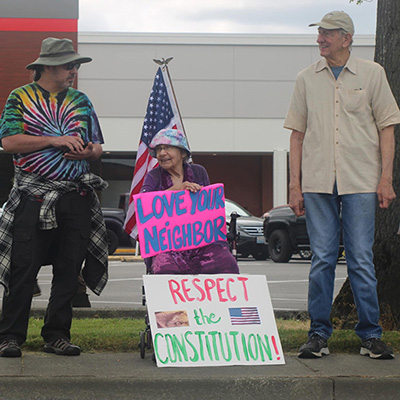
Everson protestors — some 300 strong — talked of the meaning and purpose of “resistance.” As Niki Thane said, it requires “being present. Make sure you are not participating in the violence.”
Diana Clinch noted that her cultural background informs how and why she resists. “I don’t come from any marginalized or discriminated communities. I want them to know not all white people feel that way. I don’t get to choose where I come from.”
She said she wants to make sure that it is clear that “the hate that is being spewed, I don’t support that.”
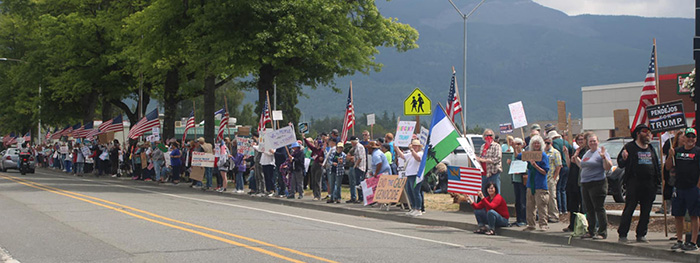
Among the handful of counter-protesters was a man who gave only the name Kevin, who said he is from Canada, and hopes “we become the 51st state.” Another counter-protester attended sporting a gun in the pocket of his shorts.
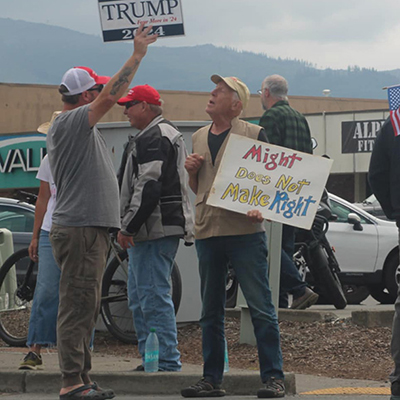
While protestors and counter-protesters kept mostly to separate sides of the street, a few heated conversations flared — in one case at least resulting in apparent friendly resolve.
Richard Biemold said he came out to the protest “see if any of my neighbors are here.” He said he hadn’t seen any there. Nonetheless, Biemold said, “It makes my heart happy that people care this much.”
— Compiled by Luisa Loi, Lane Morgan, Sstipsn Kalime (Thrisa Phillips Jimmy) and Sam Fletcher