
The movement that blocked the building of a nuclear power plant near Sedro-Woolley in the 1970s has largely faded in memory, but lessons from the effort hold relevance for those hoping to shape policy today.
The concern of Iran’s civilian nuclear program used to rapidly develop nuclear weapons has brought a constant string of global headlines this month, with many making arguments not so different than those of Skagitonians in the 1970s when Puget Power and Light Company — now known as Puget Sound Energy — received approval to build a nuclear power plant outside Sedro-Woolley.
Warming river temperatures that would ravage salmon populations. The release of harmful biocides into local water supplies. The looming possibility of earthquakes. And, in the worst-case scenario, the type of nuclear disaster that would devastate places like Chernobyl and Fukushima.
“That was everybody’s fear, is that if they had a nuclear meltdown … that would be the end of Skagit County,” said Ron Shrigley, former member of Skagitonians Concerned About Nuclear Power or SCANP.
According to Campaign for Nuclear Disarmament, civilian nuclear infrastructure creates risks for weapons development through repurposing uranium and plutonium-239 for weapons grade material.
The movement against the plants has largely faded from the forefront of public memory, but lessons from the decades-old fight still hold relevance for those hoping to shape policy today.
In April, the town of La Conner became the first municipality in the state to pass a resolution supporting nuclear disarmament. But Julia Hurd, a long-time anti-nuclear activist, worries the awareness of nuclear issues has largely faded, though the gravity of the issue has not.
Today, nuclear power is regaining momentum as demands for clean energy grow. Meanwhile, countries like the U.S., China and Russia still hold large nuclear arsenals despite pushes for de-escalation. The U.S., for example, has decreased its nuclear warhead stockpile by 83% between 1989 and 2023 but still had nearly 4,000 warheads.
“We’re trying to bring it back, the movement, because it is such an existential threat. It always has been,” Hurd said. “It’s so important because there is no plan B. It only takes one time for this to happen, and if you have these weapons, they’re going to be used. It’s just a matter of time.”
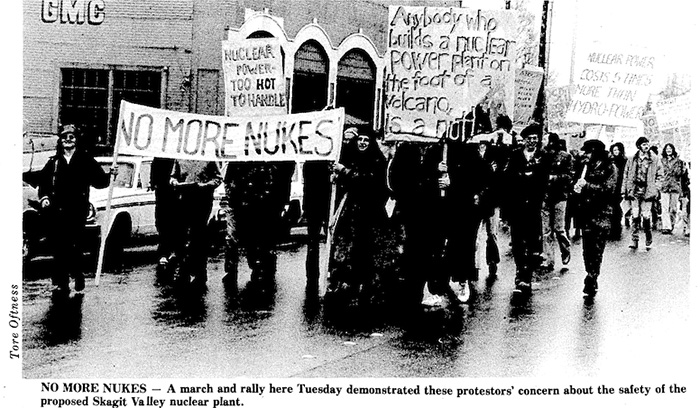
In the ’70s, SCANP would fight for five long years against the power plant. It would be one of the first times in history that public opposition stopped a nuclear power plant.
“(We) had a huge sigh of relief that we, a small county in the western part of the United States, for the first time, stopped a nuclear power plant from being sited by using scientific information,” said Shrigley. “It took a lot of people dedicated to bring this whole operation down.”
Picking the right strategy
The nuclear power plant was an essential step if Puget Power was to meet growing electricity demands, officials argued. Moreover, it would bring in more jobs to the rural county. Warm water from the project could even be used for a special fish-rearing facility.
Initially, public opinion was in favor of the plant and the jobs it promised to bring. But eventually SCANP’s campaign was successful.
SCANP members weren’t convinced by Puget Power’s arguments.
But the group faced an uphill battle against large corporate interests with deep pockets. So they turned to what they were convinced would be a winning strategy: cold, hard facts.
“We didn’t want to go through the usual ‘not in my backyard’ approach. We didn’t want to use emotion,” Shrigley said. “We needed to use hardcore, scientific reasons to confront the movement.”
The group hired Seattle environmental lawyer Roger Leed and University of Washington geologist Eric Cheney. Both were among SCANP members who represented the group in hearings for the project. Leeds would eventually help the group sue the state for approving the plant, and Cheney was able to prove the project was located near earthquake fault lines.
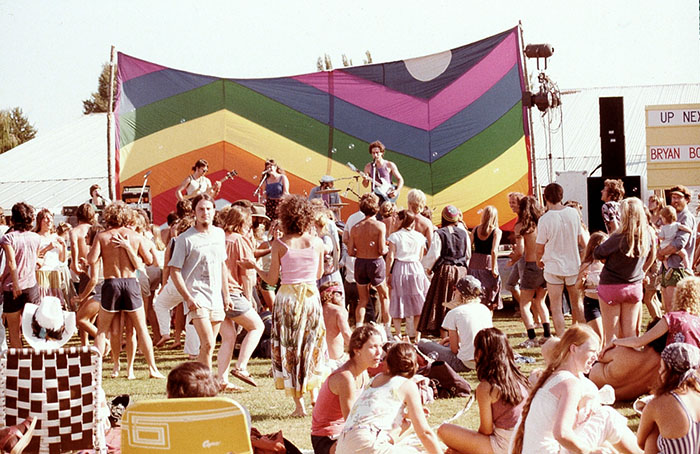
From there, the group used every possible tool in its arsenal: lawsuits, protests, educational lectures, bake sales and auctions. For years, it hosted the Magic Skagit Music Festival as one of its largest fundraising efforts.
“We would do everything we could think to do to not only raise money but to have these events to educate people,” former SCANP member Debbie Aldrich said. “We never stopped. You know, it was always something.”
She added that another lesson from her time with SCANP came from Helen Day, who stressed that real policy change goes far beyond protests and demonstrations.
“She said, ‘Debbie, you know, you can demonstrate all you want, but unless you get people in office and you get your issues on the platform and work for it — it’s not going to become law unless you you get it there’,” Aldrich said. “I did learn from that; you got to get involved politically.”
When the issue was put to a vote in 1979, 71% of voters cast ballots against the project. The partial meltdown at the Three Mile Island nuclear plant earlier that year likely swayed voters as well.
The process had been drawn out so long by then — in large part thanks to SCANP’s efforts — that the project’s rezoning contract expired. County commissioners chose not to renew it.
Shrigley said his biggest takeaways from the effort were to, “speak truth to power, question authority and think globally; act locally.”
“These are powerful statements for yesterday, especially today and the future,” he said. “I’ve been in more trouble following those phases ever since I was in high school in the ’50s.”
Standing together
Over 400 demonstrators lined up shoulder-to-shoulder along the narrow road leading up to the Bacus Hill site. It was a silent protest — organizers stressed that participants weren’t to block the road, touch vehicles or yell anything at officials who were doing a site visit with the U.S. Nuclear Regulatory Commission.
As the caravan of officials neared, Shrigley remembers tapping into the recently released movie “Star Wars” as he spoke to the crowd.
“I said, ‘May the force be with you’,” he remembered with a chuckle. “And the demonstration was very successful … it was a pretty high-tension, exciting time.”
Part of SCANP’s success was coalition building. The group was made up of people from all walks of life, ranging from local activists to farmers, grandmothers, chemical engineers, a doctor and fishermen.
“It was a beautiful mix of people. We were all focused on the same objective,” Shrigley said.
An ongoing legacy
The death of the Bacus Hill plant and similar proposed projects across the Northwest forced electric providers to look at other ways to meet growing demand.
“That was the beginning of the conservation movement,” Shrigley said. “There was a huge movement to save energy that would have had to been produced by power plants.”
Shrigley added that years later, one Puget Power official reached out to thank him and SCANP for stopping the plants, which he said the official admitted “would have been a major mistake.”
“It just felt like all of a sudden, the effort that we put in was rewarded by a person that was on that side coming to us and thanking us for stopping something that would have not worked out in the end,” he said.
The then-official of Puget Power declined an interview with Salish Current.
Although SCANP’s battle ended around the late ’70s, the win “provid(ed) fertile ground for our county’s long, organized history of anti-nuclear activism,” Hurd wrote.
Hurd told the Salish Current that local groups against nuclear power and weapons were “extremely active” during the ’70s, ’80s and ’90s.
“I didn’t realize at the time how really active we were compared to other maybe equally sized counties — but we were,” she said.
Skagit County became a nuclear-free zone in 1985 with help from groups like Skagit Citizens for Nuclear Disarmament and the Skagit Peace Education Fund.
— By Sydnee Chapman

Also read in Salish Current:
• “Commentary: La Conner passes a nuclear disarmament resolution,” May 16, 2025
• “Intalco restart: can ‘green’ aluminum get ‘clean’ power?” July 21, 2022