
Commentary: Boating nonprofit enables the joy of sailing for new and veteran sailors, young and old lovers of the sea, with a wide range of abilities, disabilities and incomes.
Ed.: The essays, analyses and opinions presented as Community Voices express the perspectives of their authors on topics of interest and importance to the community, and are not intended to reflect perspectives on behalf of the Salish Current.
My best friend and sailing buddy was diagnosed with ALS around 2008. She was a psychologist who came to love sailing in the 1980s when I convinced her to stop screaming, “This is not normal!” when the boat heeled over. To me, slicing through the water, powered by wind alone, with the boat tilting about 30 degrees was not just perfectly normal, natural and psychologically healthy; it was the goal. And it brought me utter joy.
The last time we went on Bellingham Bay, however, about two years before she died, sailing was decidedly unpleasant. ALS had robbed her of the strength not only to control the sails and rudder but to just sit or stand comfortably on a moving object.
If she were alive today, she would be right there with me supporting the not-for-profit Community Boating Center of Bellingham.
Since its founding in 2006, the CBC has been solely focused on providing education and access to the water for everybody, regardless of ability, age or financial status. Just within the last year, the center has significantly increased that access by acquiring more equipment and conducting staff training to help neurodivergent people, people with hearing loss and those with mobility limitations go sailing and paddling on Bellingham Bay.
The CBC now has the first of what is to be a fleet of adaptive sailboats. The brightly colored sailing craft is 9- or 10-feet long, extremely stable yet can still gently lean to the side in reaction to the “normal” force of the wind on the sails.
CBC executive director Bryan Rust, who is passionate about equitable, inclusive and safe maritime experiences, says “Our dream is to have a racing program on the Hansas (the class of adaptive sailboat the CBC is using).”
With some of the $80,000 from a recently completed fund-raising campaign for adaptive equipment, the CBC recently purchased two mechanical, assistive lifts — soon to be installed — to help safely transfer sailors and paddlers from their wheelchairs into the boats.
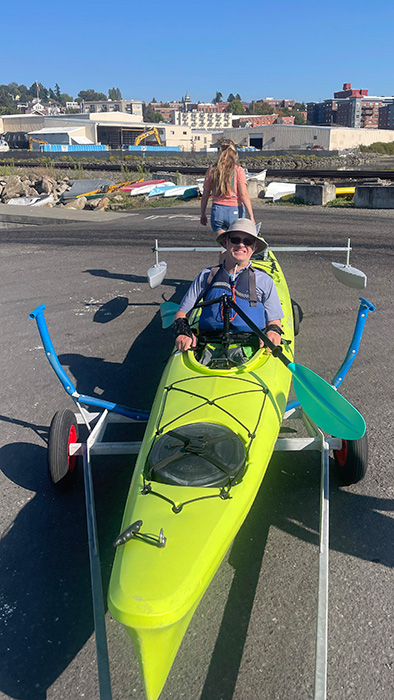
The fund has also enabled safe on-the-water experiences for people challenged with upper body limitations who would rather be on a kayak, which moves on the water at a more level angle than a sailboat. The CBC has specialized paddles and grips for them as well as outriggers that attach to and stabilize tandem kayaks for a “zero percent chance of capsize,” Bryan says.
Earlier this year, Spencer Audiology and the Northwest Washington chapter of the Hearing Loss Association of America donated a hearing loop system in the CBC’s new Wheelhouse building as well as headsets and receivers so that students with hearing loss can comfortably hear instructors whether in the classroom or out on the water.
People who use hearing aids equipped with a Telecoil or hearing loop program can receive a direct sound signal through their hearing aids in the wired/looped indoor classrooms before they leave the shore. There is also a closed-captioning system for people with hearing loss to follow along. The headsets and walkie-talkies can be used by students and instructors on the water to replace bullhorns and improve communication clarity.
Pamela Spencer, a dear friend who has been hard of hearing since childhood, often speaks of how sailing on Sundays with her grandfather helped pull her out of her loneliness, depression and poor grades in school caused by her inability to hear her family, friends or teachers. “Sailing was a big part of my development,” she says. “It gave me confidence.”
I’m out with Pam most Thursday nights, April through September, racing her sailboat on Bellingham Bay with an ever-rotating crew of new and veteran sailors, young and old lovers of the sea, with a wide range of abilities, disabilities and incomes.
I chuckled one Thursday a few weeks ago as I parked in Squalicum Harbor and saw a white Tesla towing a small racing boat to be launched into the water. Right behind it was a bus circling the harbor on one of the WTA’s new routes.
So much for the stereotype of sailing being a sport for the rich, able-bodied and privileged.
Right here in Bellingham, we have an inclusive and welcoming boating center that awarded $140,000 in scholarships and served more than 5,000 people, including 400 with disabilities, with free and low-cost programs last year.
Like Pam and I and hundreds of others who volunteer their time and money at the CBC, we give back because we know what joy, freedom, confidence and opportunity that boating brings. And everyone – especially here in Bellingham – should have that nourishment for their soul.
• • •
We welcome letters to the editor responding to or amplifying subjects addressed in Community Voices. If you wish to contribute to Community Voices, please send an email with a subject proposal to Executive Editor Mike Sato and he will respond with guidelines.
Help keep the local news flowing — support nonpartisan, fact-based, no-paywall local journalism
with a donation to the Salish Current — news for people, not for profit.