
A conservation easement, passive aeration composting and animal welfare certification help farm meet environmental and community sustainability needs.
Matt McDermott held a cup of coffee in one hand and rested the other on the back of a 500-pound sow. The pig’s ears rested over the front of her face, her shaded eyes seeming to share McDermott’s sense of chill.
“I try to keep that vibe,” McDermott said. “Animals pick up on these things.”
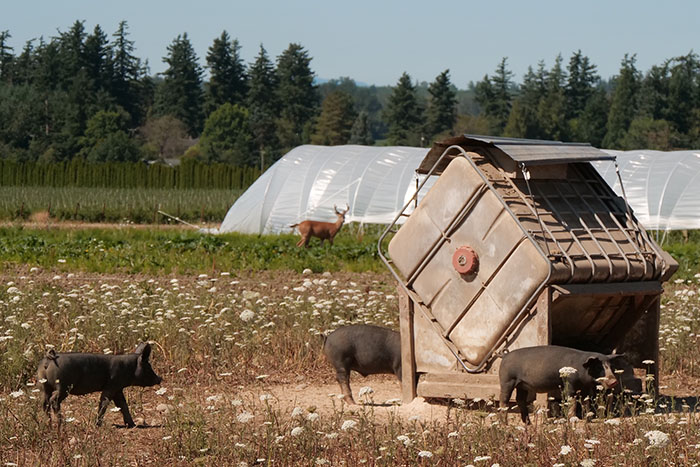
In the rising heat of the late-morning sun, Alluvial Farms felt relaxed. Near the roadside, a few dozen piglets — eight weeks old and freshly weaned — snuffled around and foraged. On the other edge of the property, a fuzzy-antlered buck strolled past rows of squash and fields of golden rye, toward the conservation easement on the north end of the property. In a nearby paddock, a group of older pigs rested in the shade while their companions ate from a converted industrial container. In the barn, a mother sow lay near the front entrance, showing off the day-old litter of piglets at her belly.
By prioritizing environmental stewardship and animal welfare, Alluvial Farms serves as a local model for sustainable agriculture. The farm’s practices, which include a passively aerated composting system and a 10-acre conservation easement along a salmon-bearing creek, aim to mitigate the negative environmental impacts often associated with conventional farming.
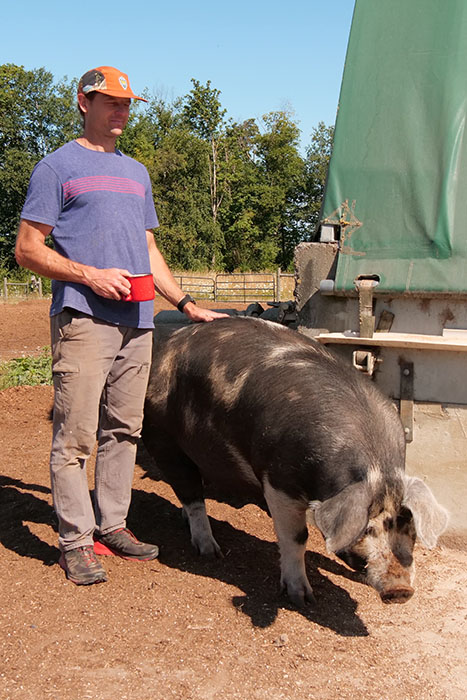
McDermott’s pigs spend the entirety of their lives on the farm, from farrow to finish. They graze, wallow and wander in a rotation of one-acre paddocks. They eat a mixture of grain and legumes, some of which is grown onsite, and their composted manure fertilizes the other food grown on the farm. The whole operation is certified Animal Welfare Approved — and the pigs’ easy demeanors seem to show how well they’re treated.
In a paddock connected to the main barn, McDermott stood among the gestating sows and drank his coffee. The pigs were relaxed in his presence; his tone of voice was low, mellow and consistent.
“The other pigs, they kind of come and go, and it’s a little bit different emotionally, mentally,” McDermott said. “But these animals are here for five, six years in some cases — and you hang out with them every day, so you might as well develop a positive relationship with them.”
Inside the barn, Alluvial’s sole boar — a registered Berkshire — napped in the same paddock with a group of sows whose piglets were recently weaned. In a pen across from them, a sow with an injury rested in isolation.
“Over the years, you kind of learn how to engage with them so that when they do have a bum foot like that one in there, they trust you to examine it and know that you’re there to help them,” McDermott said.
Visitors are free to walk around and peek at the pigs. The farm is open dawn till dusk and often hosts educational tours.
“I think it’s important to be transparent with what you’re doing so people can come in and ask questions and see what’s going on,” McDermott said. “I think that ends up being a really good selling point for the product, too.”
Visitors, McDermott said, are often shocked by the farm’s mild smell.
“They’re expecting these really foul odors, like from hog manure lagoons,” he said. “Sometimes, you’re just like, ‘Well, geez, the bar is kind of low’.”
Industrial farming practices have created the expectation that livestock operations stink. Many conventional hog farms are sources of excess ammonia, nitrogen and other manure-related products that can pollute waterways — but it doesn’t have to be that way.
Managing ‘brown gold’
Improving soil health is one of the most effective ways to tackle this issue, according to Arash Ghalehgolabbehbahani, the director of research at the Rodale Institute. The institute works to support organic farmers and to help smooth other growers’ transitions into organic practices.
“When we manage soil appropriately, we increase the soil’s carbon and organic matter, and we can actually hold water in the soil,” Ghalehgolabbehbahani said. “That means less runoff.”
Not far from the barn, a building divided into four concrete bays holds Alluvial Farm’s pièce de résistance — manure-rich compost.
Backyard gardeners are likely familiar with how labor-intensive it can be to make this “brown gold.” Churning compost, whether by hand or machine, can be energy intensive. Thanks to assistance and engineering from the Natural Resources Conservation Service, Alluvial Farms runs a passively aerated composting system.
A fan — “like a bounce-house blower,” McDermott said — injects air into the compost piles through a series of PVC pipes. This aerates the pile without having to turn it, allowing bacteria to break down the mixture of manure, urine, wood shavings and straw into a nutrient-dense soil amendment. The final product sports a mild but earthy smell — what some wine connoisseurs might call “barnyard funk.”
Supporting salmon — and wine
But compost isn’t the only thing keeping Alluvial Farms from being at risk of producing agricultural runoff. A 10-acre conservation easement serves as a buffer between the farm and Dale Creek — a historically salmon-bearing stream that feeds into the Sumas River.
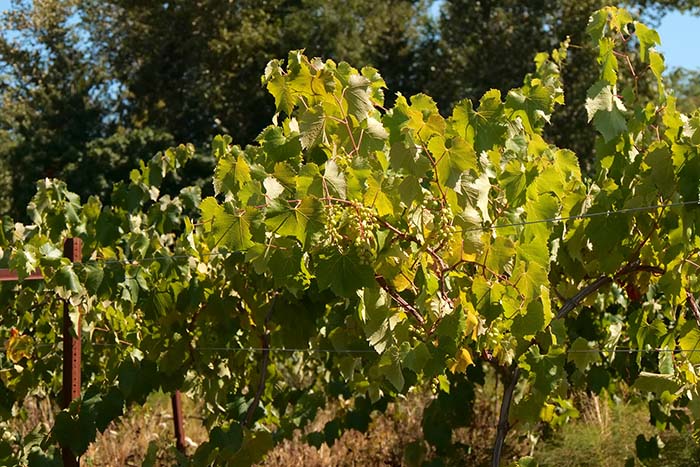
At the north end of the farm, golden rye fields and rows of bright green Jupiter grapes give way to evenly planted evergreen trees, shrubs and other native plants. Past them, a stand of old cottonwood trees stand guard over the creek.
After purchasing the farm, McDermott said he worked with the Conservation Reserve Enhancement Program to create the easement zone. CREP then planted approximately 500 native plants per acre, 5,000 plants total.
“The whole idea here is to protect and enhance this riparian zone,” McDermott said.
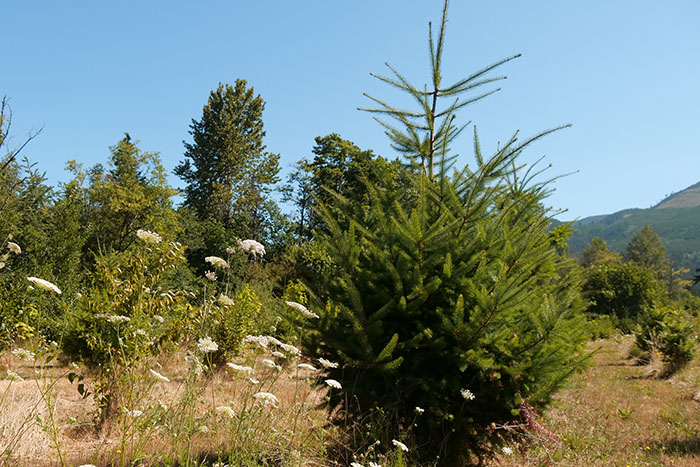
Robust riparian zones — the transitional spaces between land and water — help preserve salmon habitats, said Kaïa Hayes, the land and water policy manager at RE Sources. Trees, grasses and other plants help store water in the land around the river.
This is especially important toward the end of the dry season. In 2021, the University of Washington’s Skagit Water Supply and Demand Synthesis found that rivers in the Skagit Valley have lower water levels in the late summer and fall, dipping below ideal conditions for salmon spawning and other ecosystem aspects.
According to the Whatcom County Climate Action Plan, Whatcom County and the broader area mirror these trends. Low flows and high temperatures in Whatcom Creek and the South Fork Nooksack River, as well as others, have exacerbated problems for fish in the region.
Hayes said that critical flow is a concern for the local watershed, particularly as late summer approaches. Agricultural demands for water tend to peak when salmon journey upstream — making solutions like ecological forest management, which take advantage of forests’ water-storing abilities, of potential value to the region.
Alluvial’s conservation easement is featured in RE Source’s Climate Resilience Map as an example of “fish-friendly farming” in the region.
McDermott said he sees salmon fry in Dale Creek often, but that he only saw salmon spawning there once, during the 2021 flood.
“We had so much water coming off that I think it opened up some beaver dams down below our property,” he said.
Alluvial Farms is surrounded by other farms that feed from the same water source. The site of the now-closed Cloud Mountain Farm, where McDermott once worked as the production manager, is just down the road. The Jupiter grapes serve as a byproduct of his tenure there, he said.
Back by the barn, a sunny greenhouse hosts a block of tall cherry tomato plants. This summer, McDermott is renting the space to Vertical Fog Farm — another Cloud Mountain connection.
McDermott said collaboration is a key part of his work, whether that’s sharing equipment with neighbors at the start of the growing season or renting out spaces like the greenhouse.
Alluvial Farms has been in business for 10 years. Customers buy pork products — including meat, pet treats and moisturizing “oinkment” — at the Bellingham Farmers Market and directly from the farm. Pork shares — offered in the form of monthly subscriptions or buying a whole, half or quarter hog — give customers the opportunity to choose their favorite cuts.
Support from the community has been key to the farm’s success, McDermott said.
“Without a community that values what a small farm brings to the community, you don’t have a business,” McDermott said. “How supportive the community has been — I think that’s allowed us to grow and establish ourselves.”
— By Oren Roberts
Also read in Salish Current:
• “PNW Climate Week kicks off with climate solutions,” July 17, 2025
• “Commentary: Composting as a climate solution,” Dec. 8. 2022
• “Who will farm to feed the people?” Oct. 28, 2022
• “Farmer-artist counters food, fuel uncertainty — through permaculture,” March 23, 2022
• “‘Food hub plus’ part of ambitious collaboration to meet housing and food needs,” Oct. 1, 2021