
Anonymous self-proclaimed auditors visited local municipal buildings for photos, video, records requests.
According to Police Chief Daniel MacPhee, the identities of two masked individuals who were filming and taking pictures in downtown Everson in the name of a “First Amendment audit” were never found.
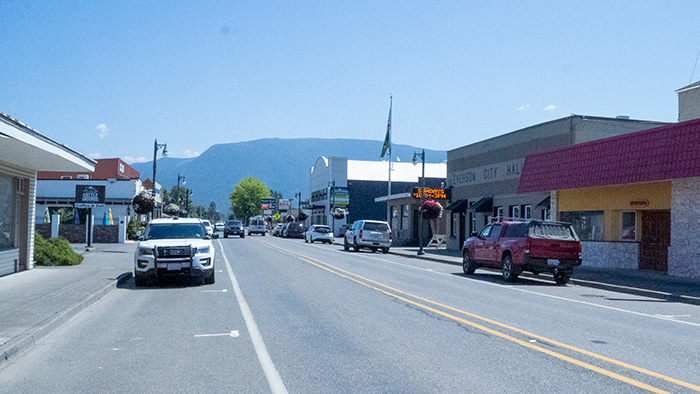
In June, the masked auditors went inside the post office and City Hall and made a records request to the employees behind the counter as their cameras continued to record the small lobby.
The encounter led to questions and discussion on social media about the growing movement of First Amendment auditing, where individuals record public officials, buildings and spaces to test the boundaries and limitations of their constitutional rights.
MacPhee said he was made aware of the auditors through several calls by concerned community members, along with the workers at the post office, who reported the pair had been filming inside. But the calls faded, and so did the mysterious auditors, by the afternoon.
These self-proclaimed auditors typically publish their recorded content onto online platforms such as Facebook or YouTube. However, Salish Current could not find the identities of the auditors or the encounter with the City of Everson published anywhere.
In general, freedom of the press includes the right to record video and audio. However, this right is not absolute.
According to RCW 9.73030, Washington law restricts the right to record audio of private conversations, even if they occur in a public place, depending on whether the circumstances show the speakers considered their conversation private. Recording such conversations requires the consent of all parties.
Governments can also enact rules that control the “time, place and manner” of the audit as long as these rules are neutral and not targeted to suppress speech. According to Judith Endejan, a Seattle-based attorney focusing on communications, governments can control the timing of access and the locations and impose other legitimate restrictions, such as restricting the recording of children or crime victims in public corridors. Recording must occur in a “public forum.”
Mike Norton, a YouTuber who has garnered hundred of thousands of views traveling across the country recording their interactions with police officers, has firsthand experience walking this line.
During most of his audits, Norton stands on the sidewalk, he said, which is considered a traditional public forum.
Violating jurisdictional laws could result in an arrest, Endejan wrote to Salish Current, although police cannot search a recording device without a warrant.
“You have to know your rights,” Norton said, “because if you don’t know your rights, it’ll be really easy for somebody to trample on them.”
MacPhee said that there is a difference between filming within a space and causing a disruption or interfering with other individuals.
“The only issue obviously would be if it starts to navigate into something where it becomes sort of disorderly conduct or harassment or it turns into something beyond just simply standing there filming and exercising your constitutional right,” he said.
Across the region, other police departments have also dealt with First Amendment auditors, with protocols in place to ensure positive interactions.
“It’s obviously unusual,” said Burlington Police Chief Kevin Turner. “When it’s brought to our attention, we question it but just (stay) friendly, open and trying to accommodate what we can within the confines of policy and law.”
Turner also said that it was well within an individual’s constitutional right to come into the lobby of the municipal building and to record and take photographs. However, he said that there were exceptions to exercising that right, like going onto private property or entering secure areas, such as a courtroom, without permission.
Turner described a scenario in which, if an individual was filming or taking pictures inside the lobby while a victim or witness involved in one of the department’s cases was in view, then he would escort the witness to a more secure area where they couldn’t be recorded.
“In my last agency, we had a group come into the lobby and they put it up onto YouTube that we passed our audit,” said Turner. “The last time I stepped out and spoke to somebody, I kind of gave him a brief history of the department and obviously there wasn’t any confrontations, so they ended up just leaving.”
Lieutenant John Vanderyacht of the Ferndale Police Department said that larger municipalities will often attract more attention from auditors than smaller towns.
“A lot of people that do this type of activity want to get more publicity,” said Vanderyacht. “Part of spreading a message is a targeted audience, and so I think you want the biggest audience you can get, which would probably be a larger city.”
Vanderyacht said the Ferndale Police Department receives training in being able to appropriately enforce the laws associated with those types of activities. One of their policies, he said, was that individuals can record law enforcement if they do not interfere with their work.
“A lot of people assume that officers will get triggered or activated with these types of activities,” he said. “But if you know it’s legal, there’s nothing you can really do about it.”
According to Norton, that’s part of the problem — sometimes police are not aware of the intricacies of the law either.
“In the last two years since we’ve been doing this, we’ve had hundreds of encounters with police officers in probably 35 states,” he said, “and it just consistently astounds me when a cop says something that’s just not true.”
Vanderyacht said that using basic de-escalation techniques, such as acknowledging the auditor’s message and respecting their right to record, can help improve departmental transparency and public trust.
“I think there’s nothing wrong with being audited,” he said. “If it’s from start-to-finish a fair appraisal, they’ll either show if a state entity is following the rules or not, and if that’s done in a fair manner, I think that’s helpful.”
— By Ronan Lynch