
One of the earliest cable networks in the country was built — neighborhood-by-neighborhood — by a Bellingham television pioneer.
On a clear afternoon in June 1953, Rogan Jones was speeding south from the Vancouver airport with a precious cargo: film of the coronation of Queen Elizabeth II the day before. It was to be the first official broadcast of his new television station, KVOS, channel 12. The flight from Toronto arrived late, but fortunately the film had been developed on the first plane from London. The broadcast was scheduled for that evening, but there wasn’t much time to spare. Fortunately Jones had an escort — first the RCMP and then the Washington State Patrol — so speed limits were not a concern.

This would be the culmination of his dream. But for Jones, it had started many years earlier. Launching a television station in a brand-new medium took time, patience, and imagination. Rogan Jones had all three.
Television in the United States had a slow and difficult birth. The first television was demonstrated in London in 1926. In the early years, many competing systems and their inventors vied for supremacy in the nascent television landscape.
In both England and the U.S., experimental television broadcasts took place intermittently through the 1930s. The BBC had a fledgling television service that aired the 1937 coronation of King George VI. In 1939 NBC broadcast the opening of the New York World’s Fair, with appearances by Franklin Roosevelt and Albert Einstein. But World War II put a stop to most work in TV development, as most electronic expertise was dedicated to the war effort.
It’s not clear when Rogan Jones started daydreaming about starting a TV station, but he was well positioned to do it, as he had owned the only radio station in Bellingham, KVOS, since 1929. The station was founded in Seattle in 1926 by Lou Kessler, a 30-year-old entertainer with little business experience. (KVOS originally was billed as “Kessler’s Voice of Seattle.”) But the station faced stiff competition there and Kessler moved it north to Bellingham in 1927. Finances didn’t improve, and the business was declared insolvent by a court and sold to several of its creditors, who quickly sold it again — to Aberdeen businessman Lafayette Rogan Jones, for $9,000. KVOS radio enjoyed exclusivity in Bellingham until the launch of KPUG in 1948.
Jones’s plan for television got underway in 1948, when the only TV station in the northwest was KING in Seattle. If you had a good antenna, parts of Bellingham could get KING’s broadcasts. Jones envisioned one giant “community antenna,” connected by a cable to households all over town. This was likely one of the first three cable TV systems in the country. Others were starting up around the same time; the most noteworthy were in Pennsylvania and Astoria, Oregon. Developers with similar ideas were apparently unaware of each other initially, and record-keeping was haphazard, so it’s not clear who was actually first.
Slowly Jones built his network, one neighborhood at a time. The telephone company refused to let him use their poles, so some creativity was required.
“Dear Mrs. Stowe,” he wrote to a woman in the path of his cable. “Friends in your neighborhood want our television cable (perhaps you may too). Would you let us attach a wire and small metal box (3x4x1) to the fir tree in your front yard?”
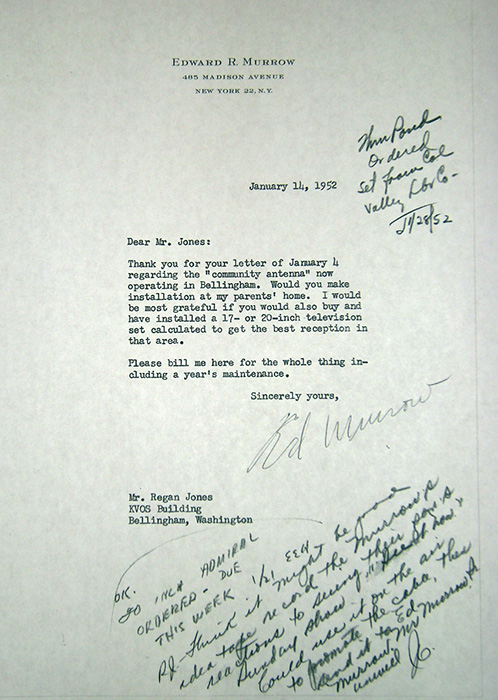
Jones figured that if he was ultimately going to launch a TV station, he would need to make sure that people had TV sets to watch it. People were excited by the advent of television, and the local appliance dealers were happy to sell TVs to the public. Jones’ customer households included the parents of famous CBS journalist Edward R. Murrow; they lived in Bellingham on 13th Street.
Jones wrote to Murrow in New York, proposing to connect Murrow’s folks to the new cable. Just a week or so later, Murrow responded, asking Jones to sign his parents up and buy them a TV set as well. “Please bill me here for the whole thing including a year’s maintenance,” he wrote.
The Federal Communications Commission had frozen applications for TV licenses in 1948, so that standards and frequencies could be finalized. When the freeze was lifted in 1952, Jones was ready to go with his application. With an investment of just $82,000 and lots of creativity from his engineers, KVOS began test broadcasts in the spring of 1953.
Canadian television was even farther behind the United States at the time. There were no stations in Canada west of Toronto, so KVOS had an early advantage in the Vancouver market. CBUT would begin broadcasting there six months after KVOS.
KVOS’s test broadcasts and fine tuning took longer than expected and the public grew impatient, prompting Jones to send out a postcard that spring showing an octopus with tools in all its tentacles and promising KVOS television “soon,” but with no date attached. But eventually the official debut broadcast took place on June 3, 1953 — the day after Queen Elizabeth’s coronation.
At first Jones had not seriously considered Canada as a primary market, despite the huge discrepancy in population of the lower mainland compared to Whatcom County — at least four times the potential audience. He envisioned KVOS as a Bellingham station, but a lack of sufficient ad revenue soon turned his thoughts northward. The first transmitter was on Yew Street Hill (where Cascade Radio Group is still located), and reception in many Vancouver neighborhoods was poor. Jones negotiated for a transmitter site on Orcas Island’s Mount Constitution, and KVOS began broadcasting from there in September 1954. The following year KVOS TV moved into its new studios at 1151 Ellis Street.

Once a good signal was available in British Columbia, Jones began to employ salespeople in Vancouver, and soon “we began making money beyond our wildest dreams,” he later wrote. Despite a few bumps in the road, the Vancouver operation expanded to include a studio and a large sales operation. At its peak KVOS employed 155 people in Canada, and ratings from 1958 show that on some evenings, more than 50 percent of TV sets in Vancouver were tuned to KVOS.
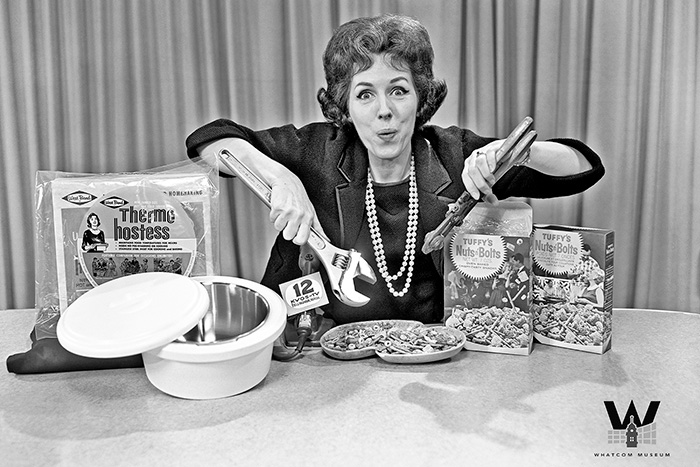
The community aspect of KVOS programming is exemplified by Elaine Horn’s tenure there. After several years on radio, Horn began her “Woman’s World” TV shows in 1959 and they continued well into the 1970s. Jeff Jewell, Whatcom Museum archivist and curator of the current exhibit “Elaine Horn: Broadcasting from Bellingham,” said the local flavor was an essential ingredient in the success of KVOS.
It was an era where “people knew each other,” Jewell said. “It was a much more community-oriented time.” He sees the museum exhibit as “a glimpse into how the world has changed,” he said.
Besides Horn’s show, Jones was constantly coming up with new ideas for local, low-budget programming. One of these was “Around the World Press Conference,” featuring students interviewing international college students, with a grand prize of a trip around the world — which would generate even more programming.
Jones extended this community spirit to his Canadian broadcast area as well, once offering to donate an elephant to the Vancouver Zoo, “to help the community where so much of our business is done.”
A Member of Parliament from British Columbia, Tom Goode, called the KVOS cross-border sales enterprise “a ridiculous situation of Canadian money being sent to Bellingham … promoting the sale of Canadian products to Canadian people.” Rogan Jones was worried that Canada would legislate against his type of operation somehow. So in 1961 he sold KVOS TV to Wometco Enterprises for $3 million. He kept the radio station and changed its call letters to KGMI.
Wometco owned the TV station until 1983, enjoying great success. Since then it has changed ownership several times. In 2010 the last Bellingham staff members (by then fewer than two dozen) were laid off, and the station moved studios and offices to Seattle. In December 2023 KVOS switched its programming to the Spanish-language Univision network.
Rogan Jones remained an active part of the community until his death in 1972.
— By Rich Donnelly
Ed.: Meet modern-day journalists reporting for Salish Current in a pop-up newsroom at the Lightcatcher Studio Friday, Oct. 3, during the Whatcom Museum’s Free First Friday.
Also read in Salish Current:
• “Shining light, giving voice: media and message,” Oct. 1, 2024
• “Western alums create investigative reporting fund,” July 3, 2025
• “New La Conner paper emerges after long-time weekly shuttered,” April 3, 2025
• “Commentary: Who speaks to the outrage of our unfolding national catastrophe?” Feb. 24, 2025
• “Local journalism is key for health communities: forum,” March 18, 2022