
Part one of three in our election-season series on what voters and candidates are talking about: Compact communities, less bureaucracy, higher-paying jobs among ideas touted.
Updated Oct. 14, 2025
Communities in Whatcom, Skagit and San Juan counties are getting creative in trying to solve the shortage of affordable homes and rentals.
In Bellingham and Friday Harbor, land trusts maintain ownership of the land on which their houses are built, making home purchase more affordable because the cost of land is taken out of the equation.
In Whatcom and Skagit counties, qualified homebuyers can acquire a home through Habitat for Humanity in exchange for 150 hours of sweat-equity labor and an interest-free mortgage — financed by the organization — to cover the cost of land and materials.
In Anacortes, voters approved a sales tax increase to fund construction of affordable housing, and the city council changed its zoning code to allow for construction of cottages — the idea being smaller homes will command a smaller price.
On the rental scene, Anacortes allows the long-term rental of accessory dwelling units — also known as mother-in-law apartments, a rental option allowed in many Washington cities. A developer was allowed to build an additional story in exchange for five affordable-rent apartments in his apartment building. A former hotel on Commercial Avenue near Highway 20 converted to apartments, with rents starting at $1,000 for a 286-square-foot one-bedroom, one-bath apartment.
Falling behind
But the pace of construction isn’t keeping pace with need.
Whatcom County needs nearly 35,000 new homes and apartments by 2044 to meet projected growth, with over 22,000 of those needing to be “affordable” — meaning the monthly rent or mortgage payment does not exceed 30% of the area’s median household income. That means 1,100 affordable homes and apartments must be built each year for the next 20 years to meet projected needs.
The City of Anacortes estimated in October 2020 it would need 971 new affordable homes and apartments through 2036 to meet its affordable-housing needs. Housing built since then by the Anacortes Housing Authority, the Anacortes Family Center and the Samish Indian Nation reduced that number to 925. After completion of several projects proposed or underway, the city will still need 848 new affordable units to meet its projected needs — some 78 homes a year for the next 11 years.
The housing challenge is just as great on San Juan Island. A housing needs assessment published by the Town of Friday Harbor stated that about 400 homes will be needed over the next 25 years to accommodate the projected population.
“We know how long it takes to actually bring units online,” said Amanda Lynn, executive director of the San Juan Community Home Trust, which has built 49 affordable homes and has 40 affordable apartments and eight to 12 affordable houses scheduled to be built.
“If we need to build 400 units over 25 years, then we needed to be planning and building projects yesterday. It’s going to take every bit of that 25 years to get those 400 homes built at the current pace we’re able to move.”
Bureaucratic barriers
Lynn wants the next mayor of Friday Harbor — the economic center of San Juan Island and the only incorporated town in the county — to “decrease the bureaucratic barriers to creating affordable housing.”
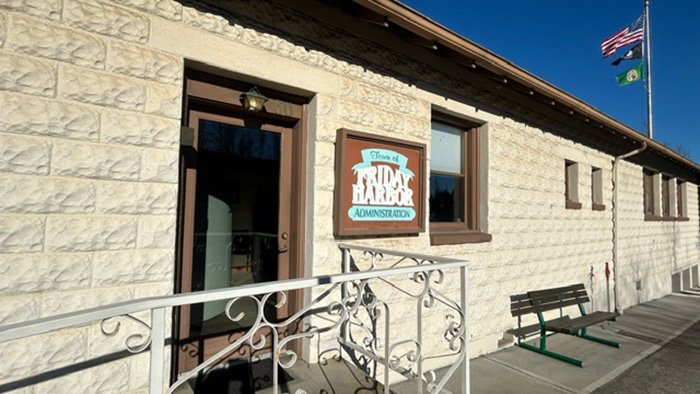
Holliwalk, a four-duplex development with two-bedroom, two-bath homes for $190,000, was completed in 2023, but the town added development requirements — street improvements, additional water meters — after construction was completed despite approving the original site plan.
Homeowners are renting their homes until the conflict is settled and the home sales can close. Lynn said the town needs expedited review and permitting and “streamlined partnerships that are really geared toward getting to a ‘yes’ on a project.”
The mayoral candidates seem to be leaning in that direction.
Candidate Evan Perrollaz, deputy superintendent of the island’s hospital district, said he would advocate for multifamily housing and cottage clusters in zones currently limited to single-family homes; streamlining permitting for affordable housing projects; offering density bonuses, expedited reviews or tax abatements for developments that commit to affordability in perpetuity; and easing parking and lot size requirements.
“We should allow for more flexibility where appropriate,” he said in a Q&A on the home trust website. “These changes aren’t about unchecked growth, they are about thoughtful, community-first planning that keeps Friday Harbor livable for the people who make it work.”
Candidate Emilio Santiago, cultural resources program specialist at San Juan Island National Historical Park, opposes requiring the home trust to install a water meter for each home it builds, one of the changes that is keeping Holliwalk from opening.
“As the tax parcel has a single owner (the home trust), so too should the ‘user’ be defined as the singular owner of the parcel,” Santiago said. “The costly requirement for individual meters is meant as an income generation strategy for the town that is inappropriate for neighborhoods providing permanently affordable housing.”
Developable land is scarce in Friday Harbor, which is roughly two square miles in geography. Santiago supports increasing the number of homes that can be built per acre. “Rezoning of certain parcels, especially on annexed lands, from single-family residential to multifamily could open opportunities for construction that concentrates density still within the urban growth area,” he said. “I support common-sense rezoning.”
One affordable housing solution, according to the candidates: higher wages. The poverty rate in Friday Harbor is 12.6%, above the state rate of 10% and national rate of 11.1%, according to various state and federal agencies. Perollaz and Santiago said they would champion living wages — starting with town employees.
“We should lead by example by ensuring that all town employees are paid a living wage,” Perollaz said. “Beyond that, we can support economic development efforts that focus on local businesses, skilled trades, healthcare and remote work opportunities that provide higher wages and long-term careers.”
Santiago said the wealth gap in San Juan County is “staggering,” with Friday Harbor’s poverty rate and below-average median income contrasting with very wealthy enclaves elsewhere in the islands. “The town has had some successful efforts in helping low-income folks, such as the Affordable Housing Grants Program and the Utility Assistance Program,” he said. “The town can also support efforts to reduce income inequality starting with its own employees. By paying them fair wages set in good-faith negotiations, other employers may be encouraged to follow suit when the benefits are clearly seen.”
Little land for living
Scarcity of land, low vacancies and housing demand are driving up housing costs in Anacortes, which is roughly 40% park and forestland. The median closing price for a home in Anacortes during summer was $650,000, according to the Northwest Multiple Listing Service. But the median household income is $91,006, according to the Economic Development Alliance of Skagit County — enough to afford a $350,000 home, according to federal affordability standards that say housing costs should not be more than 30% of income.
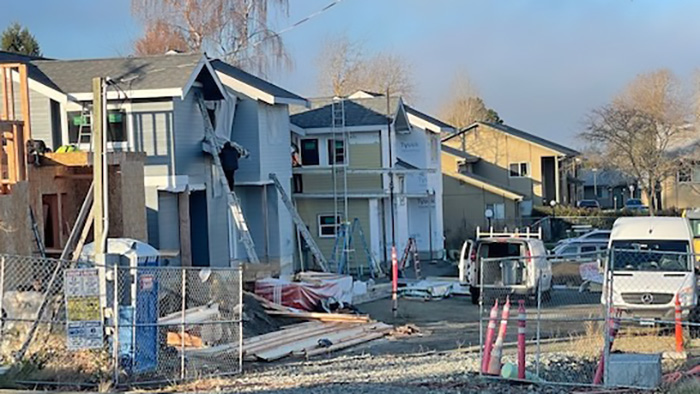
City council member Carolyn Moulton, who is running for reelection to Position 6 against local library board president Courtney Orrock, said availability of more homes could help lower costs. Streamlining the permitting process — including in shoreline areas — would “make it possible for things to get built” and would in turn bolster city revenues, she said at a Sept. 9 candidates forum hosted by Fidalgo Democrats, “A lot of sales tax comes in from building.”
Residential and commercial construction is currently lagging. “Our peak building permit issuance within the last five years was 107 and I think last year we had 36,” she said.
City council member Anthony Young, who is running unopposed for reelection to Position 7, said in an earlier interview that the city’s housing mix should include a “stair-step” of small homes, modular homes and homes that offer a lease with option to buy.
“We have a housing shortage crisis,” Young said at the time. “Ideally, we’d have a targeted place where we’re building starter homes that enable people to save some money and then obtain a reasonable mortgage. Then, after five or 10 years, they earn enough equity that they can look at buying up to meet their growing needs.”
Building density
There are several affordable housing developments completed or under construction in Whatcom County, among them the Whatcom Community Foundation’s Millworks project, the Opportunity Council’s Bellis Fair project, the Kulshan Community Land Trust‘s LaFreniere Court Townhomes and Telegraph Townhomes, and Habitat for Humanity’s Mateo Meadows in Everson. [Ed.: A previous version of this article misstated Millworks’ development leadership. Salish Current regrets the error.]
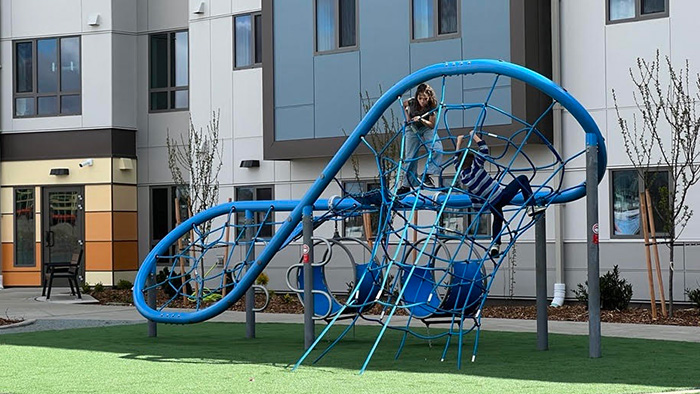
Maya Morales, a Whatcom County charter review commissioner seeking election to County Council District 2, said building neighborhoods that are bikeable and close to transit can boost affordability. “I feel like there are ways in which we can build density around current transit lines or future hubs,” she said at an Aug. 27 candidates forum hosted by the Bellingham City Club. “We need to be sure that we’re balancing all of our communities’ needs while we grow because there is a lot that is exciting about growing.”
Likewise, Bellingham City Council District 6 candidate Andrew Reding proposes adopting SMARTcode, which encourages development of compact communities where daily activities — home, work, recreation and civic uses — are within walking distance. Ward 4 City council member Skip Williams seemed to lean toward that approach of community development — “a more urban village structure” where small businesses and community amenities “will be incorporated into the urban village and create a sense of neighborhood.”
Kerri Burnside, candidate for City Council Ward 4, said it will take affordable housing partnerships to develop enough housing priced at 80% of area median income to support workers and small businesses.
The minimum wage in Bellingham was increased on May 1 to $18.66 per hour, which is $2 above the state minimum wage. “That makes an individual working full time and earning minimum wage income-eligible for a $970 a month housing unit,” Burnside said. “What no one is talking about is that doesn’t exist. The average one-bedroom apartment is $1,470 to $1,700 a month.”
The solution: land trusts, public development authority, Habitat for Humanity, community co-ops and, she said, developers who will build housing “at the price point that we desperately need.”
By Richard Arlin Walker
Skagit candidate forums this week
- Anacortes City Council Positions 4 and 6, Anacortes Port Commissioner Positions 1 and 2 — Tuesday, Oct. 14, 5–8 p.m,; Anacortes City Hall, 904 6th Street
- Public Hospital District 304 Commission Position 5, Sedro-Woolley City Council Wards 3 and 6, Sedro-Woolley School Board Districts 1, 3, 4 and 5 — Wednesday, Oct. 15, 6 p.m.; Sedro-Woolley City Council Chambers, 325 Metcalf Street
- Burlington City Council At-Large, Skagit Port Commission Position 2, Public Hospital District 1 Commission Positions 2 and 4, Mount Vernon School Board Districts 2 and 4, Mount Vernon City Council Ward 1 Position 2, Ward 2 Position 2, and At-Large — Thursday, Oct. 16, 6 p.m.; Mount Vernon Police Multipurpose Room, 1805 Continental Place (also livestreamed on TV10).
- Hamilton City Council Position 4, Lyman City Council Positions 1 and 2, Concrete mayor, Concrete Town Council Positions 3 and 5, Concrete School Board District 3 — Sunday, Oct. 19, 1 p.m.; Concrete Theater, 45920 Main Street (mail questions for the candidates by Oct. 6 to info@skagitlwv.org).
Whatcom candidates in recorded forums and interviews
- Port of Bellingham Commissioner, proposal to expand port commission from 3 to 5 members, Bellingham School District levy, charter review amendments; Bellingham City Club Oct. 15 forum (advance registration closed Oct. 12; recording to be posted after the event).
- Whatcom County Council District 3 and Bellingham City Council Ward 6; Bellingham City Club Sept. 24 forum.
- Whatcom County Council District 2, Bellingham City Council District 2, and Bellingham City Council District 4; Bellingham City Club Aug. 27 forum.
- Whatcom County Council, the Port of Bellingham, municipal councils, contested races for the county’s seven school boards; online interviews by League of Women Voters of Bellingham/Whatcom County.

Also read in Salish Current:
• “Making the next step ‘a better choice’,” Oct. 17, 2025
• “Child care, housing costs hamper business recruitment,” Oct. 16, 2025
• “Why vote? Primary results affect our daily lives,” July 25, 2025
• “Commentary: Down-ballot elections can change lives in seismic ways,” March 25, 2025
• “First-time voters and last-minute ballots,” Nov. 26, 2024