
A once-abundant giant has nearly become a myth in the Salish Sea; researchers hope to change that.

A hundred years ago, the basking shark population in the Pacific Northwest was so dense that it blocked fishing vessels attempting to harvest in Vancouver Island’s Alberni Inlet. Today, reported sightings are not nearly as common as those of Bigfoot.
A newly formed Basking Shark Working Group, comprised of researchers from various organizations across the West Coast, hopes to change that — but they face a large hurdle: finding a shark to study.
According to Kelly Bushnell, a fellow at Western Washington University’s Salish Sea Institute, what happened in the Salish Sea in the 20th century forever changed the basking shark population along the entire West Coast.
Basking sharks are the second largest fish in the world, as big as 40 feet and 5 tons, following only whale sharks. Their shape is like a great white, but unlike the great white, they have gaping mouths dominating their faces used for filter feeding plankton like baleen whales.
Basking sharks are listed as endangered by the International Union for Conservation of Nature. An extremely long gestation period, slow growth to maturity and habitat degradation are contributing factors.
The great shark war
Long before European settlers arrived, Nuu-Chah-Nulth, Makah and other First Nations hunted basking sharks in addition to whales, Bushnell said at a presentation at the International Conference on Basking Sharks in Ireland in September. Ancient place names in the Nuu-Chah-Nulth language include “Shark Creek,” near what is now called Alberni Inlet.
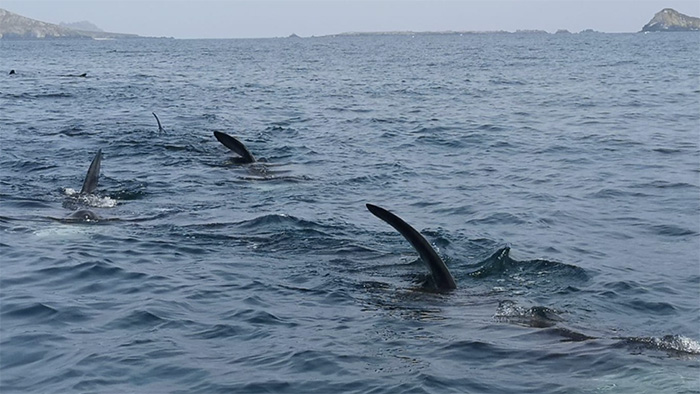
As settlers arrived, one of the world’s densest populations of basking sharks became an impediment to the fishing and timber industries. A new industry hunting sharks for the oil in their livers became a way to make money and remove them.
After World War II, synthetic lubricants replaced shark oil, and salmon fishers began coming in contact with basking sharks again.
Even though basking sharks do not compete with fishermen for prey, the constant contact led to “destroyed nets, angry fishermen and headlines decrying them ‘menace,’ ‘fighter,’ ‘marauder,’ ‘great brute,’ ‘deep-sea pirate,’ ‘monster,’ ‘nuisance,’” Bushnell said. “A new war was declared.”
In 1949, Canada’s fisheries department officially marked basking sharks as destructive pests, encouraging fishermen to kill them on sight. They even outfitted a ship called Comox Post with a blade on its bow to ram sharks, killing a record of 34 in one day in 1956.
While the designation did not extend past the “invisible marine border” of the U.S., the sentiment did, Bushnell said.
By 1970, an estimated 1,000–2,600 basking sharks were killed in the Pacific Northwest. From 1996–2021, there have been just 42 confirmed sightings in Canadian Pacific waters and 1–2 each year since.
To many involved in the working group — which is still in its developing stages — attention to the sharks is long overdue.
“I view this vision of the working group also as a return to basking sharks holding a place in our cultural identity in the Northeast Pacific,” Bushnell said.
New wave of shark science
Alexandra McInturf, Oregon State University research associate and working group member, said basking sharks are her favorite species.
“They’re just really confusing, enigmatic animals,” she said in an interview. “They’re one of three filter feeding shark species. Unlike the other two, which are the megamouth and the whale shark, they can’t suction feed. So, the only way that they can eat is basically to swim around with their mouths open, which I had a mentor tell me was a hydrodynamic disaster, because it’s like swimming around with a parachute attached to your back.”
Studying basking sharks is more like studying whales than other shark species, she said, because they can’t be lured.
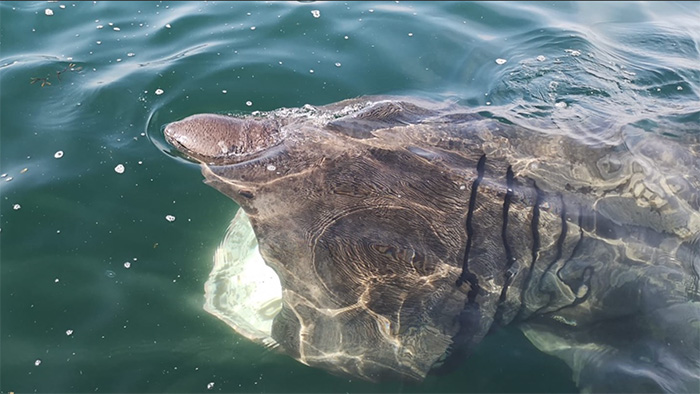
A common misconception is that basking sharks are slow-moving, she said. Recent studies have shown they are closely related to great whites, able to breach from the water at high speeds for reasons researchers are left only to guess.
“They have these traits of a major top predator, and I guess they are at the top of a very small food chain because they eat zooplankton, which eats phytoplankton,” McInturf said. “But in other ways, they just really defy our understanding of what a predator is, and I think that’s very cool.”
Similar to white sharks and unlike other species, basking sharks can regulate their internal body temperature through regional endothermy — warming specific parts as opposed to the whole body at one time.
“I’m sure a lot of people have confused them,” McInturf said. “Actually, I know Discovery Channel has confused them for white sharks.”
According to McInturf, basking shark recovery has not been a state or national priority because they’re difficult to find.
“To dedicate a whole research program to studying them here is a really fraught endeavor,” she said. “We’re talking a couple sightings a year maximum.”
A major aim of McInturf and the working group is to create central database for sightings. A comprehensive population assessment is a crucial first step to their recovery, she said.
While the database is in development, people can report basking shark sightings by emailing McInturf directly.
In the most recent study about local basking sharks, McInturf compiled data from surveys from 1962–1997 and other sources from 1973–2018 to identify environmental drivers that have affected the population.
She found that the West Coast population declined greatly in the mid-1980s, with the school size dropping from an average of 57 individuals to 24. Since the ‘90s, no schools larger than 10 were reported, with the mean size being about three individuals.
In the past, sightings were recorded year-round, but McInturf’s research shows that since the 2000s they are mostly in the summer months.
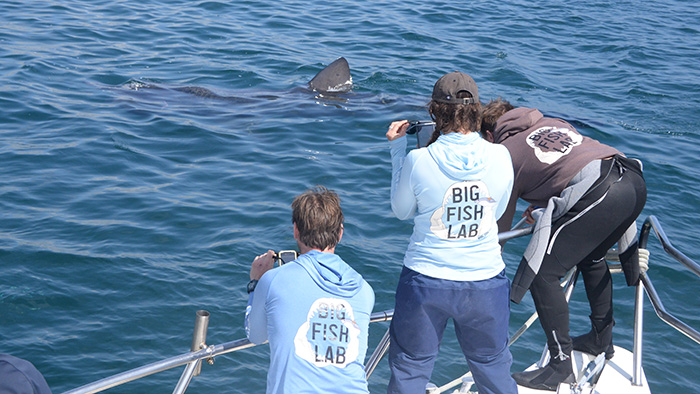
“In places where their population is healthy, like Ireland, they’re often aggregating. They’re often coming in numbers,” she said. “They exhibit these really cool coordinated swimming behaviors. It’s very possible that these places where they’re doing well, they’re places where they’re interacting with each other, potentially to mate. So, the fact that we’re only seeing really solitary individuals these days to me is potentially not a good sign for population persistence.”
Some researchers fear there may be none left off the entire West Coast the near future.
In an email, Bushnell wrote, “it’s so important that more people know what we stand to lose entirely here if we’re not really proactive in the coming decades.”
Through fishing regulations and net bans, basking sharks are protected along the West Coast, McInturf said, but almost nothing is known about what happens offshore.
“They are generally mysterious even in places where they’re well studied,” she said. “In Ireland, they can travel from Irish waters or the U.K. generally. They can travel to Morocco. They can travel up to Norway across to Cape Cod. In Cape Cod, they go down to Brazil. But not everybody does the same thing, and it’s really hard to predict who’s going to do what.”
McInturf hopes her research in Ireland, collaborating with Trinity College Dublin, may help her understanding of the population on the U.S. West Coast.
Despite the population remaining virtually invisible, she maintains hope.
“I am a little bit optimistic over the last couple of years,” she said. “We have been seeing a slight increase in sightings, and most of my information comes from social media or people sending stuff to me. There’s just a lot of data gaps and I think a lot of effort that needs to happen on that front.”
— By Sam Fletcher
Also read in Salish Current:
• “PNW researchers seek comprehensive dogfish data,” Oct. 30, 2025
• “San Juan sea serpent spotting reported — again,” Sept. 11, 2025
• “Friday Harbor researchers look to sea star transfers,” Aug. 19, 2025
• “Fight continues against sea star wasting disease,” July 28, 2025
• “Tagging nearly complete on most-elusive Salish sharks,” July 15, 2025