
While tribal communities honor the spring salmon run, biologists highlight more work needed on the Nooksack River’s South Fork basin.
Chinook have returned to the South Fork of the Nooksack River, and with that comes the swell of drumbeats in gymnasiums and community buildings, creation stories, the sharing of salmon and the ceremonial returning of the bones to the river.
Lummi Nation will hold its First Salmon Ceremony on May 14, 9:30 a.m. to 2 p.m. at Lummi Nation School. The event is free and open to the public. Swinomish and Nooksack tribal communities will also hold respective ceremonies open only to tribal members.
Once an annual tradition, the First Salmon Ceremony went away when commercial and recreational fishing drew too heavily on the Chinook population in the 20th century, causing it to crash, said Mike MacKay, a retired Lummi Nation fisheries biologist who took part in the Chinook recovery effort.
Dana Wilson, a Lummi tribal member, credits Dora Lee Solomon, a prominent Lummi fisherwoman, with bringing the ceremony back before her passing in 1998. But the return of the salmon took a collaboration, MacKay said, between biologists and field technicians of Lummi and Nooksack Natural Resources, and much trial and error between 2006 and 2012.
According to Ed Johnstone, chair of the Northwest Indian Fisheries Commission, “without the fish, we don’t exist.” And without the South Fork Chinook, there is no First Salmon Ceremony for tribal communities.
Lummi Nation’s theme this year is “Care for Mind, Body and Spirit.” According to Samuel Tso, a culture teacher at Lummi Nation School who helped organize, the event was planned by high school seniors for a graduation performance pathway offered by the state.
“It’s supposed to help heal our Indigenous people that are from this area,” he said. “There’s going to be encouragement, there’s awareness, there’s some lessons to be learned and stories to be shared.”
Tso sees the ceremony as a vital tool for decolonization.
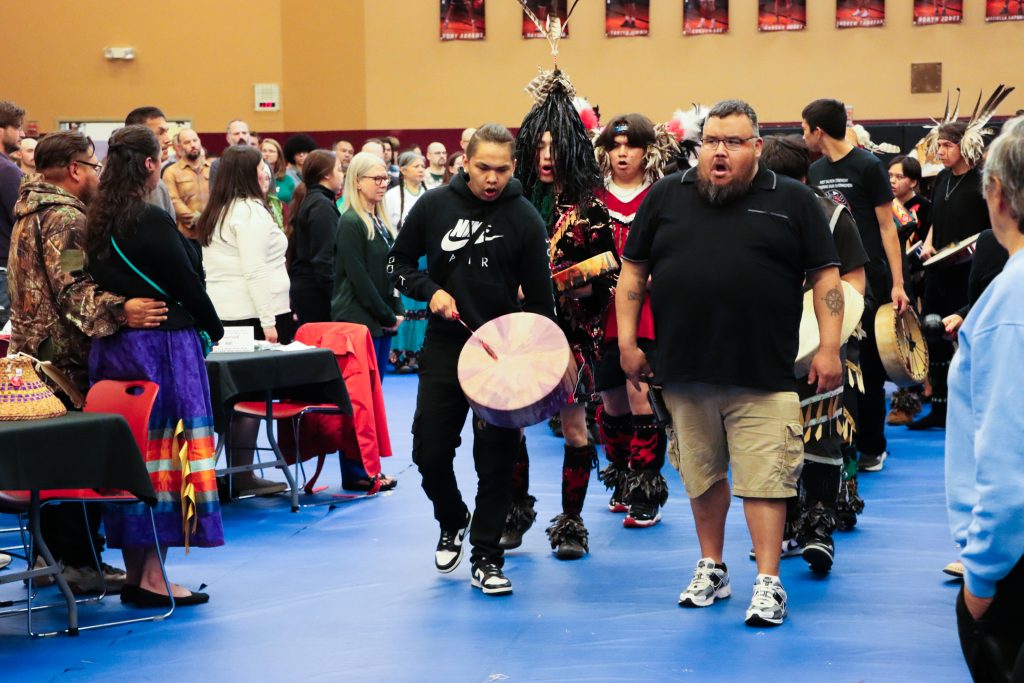
“(The ceremony) matters to me a lot, because it shows that our culture is still alive, that our children are learning through our culture, our education system is being, in essence, decolonized, and our old teachings are being brought forward as the means of teaching our children of how to be in this modern world as we live in two different worlds,” said Tso. “It reaffirms that those that are in power, politics, tribal politics, know and understand that our youth are being taught about their treaty rights, about their fishing rights, about who they are as individuals. More importantly, this means a lot more for me because as an individual. This is my baby that I created as a graduation performance pathway. And we’ve been doing this for the past four years, utilizing this to help our students graduate high school and through our means of culture.”
Life through the South Fork
The 2022 season of the South Fork Chinook showed a run of 4,009, including natural origin, hatchery origin and pre-spawn mortality numbers. This is the largest run since the most recent recovery effort in the South Fork, but biologists understand there is a long way to go for a full recovery.
According to Devin Flawd, stock assessment manager for Lummi Nation Natural Resources, the 2023 estimates are not as high as 2022, but still some of the highest on record. Not including pre-spawn mortality, Lummi Nation estimated 1,402 escapements from both the South Fork hatchery and natural origin Chinook in the South Fork basin.
Numbers for 2024 are not yet finalized, he said.
While South Fork spawners decreased, those spawning in the North and Middle Forks went up both years. In all cases, Flawd said the rate of pre-spawn mortalities are a major concern.
While Flawd has seen recent increases in adult returns and total escapement in the South Fork, there has not been a corresponding increase in juveniles from naturally produced offspring. Reasons for this are likely related to habitat pressures, he said — sediment in spawning beds, summer low flows and major flooding events.
The low numbers of naturally produced juveniles indicate the biggest pressures for Chinook come from the river habitat as opposed to the ocean.
“In combination, these factors have always been a bottleneck to survive in nature,” Flawd said, “but there is a concern that modern climate change impacts, paired with long-term habitat degradation and a slow pace of habitat restoration have made issues worse.”
The tribe aims to improve the degraded environment by increasing deeper, cooler pools available.
“Continuing to support restoration efforts will go a long way, though practitioners often point out that the pace and level of restoration have not kept up,” Flawd said. “Therefore, we have to find a way to balance what the fish need with what people need who are living in the same areas, which has always been a struggle. I think that adhering to solutions outlined in various salmon recovery plans such as restoring habitat would likely help the issue, though time will tell on that.”
A community of sustainability
A major teaching of the ceremony is sustainability, Tso said.
“The ceremony itself reminds all of us about how we’re supposed to be, how we’re supposed to conduct ourselves and how we’re supposed to caretake for the world around us,” he said. “Inside of those stories, it tells us in our history that when we were first created, we were told first thing to caretake for this world that we’ve been introduced to. We were told that everything in this world has a delicate balance. And if we don’t keep that balance, then us as people will disappear along with whatever starts to disappear.”
One of the ancient stories told at the ceremony is of a salmon woman who brought her children, the salmon, to feed village people. As generations went on and people became ungrateful, she left and took her children with her.
“It was part of that reminder out of respect of ‘don’t take more than what you need,’” Tso said. “It was also part of respecting us and the world around us that yes, it is a delicate balance and If we use or abuse it, we’re not going to have it anymore.”
The ceremony is also a celebration of the wider community, he said.
“It’s one of the few ceremonies that we do allow open to the public for people to see and witness and hear our songs, our dances and our stories and come and sit down and share a meal with us when we honor that first salmon and we return it back to the water,” he said. “We appreciate those that want to come and support us. We appreciate those that want to continue to tell our story through our lens and help us get that message out there that we’ve been fighting to try and do all this time, especially when we go to protect land, when we go to protect water, our forestry, our salmon and trying to help in restorative justice.”
—By Sam Fletcher