
Among 61 lawsuits aimed at Trump administration, Brown fights for environmental protections in coastal communities
Since Washington Attorney General Nick Brown took office a year and a half ago, his team has sued the Trump administration 61 times. Yet most of his work, he said at a recent Bellingham City Club meeting, doesn’t make headlines.
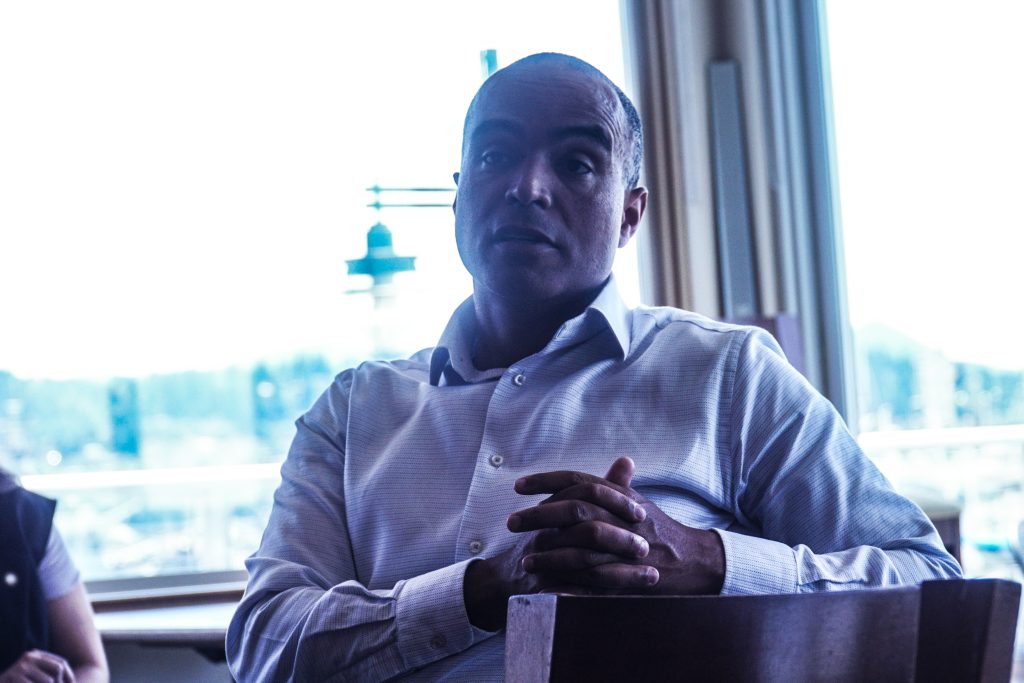
At a press conference after the meeting, Brown said that the federal cases around environmental protections and climate resiliency funding has particularly impacted rural and coastal communities such as Skagit, Whatcom and San Juan counties.
Brown himself grew up in the 7,000-person community of Steilacoom, and First Assistant Attorney General Maureen Johnston is a Bellingham native.
These cases include:
· Suing the U.S. Environmental Protection Agency for repealing nationwide standards on emissions of mercury and other toxic air pollutants.
· Suing the EPA for its attempt to rescind its 2009 Endangerment Finding, which determined that greenhouse gas emissions from motor vehicles contribute to air pollution that drives climate change and endangers public health.
· Suing the EPA for ending a $7 billion program that lowers energy costs and pollution by bringing solar energy to low-income and disadvantaged communities.
· Suing the U.S. Department of Commerce for withholding more than $9 million in congressionally authorized funds to help Washington communities most vulnerable to the effects of climate change build resilience, such as the Tribal Stewards Program.
· Suing the Trump administration for an executive order declaring a national energyto bypass or shorten environmental reviews for energy projects focused on fossil fuels.
· Suing the Trump administration over its decision to shut down the Federal Emergency Management Agency’s Building Resilient Infrastructure and Communities program, which was designed to protect communities from natural disasters before they strike. In the state, 27 open projects through this program total $182 million, with the majority of this going to small towns, rural and tribal communities.
The Attorney General’s office now has an oversight role in hospital consolidation, which also disproportionately impacts rural communities, Brown said. The new rule makes it so when health facilities want to merge, the Attorney General’s office must review the notice.
Cost of housing in Bellingham is 39% higher than the national average. Brown’s team also brought forward several cases regarding housing. One lawsuit challenges RealPage, which uses an algorithm to inflate housing prices. Others aim to prevent housing providers from preying on seniors and others.
“It’s surprising to me, not anymore, but it was in the beginning, about how consistently that comes up as a concern for people outside of Seattle,” he said.
One of the more high-profile state cases includes suing Albertsons, the parent company of Safeway and Haggen, which creates a “buy one get one free deal” and then slowly raises the price of the original product. Brown argues this is illegal under the Consumer Protection Act.
Brown v. Trump
Cases that receive the most attention are often the ones targeted at the federal government, Brown said at the City Club meeting.
“It saddens me that so much of our work is defending Americans from their president,” he said.
Brown described the changes he has seen since he took office as “North Korea-esque.”
“The portrait of the president of the United States is literally today hanging in the Department of Justice. It is hanging from the department of federal justice and many other federal agencies akin to what we see in truly authoritarian governments across the world.”
Requests for comment from U.S. Rep. Michael Baumgartner, R-Spokane, who criticized Brown regarding the state’s immigration policies, and Republican Pete Serrano, who ran against Brown in the 2024 attorney general race, went without response.
Washington was the first state in the country, on the second day of the president’s term, to sue to protect birthright citizenship.
“There are plenty of things the administration does that I don’t like, that are bad policy, that are perfectly legal,” he said. “We don’t litigate just to litigate. But when it’s illegal and it harms Washington, we act.”
That means fighting to protect the $121 million of public-school education grants the administration tried to withhold and $21 million funded through the Victims of Crime Act passed through Congress in 1984. In total, Brown’s office has protected $15 billion that would have been cut from the state, he said.
“Our laws protect people who are undocumented, who are transgender, who have programs that support DEI which remains legal in the state. All of those things made us a target for the administration, but we have fought back successfully time and time again.”
One of the biggest differences between the first Trump term and the second is the collaboration between attorneys general across the county, Brown said. His office has brought forward three times the number of cases than at this same time in Trump’s first term.
This isn’t a brag, Brown said, but a reflection of the unconstitutionality of this administration. Despite this, Brown remains hopeful.
“It’s not just Donald Trump,” he said. “It is leaving and breathing in people in every level of government. I think it in part emanates from not them but us, and what Donald Trump and others have revealed in this moment is some challenges in us, how we talk to each other, how we think about these issues. But we’re going to be OK. We’re going to keep fighting. We’re going to keep fighting in strong coalitions.”
He added, “I’ll stay young.”
—By Sam Fletcher