
Steamboats, timber mills, an amusement park: author surprised by wide range of economic activity during early years of development around lake
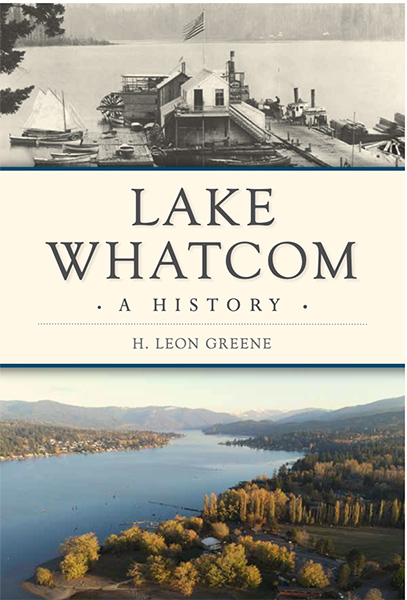
A retired cardiologist, H. Leon Greene has previously written a guide to short-term missions, a Civil War biography about George Proctor Kane, an exploration of the medical and biblical truth about near-death experiences, and a study of the Civil War germ warfare plot of Luke Pryor Blackburn. His latest book, “Lake Whatcom; A History,” was published in 2024 by The History Press.
Dean Kahn: What’s your connection to Whatcom County?
H. Leon Greene: My wife and I have lived in Bellingham since 2012. Neither of us was raised in the area; my wife grew up in Maryland, I grew up in Oklahoma. We came to Washington in 1979 when I accepted a position at the University of Washington, serving as a cardiologist at Harborview Medical Center until 2004. We then sojourned for eight years in Central America at a missionary hospital.
By the time we returned to the states in 2012, all of our children had settled in Bellingham (three had attended Western Washington University). Our decision to move to Bellingham in retirement was thus a no-brainer.
Kahn: Why did you decide to write about Lake Whatcom?
Greene: I love learning about the history of places where I live. Knowledge of history enriches your experience at any location. When we lived in Honduras, I wrote a book about the region’s local history, covering events dating back to pre-Columbian times. (It was only published locally.)
As a physician and a medical researcher, I was always writing something. When we moved to Bellingham, we bought a house that was only about 100 yards from the shores of Lake Whatcom. From our front deck, we could see the site of the old amusement park, and I would frequently envision the activities and events that might have occurred there. My imagination re-created the park, and I was prompted to learn the real story of its construction, use and demise.
In so doing, I discovered the other rich history of the lake — the timber mills, the railroads, the coal mines, the steamboating and the stories of the many men and women who created the environment around the lake.
Kahn: Are there any advantages or disadvantages when a relative newcomer writes about local history?
Greene: The advantage is that everything is new and exciting. Starting with a blank slate creates a fertile field for discovery. One is not hampered by preconceived notions, nor is there any idol that must be deconstructed. Start with a fact and pursue it wherever it goes.
The disadvantage is that your resources likewise begin from nothing. Every path of discovery must be forged anew. You don’t realize that the man across the street is the local expert on an important topic.
Kahn: Were there particular surprises that you came across as you researched the lake’s history?
Greene: The biggest surprise was the wealth of activity that had transpired here over more than a century-and-a-half ago. Who would have guessed that Lake Whatcom would have been a center for coal mining? Who could have envisioned steamboats working up and down the lake? Who knew that Silver Beach was the playground for the citizens of Whatcom, Sehome, Bellingham and Fairhaven? Who remembers the many railroads that vied for the business around the lake?
Kahn: Do you have a favorite person of note in the lake’s story?
Greene: That’s tough! It’s like asking, “Who is your favorite child?” I suppose John J. Donovan would be a leading candidate for the honor of my favorite Lake Whatcom personality. He was a successful businessman, but his activity crossed so many boundaries. He was involved in coal mining, railroading, timber and lumber production, civic projects, philanthrop, and so many organizations and agencies. He was honest, was fair to his employees, and sought to help others without seeking fame for himself. He was true to his church and its values, and he stood for just causes against significant opposition.
Kahn: In what ways does the lake’s history reflect the general pattern of discovery and development in the West? In what ways is it different?
Greene: Lake Whatcom’s activity paralleled the expansion of the West. It was dependent upon the development of transportation, especially railroads and trolleys. It leveraged the value of timber and coal, and it used the steamboat as a means of transportation, shipment of commercial products, delivery of mail, and use in recreation. It also capitalized on the nation’s new love of amusement parks — White Cities, as they were called.
It was different only in that many of the commercial ventures were short-lived. Commerce soon gave way to housing and residential development.

Kahn: Are there aspects of the lake’s history that you found to be frustratingly short of historical material?
Greene: Personal histories, often seen in the form of diaries at that time, were generally lacking. J. J. Donovan kept a diary, but the story of other key players in Lake Whatcom’s history had to be gleaned from more obscure sources — particularly newspapers and the few books published during the early years of the lake’s history.
Kahn: Given the use and abuse of the lake over the decades, how would you describe its current condition and future prospects?
Greene: The lake is currently being used well, though we all need to exercise diligence to avoid further pollution. The volume of water used now is considerably less than it has been when Georgia-Pacific needed millions of gallons daily. Development around the lake must be contained, consistent with preservation of good water quality.
Kahn: Has researching the lake’s history changed your daily perspective of where you live?
Greene: Yes, as I daily walk or drive around the lake I’m constantly reminded of what happened in decades past. I can imagine the steamboats whistling as they depart from the many docks around the perimeter of the lake. I envision the trains and the trolleys; in my mind I see the hundreds of people enjoying the Ferris wheel, the merry-go-round and the roller coaster.
Kahn: What advice would you offer to someone who wants to write about the history of a local place?
Greene: As an amateur myself, I’m hardly in a position to be giving advice. But I can tell you what brought me enjoyment. Visit your local repositories of history — here, they would be the Whatcom Museum, the Washington State Archive, and the Center for Pacific Northwest Studies. There are many people there just awaiting your visit. They will fall all over themselves to help you. You will never encounter a more friendly or helpful group of people. Speak with locals who have spent their entire lives at the sites you’re researching. Likewise, most all will devote hours to assist you.
Kahn: What’s your next book project?
Greene: Thanks for asking! In the pursuit of Lake Whatcom history, I frequently encountered references to Dirty Dan Harris. Soon I realized that there were no comprehensive works about his life. Many writers have devoted a page or two to Harris’ exploits, a few short book chapter, and one brief compendium of Harris’ legends and fables, but all stories about Harris are mixtures of fact and legend.
I decided to attempt to separate truth from fiction, all the while filling the gaps in his story. So I’m having a great time discovering his early years as a whaler, his smuggling exploits, his founding of Fairhaven and his troubled personal life. It’s another adventure!
This article will appear in December 2024 in the annual journal published by The Whatcom County Historical Society. The author will also give a brief presentation and sign his book at Village Books in Fairhaven on Sept. 5 at 6 p.m. in the Readings Gallery.
— By H. Leon Greene and Dean Kahn