
Community at the base of a hill tagged for logging raises concerns about potential for an Oso-like landslide
The 2014 landslide four miles east of Oso, perhaps the deadliest in U.S. history, sent an unstable hill across the North Fork of the Stillaguamish River, swallowed a neighborhood, killed 43 people and destroyed 49 homes.
Just 26 miles from this incident and a decade later, residents of Sauk River Estates near Concrete fear a similar impending disaster.
Sauk River Estates, a community of 83 manufactured homes, sits at the base of a 1,300-foot hill, where Nielsen Brothers logging company has marked to clear 54 acres — much to the concern of the residents.
Nielsen Brothers’ orange tape sways from branches touching Sauk River Estates, and in this neighborhood, there is no distinction between the plots and the forest. Mossy maples entangle the community. Residents string lights and hang decorations on evergreens. Chickens wander the shaded gravel road.
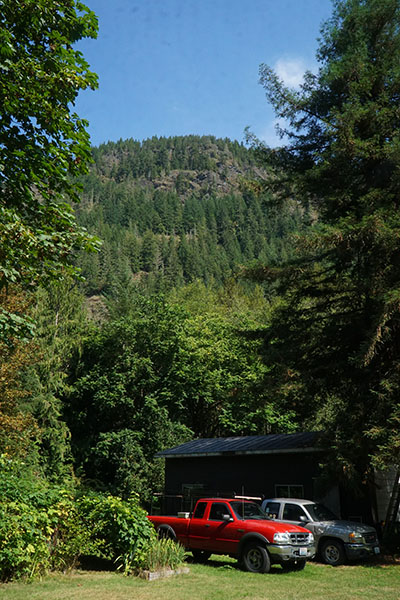
The hill is tall and steep and looming, and it’s easy to imagine how a landslide could bury these homes.
The Stillaguamish River Valley of Oso had been logged throughout the 20th century and into the 21st, and a 1988 study published in Environmental and Engineering Geoscience found that prior to logging, ground displacement rates responded to long-term precipitation trends, and ground displacement rates increased significantly following logging.
However, data shows that similar landslides have occurred near Oso for at least 2,000 years, long before timber harvest, and scientists believe that groundwater and rainfall at the time played a major role in the speed and impact of the slide.
Missing from the map
For the hill above Sauk River Estates, Nielsen Brothers’ Class III permit applications were approved by the Department of Natural Resources, or DNR, meaning that the project has an ordinary potential to damage public resources.
But, according to Sauk River Estates President Alex Gray, there was something wrong with the application: Sauk River Estates was nowhere to be found, a blank spot on the page. The plan clears trees right up to the border of many properties, over an aquifer and next to a wellhouse. None of this appeared on the application.
The DNR approved the logging company to use the main road of the neighborhood, a road owned by Sauk River Estates, without consulting Gray. Because the permit was designated as Class III, no assessment was made for wildlife.
Next steps
These concerns brought Gray before the pollution control hearings board to appeal the application. Gray is hoping for a Class IV Special permit requirement, a project with substantial impact to the environment. Reclassification would mean halting the project for an environmental impact survey in accordance to the State Environmental Policy Act.
After the board heard from Gray and representatives from Nielsen Brothers in July, residents of Sauk River Estates remain in the purgatory of two classes. According to Gray, the assistant attorney general has suggested that it’s possible the DNR will consider reclassifying the project’s permits.
A hearing is set for April of next year. [Updated Sept. 8, 2024; an earlier version of this story said March.]
Aspect Consulting, a Seattle-based firm that Gray hired, identified multiple areas of potentially unstable terrain not addressed in the logging company’s permits. The firm recommended evaluating the highlighted areas with a qualified expert, addressing risks to Sauk River Estates residents.
According to Aspect’s assessment, the DNR should also study how the project’s road construction and timber harvest impacts the water quality within Sauk River Estates’ wells. The firm asked for justification of the Class III designation by a DNR-qualified expert.
Nielsen Brothers’ plan brings logging machinery 10 feet away from the well of Kim Skarda, a Sauk River Estates resident.
“Several of my neighbors live there, and they depend on being safe in their homes, and I care very much about them,” Skarda said.
Beyond a possible landslide
For Skarda, there are many factors at stake in addition to a potential landslide.
“It’s an absolutely amazing forest,” she said. “It’s a rainforest of ferns and deep moss and lichens and maple and fir and cedar and there’s bear and there’s deer and there’s coyotes and there’s even mountain lions. So, even beyond the human concern of it, there’s concern for the river. There’s concern even for the highway, which is right there. There’s multiple reasons why light needs to be shown on this to avoid the danger of what could happen.”
Gray’s concern lies with the residents and not general logging practices.
“We’re not anti-forestry or timber, but the idea of turning the hillside up, especially with these known instabilities at this point, is just too enormous to ignore,” he said.
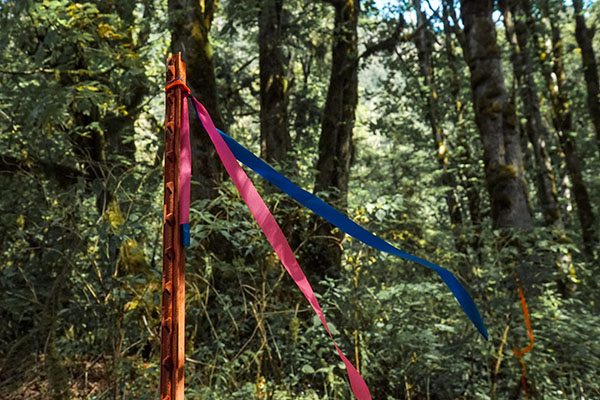
According to Sam Petska, a forester with the Nielsen Brothers, there is no defined timeline for the project and, though they can start again at any point with three days’ notice, they plan to wait out the appeals process.
When Gray set off to object to the project, he had no idea what was coming his way, he said.
“There’s no consideration for the fact that there’s human beings underneath what you’re about to do,” he said, “and it turned out that we ended up on this conference call with the assistant attorney general and all these legal papers flying at us, and we had an actual judge presiding over the hearing board and we’re like, ‘what the hell have we gotten ourselves in?’”
Gray said that when he spoke with Kirsten Rowley, the DNR resource protection forester who approved the Class III permit, she asserted the DNR does take in and uphold environmental considerations. Gray said he thinks the agency’s actions show otherwise.
Skarda is equally confident in Sauk River Estates’ side of the argument.
“We wouldn’t even have a chance if we didn’t have a collective of people fighting this,” she said. “If it was just little old me, there is no way we could succeed, but the fact that we are organized, I think there is a good chance we will get them to stop.”
— By Sam Fletcher