
Planning and actions required to develop resilience to multiple challenges
By the end of this century, the San Juan Islands will see sea levels rise up to two feet, increased saltwater intrusion, both drought and extreme precipitation, extreme heat, wildfire and wildfire smoke events.
Since 2020, San Juan County government has prioritized addressing climate change, passing a resolution to take a leadership role on climate action and adaptation.

County agencies and nonprofits are working on planning for climate change and simultaneously taking action on the ground to protect limited fresh water supplies, prevent wildfires and plan transportation options for low-lying coastal roads that will be submerged by rising seas.
The county’s Department of Environmental Stewardship has hired a climate change coordinator, a climate change advisory Committee was formed and a climate element of the comprehensive plan is being developed for adoption in 2025. San Juan County also committed to reducing greenhouse gas emissions and to reducing the county’s carbon footprint.
Terrestrial and marine efforts
Environmental groups such as Friends of the San Juans have been working to monitor and restore shorelines, eelgrass and kelp beds. The Samish Indian Nation and Friends of the San Juans have been awarded $499,000 as part of a federal grant from the National Oceanic and Atmospheric Administration’s Climate Resilience Regional Challenge, focused on readying the state’s marine shorelines for the future.
With forecasts of warmer, drier summers as well as possible water shortages and stronger storms, property owners are being asked to take responsibility for preparedness.
The San Juan Conservation District (SJCD) helps landowners with wildfire prevention. As a nonregulatory government entity, the district provides landowners and residents with technical and financial assistance. The SJDC also initiated the Islands Climate Resilience group, which issued a report on observed and projected climate change impacts.
Concerns about the increasing risk of wildfires were described by Isara Grecean in these pages. Grecean examined preparedness actions underway such as the SJCD’s Wildfire Ready Neighbors program and discussed the fire situation with the county’s emergency manager, Brendan Cowan, who emphasized the importance of individual landowner responsibility as a key component in preparedness.
Land Bank actions
Since 1990 the San Juan County Conservation Land Bank has acquired 5,000 acres, including 3,000 acres of forest and 400 acres of agricultural land. Their mandate is to steward and protect these lands in perpetuity.
Land Bank director Lincoln Bormann recently spoke to the League of Women Voters and to the Land Bank Commission outlining action areas underway to combat the impacts of climate change.
Protecting key properties to limit sprawl is the number one strategy, Bormann said, because “nearly 10,000 homes could be built” under existing land-use designations. A conservative estimate, he said, of the impact of one home being constructed, including all the materials and transportation, is 30 tons of CO2 added to the atmosphere. For example, the 28 homes that could have been built around Zylstra Lake on San Juan Island, which is now a Land Bank preserve and can never be developed, has prevented adding 840 tons of atmospheric CO2.
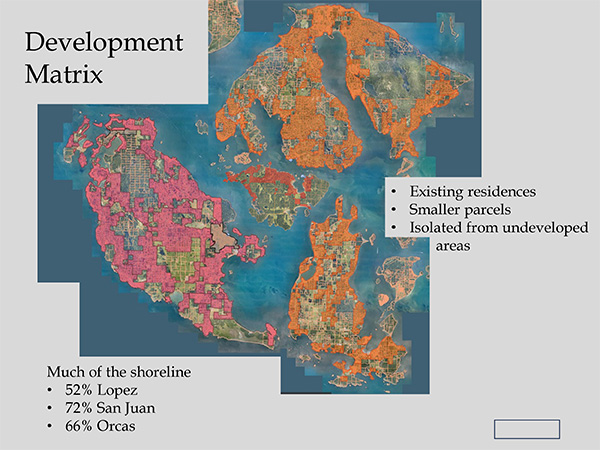
Developed areas on the islands have been mapped and designated “ineligible for conservation.” Areas prioritized for future acquisitions are part of or connect to intact, healthy natural areas for wildlife, recreation, and protection of watersheds. “We’re also looking to bolster existing public lands, increase the adaptability of forests and the wildlife that depends on them,” Bormann said.
Forest health and fire risk
The Land Bank has been collaborating with the Conservation District on wildfire prevention actions as well as taking other specific climate actions.
The risk of catastrophic wildfires is “headed our way,” Bormann said, which necessitates active forest management, and “pretty much comes down to thinning”.
The Land Bank has thinned about 130 acres on Mount Grant and Turtleback and Cady mountains, in partnership with the Islands Conservation Corps (ICC), Rainshadow Consulting, Blackcap Restoration, Samish Indian Nation and the state Department of Natural Resources.
Some of the thinned debris is bundled into piles and left on the ground, mimicking a downed tree and providing wildlife habitat and storing carbon on the forest floor.
Doug McCutcheon, land steward on San Juan Island, said improving forest health is important for reasons not exclusive to catastrophic wildfires. Improving wildlife habitat, increasing the resiliency of the site and preserving or enhancing diversity of the site are also stewardship goals.
“We’re thinking ahead about future climates and the types of plant that will thrive,” McCutcheon said. Restoration work on Garry oak habitat on the south slopes of Turtleback Mountain and Mount Grant is underway, and because this type of habitat in the San Juan Islands is at the northern extent of its range, McCutcheon said these oak savannas are “well-positioned” to thrive as the climate becomes drier and warmer.
Biochar and carbon sequestration on pastures and wetlands
“Conservation burns” of thinned wood create biochar, “which locks up a lot of carbon,” Bormann said. Since the fall of 2021, Land Bank staff and the ICC have burned nearly 1,000 piles, which yielded over 83 cubic yards of biochar, or 16 tons of CO2 equivalent.
McCutcheon explained the process of creating biochar, with the goal of getting the maximum production of carbon-absorbed charcoal. “We’re trying to get the pile to light uniformly, and as soon as it reaches the maximum burn, then we extinguish it,” he said, by spraying water and raking out the piles to return it to the soil for carbon sequestration. Native plants are then planted in the burned areas.
Biological carbon sequestration, on the other hand, is the natural ability of ecosystems to store carbon. Forests, peat marshes, and coastal wetlands are particularly good at storing carbon according to USGS, particularly related to biological or “blue carbon.”

Bormann said the Land Bank is working with its farmland lessees to better manage pastures to improve soil health. By changing grazing regimes and amending soils, more carbon can be stored in plant roots and yields are increased.
The Land Bank currently has 400 acres of agriculture land leased to farmers. A goal of the Land Bank is to increase soil productivity and move away from grazing and mowing to more diverse types of farming.
In another innovative project, the Land Bank is working on a pilot project with Yale University to spread basalt on 10 acres of agricultural land to both increase productivity of the soil and sequester carbon. The ground-up basalt actively removes carbon out of the atmosphere. “This could be a significant piece in trying to address climate change,” Bormann said. “This will pull two tons of CO2 per acre out of the atmosphere.”
The original plan to have 6,000 tons of basalt delivered to the islands this September was scrapped after there were problems with getting the rock ground finely enough to maximize the CO2 absorption, and the barging window closed. “I expect we’ll still do a small field trial this year and get the barged material delivered next year,” said Bormann.
The magic of peat
The Land Bank also has two preserves that contain vast quantities of peat, which is one of the most carbon-rich substrates in the world: Beaverton Marsh on San Juan and Hummel Lake on Lopez Island.
McCutcheon said Beaverton Marsh has 240 acres of historical peat, ranging from 15 to 30 feet deep. There is evidence that peat bogs were “really important to people in North America for food and medicine and were intensively managed,” McCutcheon said. “Bog areas like this are prone to successional forces and would have filled in with forest unless managed, likely by fire.”
Peat soils can “sequester carbon like nobody’s business” McCutcheon said, “and one of our goals is to learn more, can it still function that way? Globally, the amount of peat land cover is only 5%, very small, but it accounts for about 40% of soil carbon — equal to about 70% of atmospheric carbon.”
“This 240 acres is very tiny, on the planet, but it has an outsized impact,” he said.
Ron Zee, former board chair of the San Juan Islands Conservation District, praises the innovative efforts of the Land Bank to address climate change impacts.
“Addressing the impacts of climate change is increasingly important to the future of the San Juan Islands,” Zee said. “I applaud the efforts of the San Juan County Conservation Land Bank to explore and initiate innovative ways to sequester carbon and improve soil health in the lands they steward for present and future generations of islanders.”
— By Nancy DeVaux