
Looking for solutions to a threat that is expected to worsen with climate change
Ed.: It has been nearly three years since floodwaters from the Nooksack and Fraser rivers devastated communities and farmland on both sides of the international border around Sumas and Abbotsford, British Columbia. It was the latest and most destructive in a history of cross-border flooding. Since then, local, regional and tribal representatives have been looking for long-term solutions and shorter-term mitigations for a threat that is expected to get worse along with climate change. (“U.S., Canada make headway on cross-border Nooksack flood strategy,” Salish Current, Sept. 12, 2023)
One of many complications in planning is that some measures that could provide protection on one side of the border would make things worse on the other.
Another is that the kind of money and cooperation needed requires action and urgency at the federal level in both nations at the same time. That’s never easy to achieve, and current political turmoil in both Canada and the U.S. is making it harder yet.
Neil Peters, an engineer and dike inspector who was co-chair of the Nooksack International Task Force created after a flood in 1990, recently shared his perspectives with the Fraser Valley Current. Excerpts appear below, followed by links to the complete articles.
— By Lane Morgan
First published in the Fraser Valley Current, a BC-based local news organization:
The expert
With Abbotsford’s $3 billion plan to protect Sumas Prairie yet to receive the funding needed to allow it to proceed, experts are considering a range of alternatives, including a plan suggested by BC’s former Inspector of Dikes. …
Few people know more about the Nooksack River and the danger it poses to Sumas Prairie than Neil Peters.
As the province’s Inspector of Dikes for more than a decade, Peters regularly warned about the insufficiency of the Lower Mainland’s flood protections. He continued to raise the alarm about flood threats after he left the province.
His experience and history means that when Peters creates an eight-page draft proposal of a potential floodway alternative to a $3 billion scheme that has been unable to secure the necessary funding, it’s worth considering.
The Peters proposal
You can see Peters’ entire draft concept here.
In 2023, after more than a year of study, the City of Abbotsford endorsed a comprehensive, and very expensive, plan to mitigate future flooding from the Nooksack River. … Essentially, it proposed the construction of new dikes that would create a broad funnel that would route water across western Sumas Prairie, north of Highway 1 (and north of the former Sumas Lake bed), to a new Barrowtown pump station. That pump station could pump water up to the Fraser River when the Fraser was higher than the floodwaters—as was the case in 2021.
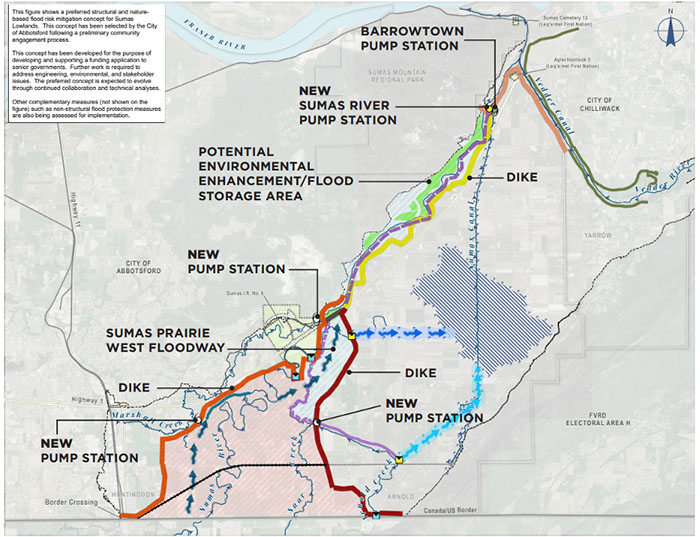
The concept would cost upwards of $3 billion. … (It) would protect the Sumas Lake bottom but leave a considerable amount of land in the western part of Sumas Prairie vulnerable to flooding.
Peters’ suggested concept is very different. (It’s not quite a proposal, since Peters himself acknowledges it may not end up being worth pursuing.)
His idea would see the creation of a large dike along the U.S./Canada border that would channel water directly east toward the base of Vedder Mountain, rather than north to the base of Sumas Mountain. The dike would then swerve northeast, parallel to Vedder Mountain. That would create a new floodway between the dike and mountain’s base. At the Chilliwack/Abbotsford border, that floodway would turn directly north, with dikes on either side. It would channel water to the Vedder Canal, into which the water would flow via a large floodgate. From there the water would continue on its way toward the Fraser.
Peters sketched out three possible dike alignments to stop the water’s flow directly north into Canada. In one version, a dike could be built along the US/Canada border. That could cause water to backup in Sumas, Wash. But flooding of that community could be avoided through the creation of a ring dike, a possibility already under consideration. With the water unable to flow directly north into Canada, the only downhill route left to it would be through the Vedder floodway.
… In addition to offering better protections for landholders in the western Sumas Prairie, Peters suggested the plan could also end up being cheaper — and an easier sell to politicians — because it wouldn’t require a massive new pump station.
The pump station question
Creating a more-confined, direct route between the U.S. and the Vedder Canal and Fraser River should hypothetically allow gravity to drive the water toward the canal and the Fraser.
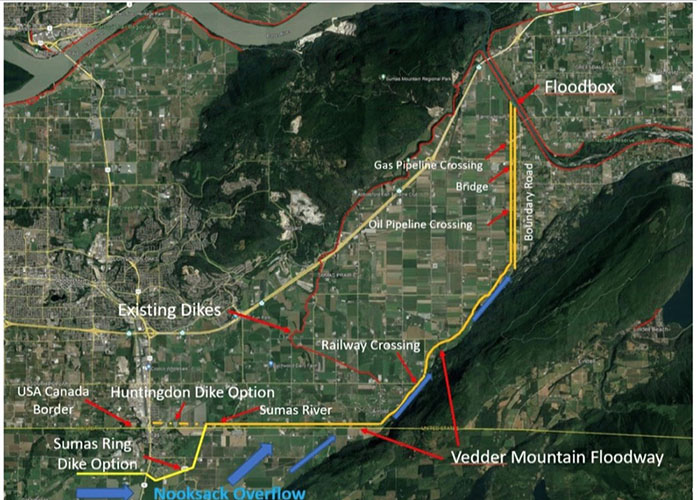
… Peters said the idea would also tie in well with flood protections being considered south of the border. A ring dike protecting the city of Sumas could increase the elevation of the water entering the floodway and, thus, the “head” of the water flowing into the floodway. That would increase the ability of gravity to move the water from Washington into the Fraser River.
Questions
Peters said he has not encountered any previous discussion of the Vedder Mountain floodway concept. It wasn’t studied while he was part of the international task force, he said. Shortly before the 2021 flood, consultants hired by Abbotsford explored a range of possibilities—including potentially drilling through Sumas Mountain — but not, seemingly, the Vedder Mountain concept.
… “The only reason I started thinking about it now is because the pump station cost was so huge,” he said. “Does it make sense to have a piece of equipment sitting there for a couple decades without running and then all of a sudden have to perform exactly as designed, with all that power available at any moment? I don’t know. It seems challenging.”…
The future
Peters first sent his concept document to the City of Abbotsford’s engineering department in March 2023, thinking it may be of interest. He heard nothing back, but said he wasn’t surprised or upset.
Peters’ concept would have been received at an awkward time, and the city’s silence was perhaps understandable: Abbotsford had committed to its preferred option and was hoping the federal government would do the same. …
In July 2023, the city submitted a 57-page application for funding to Ottawa and hoped for the best.
This summer, however, Abbotsford was told that the federal government had rejected an application for $1.8 billion, which would have been used to fund the most urgent parts of its Sumas Prairie Plan. …
So for the moment, the future of flood protection on Sumas Prairie remains up in the air. It’s possible that Abbotsford is holding out hope that next year’s federal election will bring a government willing to ante up the billions needed for its current flood plans. …
In July, a City of Abbotsford spokesperson told the Current that Peters’ proposal is “currently one of the options being evaluated” by a team of technical experts convened as part of the Nooksack and Sumas Watershed Transboundary Flood Initiative.
The planning experience
Tyler Olsen of Fraser Valley Current interviewed Peters about his experiences working with BC and American officials on flood planning.
FVC: Can you tell me about how the task force that you chaired operated, why it encountered challenges, and if you think this new table differs and could offer some hope or prospect for something different?
Peters: I was involved right from the November ’90 flood. … we had what was called the Environmental Cooperation Council, which was an agreement between the premier of British Columbia and the governor of Washington.
… our biggest challenge was political awareness, funding, support and appreciation of the issue. … we just couldn’t get any traction on the BC side to provide money for supporting the process. We couldn’t even get $25[,000], $50,000 to do a little bit more modeling or anything. It was just one these things where government loses interest because it’s not in their face. And almost the same on the American side …
FVC: I’ve been asked about whether something like the Columbia River Treaty would be possible, and it’s always been like, it seems like it would be possible, but you need the feds on board.
Peters: Yeah. So that requires a very strong, broad interest from both senior governments. And as we discussed earlier, there’s not really that much political incentive on the American side to resolve this. I mean, they would like to resolve the Nooksack flooding problems that they have throughout the Nooksack system, but the overflow is just one aspect of it, and cutting off the overflow makes the other part worse, …
… The Americans are very co-operative and, in terms of working together, they’re great. They‘ve got great technology and all good people. So these groups that they’ve set up, I think, have the potential to solve this issue. And if they develop a state-of-the-art hydrologic and hydraulic model which is seamless across border, and then they take the next step of assessing risks on both sides of the border … so that $1 damage in Abbotsford is comparable to $1 damage in Lynden and Ferndale. So you have the cost/benefit to evaluate different options, and then you go look at options and evaluate them. They would consist of everything from building a dike at Everson to contain all the flows so that there’s no overflow to a very modest hydraulic structure that might limit overflow in some way possibly, maybe to the volume experienced in 1990 where the Western prairie floods but the lake bottom doesn’t and the interceptor dike doesn’t breach. …
But I think what Canada and British Columbia need to understand is that if there’s no mitigation of the overflow on the American side, the 2021 event and worse can happen again … So once you have this modeling and the risk assessment, I think you would then, I mean I don’t know how to sell this politically, but just from a straight efficiency point of view, if Canada would put forward $500 million/$1 billion dollars, instead of spending $2 billion on this side, we give the Americans a third of what we might spend to solve the problem and see what they can do on their side to mitigate their issues, and then control the overflow with that mitigation. And then it’s sort of a joint solution, but it means Canada giving Americans money for flood protection on the American side. And I don’t know how you communicate that or sell that to Canadian taxpayers. But from an efficiency point of view, that would be the way to solve it.
FVC: Abbotsford had talked about potentially funding a fairly cheap dike near Everson. The challenge, as you say, is the downflow costs that come when you build that dike. It seems to me like the issue is partly that you can do the math and say, “OK, Canada can also help cover some of those costs, or kind of financially make the Americans whole.” But the big trick, it seems to me, is convincing the Americans; it can’t just be a break-even thing for them, it seems, because if it’s just a break-even thing, they’re probably still better off with the current situation. Bringing them to the table to improve things in Canada is almost inevitably going to hurt them. So you have to really make it worth their while to do something up there.
— By Tyler Olsen
Read the complete stories:
- “Former BC dike chief pitches alternate Sumas Prairie plan,” Fraser Valley Current, Sept. 17, 2024
- “An insider’s view of why the last Nooksack task force failed,” Fraser Valley Current, Sept. 18, 2024
- “Why stopping Sumas Prairie from flooding is ‘not politically feasible’,” Fraser Valley Current, Oct. 6, 2024
For more:
- “Devastated after flooding, north Whatcom County moves into recovery mode,” Salish Current, Dec. 3, 2021
- “Tacoutche Tesse, the Northwest’s great ghost river — Part 2: The flood and building back better,” Salish Current, Nov. 18, 2022
- “Sumas Lake: a once (and future?) feature of the border,” Salish Current, Dec. 19, 2023
- “After disaster strikes, how much is it worth to rebuild?” The Narwhal, June 13, 2024