
Wide-ranging representation lays foundation for work in 12 areas
Whatcom County’s official response to racism may soon see a spark after four years of strategizing.
The Whatcom Racial Equity Commission’s next step is to split into task groups to solve specific problems the community is facing, such as resource access, civic engagement, harm reduction and health restoration, according to its executive director, Miriam Karamoko.
The idea for the commission came after the death of George Floyd in Minnesota in May 2020. Whatcom community members organized to make an impact toward racial equity. Following the county resolution affirming racism as a public health crisis and approving a contract with the Chuckanut Health Foundation to address it, the commission officially formed in October 2022.
After a year and a half of applications and appointing the commission, the county confirmed the commissioners on April 2024 for a first official meeting in the following June. Karamoko was brought on as director in August.
Last year, the commission zeroed in on 12 areas of interest: economic mobility, the justice system, mental health, systemic racism, environmental justice, food security, substance use, immigration, education, health, housing and county processes.
The commission also connected with other organizations to form partnerships for future engagement and worked to identify funding streams.
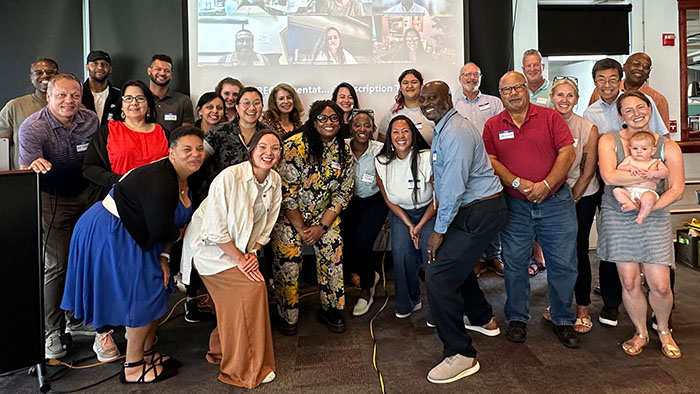
Supported by the Chuckanut Heath Foundation, Karamoko is the only full-time employee. A steering committee of six people, serving as cochairs, a treasurer and a secretary, leads the commission.
In total, 37 people make up the team: 31 voting members and six commission-elected, non-voting members.
Structured for differences
Karamoko said the large commission is one of the things that attracted them to the organization.
People from all five county council districts of Whatcom make up the commission, they said, working in higher education or the K–12 system, activist organizations, Port of Bellingham, Whatcom CARE (Coalition for Anti-Racist Education), Children of the Setting Sun Productions and others.
“The structure itself was so appealing to me, because it involved bringing everyone, which is really, really important,” Karamoko said. “The commission itself is not an echo chamber. We have people with different lived experiences and different beliefs, and so it’s just a really cool structure.”
While the amount of input has caused a prolonged timeline, Karamoko said it will yield greater results.
“We’ve been doing a lot of work to set the foundation to figure out how we make decisions, how we work together, our decision-making structure that we approved in January,” they said. “We hope to serve as a model to other folks on how the work can be done in ways that involve a lot of people, involves everyone in the space and pushes us to do better for each other.”
Built around faith
Another local equity organization assembled with a more homogenous group.
The idea for Racial Unity Now, or RUN, a Christian organization in Lynden, similarly sparked after the George Floyd incident. In July 2020, hundreds of counterprotesters — some armed — met a peaceful march against racism organized by high school students in Lynden.
Assembled through faith groups and operating with a much smaller team, RUN began hosting community events. According to founder Ron Polinder, it started with adult Sunday school classes addressing some of the issues in the community.
RUN also hosted a film series and dozens more events such as trainings on equity and racial unity, Polinder said. Of course, different processes yield different results.
While WREC and RUN may have a large overlapping mission, the approach is quite different. According to the respective websites, while WREC will ultimately make local policy recommendations, RUN focuses on grassroots, faith-based change.
Positive change does not happen overnight, Karamoko said, and will take collaboration.
“From my culture, from my standpoint, really good things take time because you’re pausing, you’re assessing, you’re really diving into what actually needs to happen,” they said. “What are the key players. Are we missing anyone? Always having that pause takes time.”
WREC will host a table on Feb. 26 from 5–10 p.m. at Sweet as Waffles on Magnolia Street in Bellingham. A portion of the restaurant’s sales from the evening will go to the organization. Commission meetings are typically on the second Wednesday of the month and have virtual attendance options.
— By Sam Fletcher
Also read in Salish Current:
• “Clyde Ford to speak on the legacy of Martin Luther King Jr.,” Dec. 2, 2024
• “Racial equity commission picks up speed toward March milestone,” Dec. 14, 2023
• “Council votes to create Racial Equity Commission: reflections of a post-modern revolutionary,” Oct. 12, 2022
• “Faith-based Lynden group works for racial unity,” July 1, 2022
• “Summer of rallies, marches sparks multiple approaches toward social justice in Whatcom,” Aug. 24, 2021