
Cascadia International Women’s Film Festival ‘entertains, inspires, enlightens, educates’
“And all of a sudden, I’m lying on this absolutely filthy Brooklyn sidewalk, and I’m looking up in the sky, and I’m having an existential moment of ‘what am I doing with my life?’” In a recent interview, Jacquelyn Christy described going to film school in her 40s.
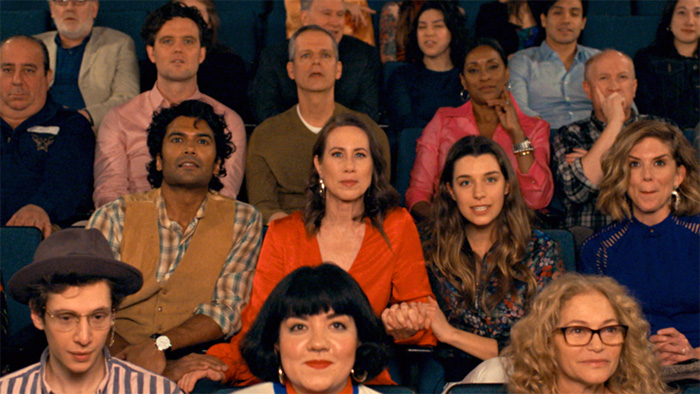
Christy’s feature debut — “Magic Hour” — will open this year’s seventh annual Cascadia International Women’s Film Festival, or CIWFF, at Bellingham’s Pickford Film Center April 24–27. Founded to support and showcase the work of women filmmakers, the CIWFF has been doing so since 2017, said Cheryl Crooks, executive director of the festival.
The festival, like Christy’s film, highlights the importance of providing space for diverse voices.
Ten countries are represented this year; among them are Canada, Israel, the United Kingdom, Iran and France, said Crooks.
Second chances
“Magic Hour” follows the story of a middle-aged woman who attends film school for the first time. Although Christy’s film is fictional, she explained, “it’s inspired by the experiences I had. I was a lot older than my classmates, and I did have a lifetime dream of wanting to be a filmmaker.”
Sitting in a small room in her parents’ East Coast house, as her mother taught a piano lesson in the next room, Christy said it’s important to pursue dreams at any age. In the seven years it took Christy to make this film, she learned an important lesson in chasing one’s dreams: “I want to hear what people have to say. I want, especially women or people who’ve been holding themselves back or being held back, to step into the light. It’s our time.”
Film, Crooks observed, “is a very powerful medium that can motivate people to investigate further or to look into things further, ask questions or get involved.”
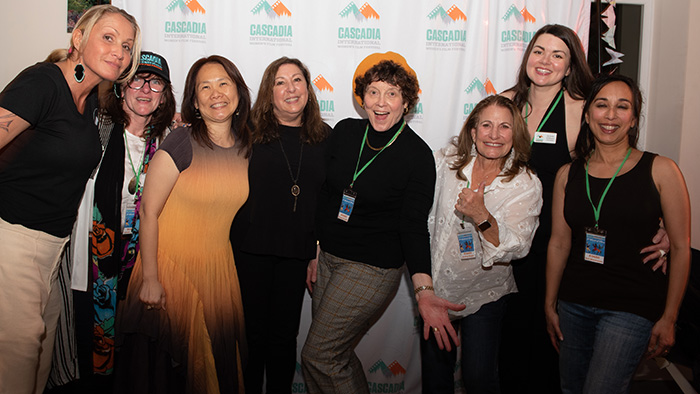
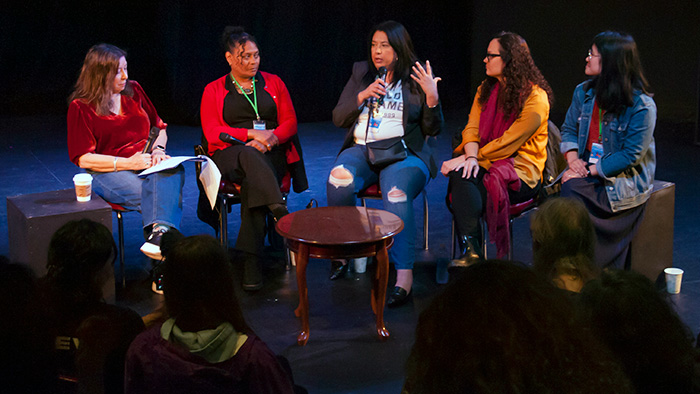
CIWFF has expanded beyond film screenings. It engages with the Cascadian community and supports women’s voices at any stage of making through script-writing classes, director discussions and opportunities to collaborate.
Crooks said Christy’s film speaks to the mission of the festival. “It talks about how she lost her chance to do this, and that’s what we’re about, giving chances to the women directors that need it.”
Going beyond film
CIWFF celebrates women in film with a growing range of events and initiatives this year. The festival showcases international films and provides a platform for emerging filmmakers. Workshops bring together both up-and-coming and experienced women directors, offering insight into the craft of filmmaking and creating networking opportunities for those looking to break into the industry, said Crooks.
The festival is also branching beyond film into both visual arts and poetry. This year, the second annual women’s visual art exhibit, “Women Rising: Expanding Visions/Diverse Perspectives,” opened at the Dakota Art Gallery on April 4 to run through May 24. “The idea behind it was that we wanted to expand the festival to showcase women artists in other media and celebrate their work,” said Crooks.
In addition, the festival is developing the Stills Poetry Project, inviting poets of all genders to submit poems in response to the films or filmmakers featured at the festival. Selected poems will be published in an anthology called “Stills,” which will be released by the independent Ravenna Press, based in Edmonds.
Laugh through it
An experienced filmmaker worth noting is Tanna Frederick, said Crooks. Frederick is an award-winning actress and director, known for her recent work in “South of Hope Street” and “Death Pays Flora a Visit,” which won Best Narrative Feature at the 2024 Gig Harbor Film Festival.
Each interviewed filmmaker made it clear that telling women’s stories is not a conglomerate act. The films are diverse in their messages and represent a myriad of women’s experiences, but one through-line among the films is that it’s never too late to tell your story.
“People in your life or the world at large tell you, you’re too old. Your job is to support other people, and nobody really wants you in the spotlight,” said Christy. “There’s a danger when we internalize that. And this movie is about pushing through that. So it’s a comedy, but it’s also drama. I think the dramatic arc is about figuring that out.”
It may be Christy’s debut film, but she is not green to the world of storytelling. “I’ve done theater even when I was a little kid. I would be in shows, so that’s a natural part of my life, but I also run my own theater and have directed and produced.”
Christy lives in New York, where she founded the theatre company, Access Theatre.
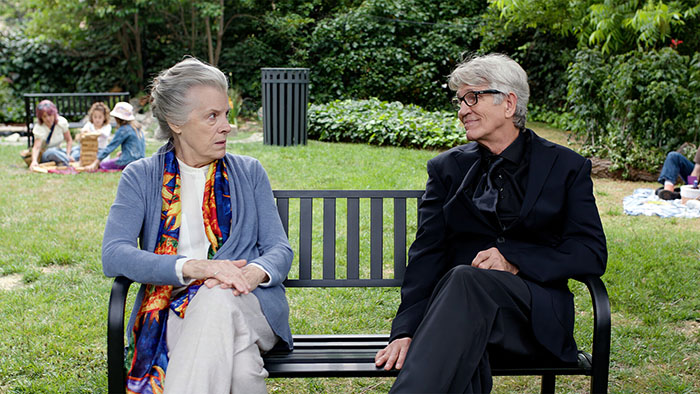
“In Death Pays Flora A Visit,” Death, played by Eric Roberts, visits Flora, played by Mimi Kennedy, to claim her life, but she refuses and makes a deal to swap places with others, leading to unexpected outcomes.
Frederick’s film, like Christy’s, uses comedy as a way to navigate hardships. “Death is hard. Comedy is harder because it’s so true,” she said. “To create a comedy out of death, a comedy with a great imagination … gives us agency over our own mortality.”
The two directors share the opinion that laughter relieves a kind of intensity that women often experience. Frederick said, “I think comedy creates depth in the work. And that includes if you’re directing a horror film as a female, that includes if you’re directing an action film as a female, use all of those soft spots that we have because those also translate into the hard moments as females.”
Female figures in film
Women continue to be underrepresented in the film industry. According to the 2024 The Celluloid Ceiling report, published by San Diego State University’s Center for the Study of Women in Television and Film, women made up just 11% of those working behind the scenes on the 100 top-grossing U.S. films. This is a decrease of 3 percentage points compared to the 14% in 2023. This underscores the importance of platforms like CIWFF, which actively work to counteract such disparities.
With the festival bringing together filmmakers from around the world and supporting emerging voices, the CIWFF is more than just a celebration of films — it’s a platform for global dialogue and empowerment, said Crooks. “The festival has always been about giving opportunities to people who might not otherwise get a chance to be seen.”
Christy’s “Magic Hour” embodies this ethos. A story about pursuing dreams no matter the age, it’s a reminder that it’s never too late to step into the spotlight.
When asked what message Christy had for those who have dreams on hold, she said, “You can live your dream on your own terms right now. You don’t need permission from anyone, you don’t have to change your personality, you don’t have to clean out the garage. You can be as neurotic as you want. You can be a complete mess and take that wherever you’re at in emotion and whatever is truthful to you and put it into your dream.”
— By Mickey Mann
Also read in Salish Current:
• “Honoring the voices of women: Indigenous stories in short films,” Feb. 2, 2025
• “Arts, recreation, stories in the dark: where lodging tax revenues go,” Jan. 29, 2025
• “Local festivals, theaters — and movie lovers — boost independent films,” Nov. 13, 2023
• “Showtime in Mount Vernon: Lincoln Theatre is a star in downtown renewal,” June 30, 2023
• “Whatcom Arts Project brings local groups together — at a crucial time,” Nov. 20, 2020