
In the face of drought, the West faces a growing water crisis — and one Whatcom city has an innovative plan to address it.
Department of Ecology officials recently declared expanded drought conditions as 19 watersheds across the state fell to less than 75% of normal water supply, one of them being the Nooksack River. The summer is predicted to get hotter and drier, and that’s when Lynden hopes to wrap up cost estimates for an innovative plan to recharge the city’s depleting water supply.
Summertime river flows are generally low at a time when human, agricultural and fish habitat demands for water are at their greatest. Climate change and population growth are expected to only exacerbate those tensions. Lynden’s managed aquifer recharge project, or MAR, on the Nooksack River comes in response to growing concerns about climate change and regional water rights adjudication.
The system would pull water from the river during high flow periods — December through May — and store it in essentially an underground reservoir until low flow periods in the summer. The project could provide several thousands of acre-feet to the river between June and November. One acre-foot is equivalent to nearly 326,000 gallons.
“The idea here was a win-win opportunity,” Lynden Public Works Director Jon Hutchings said. “There are mutual benefits to the environment in the way of fish habitat, to the environment in the way of in-stream flows in general as well as benefits to the city securing its water source for the future and putting us in a place of greater water supply resiliency.”
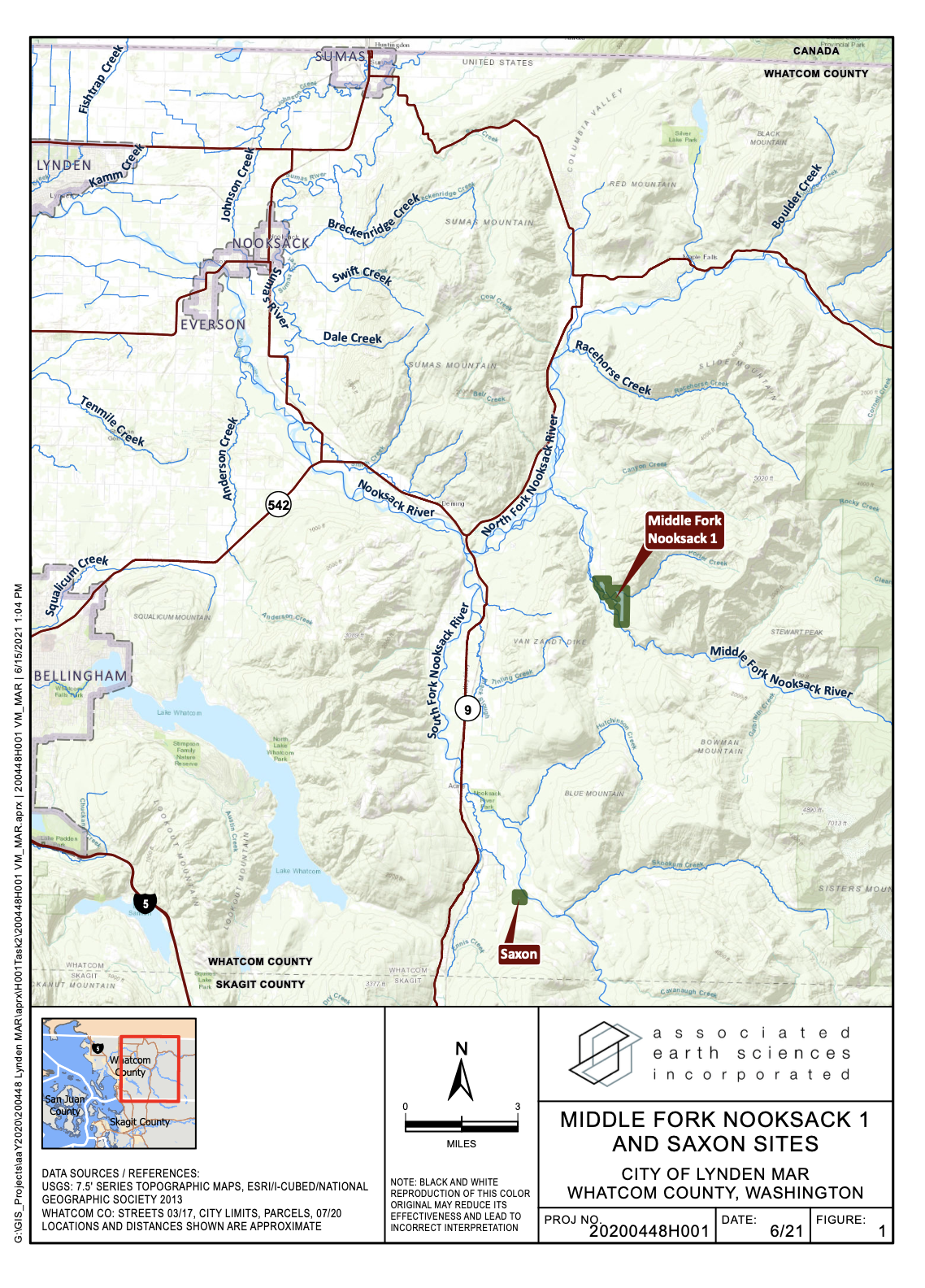
The city has narrowed to two possible sites for the project, down from about 20. One is on Saxon Road by the South Fork, and another is near the Middle Fork.
Lynden received a $4.7 million grant from Ecology in 2020. Most of that money has gone toward reviewing site options and studying the technology constraints. Some of those funds could be used for construction, but Hutchings said the city will have to pursue other funding avenues to make the project a reality.
If the city decides to move forward, construction will likely last a few years. If it determines the cost is not worth it, however, Hutchings said the project may not be completely dead in the water. Instead, the city could have a better understanding of what’s needed in a site and may determine if there’s another site that would work better.
Hutchings said the city is consulting relevant stakeholders, including the Department of Fish and Wildlife, the Nooksack Indian Tribe and Lummi Nation. Neither tribe responded to a request for comment, and Fish and Wildlife said it is not engaged with the project beyond its involvement in the Watershed Management Board, the organization that oversees water planning in much of Whatcom County and parts of Skagit. Fish and Wildlife declined to comment on the current state of fish habitat in the Nooksack River and the potential impacts of the project.
‘A pretty big lift’
Hutchings said the city opted to pursue the managed aquifer recharge project in response to concerns about how much water it can legally withdraw from its principal water source, the Nooksack River, while the area goes through water rights adjudication. Final rulings on water rights aren’t expected until at least 2026, and Bellingham estimates it could take up to 20 more years.
In the meantime, Lynden has turned to the MAR project as part of a number of water solutions. The city has also implemented reclamation of water discharge from the Darigold plant and groundwater well ownership.
The project also comes on the heels of other efforts to tackle salmon habitat challenges, Hutchings said.
A lingering issue that the MAR project hopes to address is climate change’s impact on the timing of river flow. As snow packs decrease and rain increases, high flow periods are shifting to the detriment of the salmon that call the river home.
“Water levels are declining a lot earlier in the summer, and that happens to also be the time when we have the most need for water and salmon alike,” said Kaia Hayes, land and water policy manager for environmental nonprofit RE Sources. “I think it’s worth exploring any solution that helps to maintain a critical level of stream flow during those summer months when we need to be irrigating and supporting salmon runs.”
Overall, Hutchings said the project is “moving the needle in the right direction.” If successful, the project could have broader implications.
“If this is to work, it offers a partial solution for other communities as well,” he said. “We’re kind of proud of this full project. For a small city like us, this is a pretty big lift, and it’s just fun to be part of the science.”
The National Ground Water Association said that while MAR isn’t new, strategies for implementing it have grown more sophisticated in recent decades. The evolution of MAR has ranged from artesian wells in ancient China to aquifer projects aimed at addressing reconstructions and urbanization in the post-World War II era.
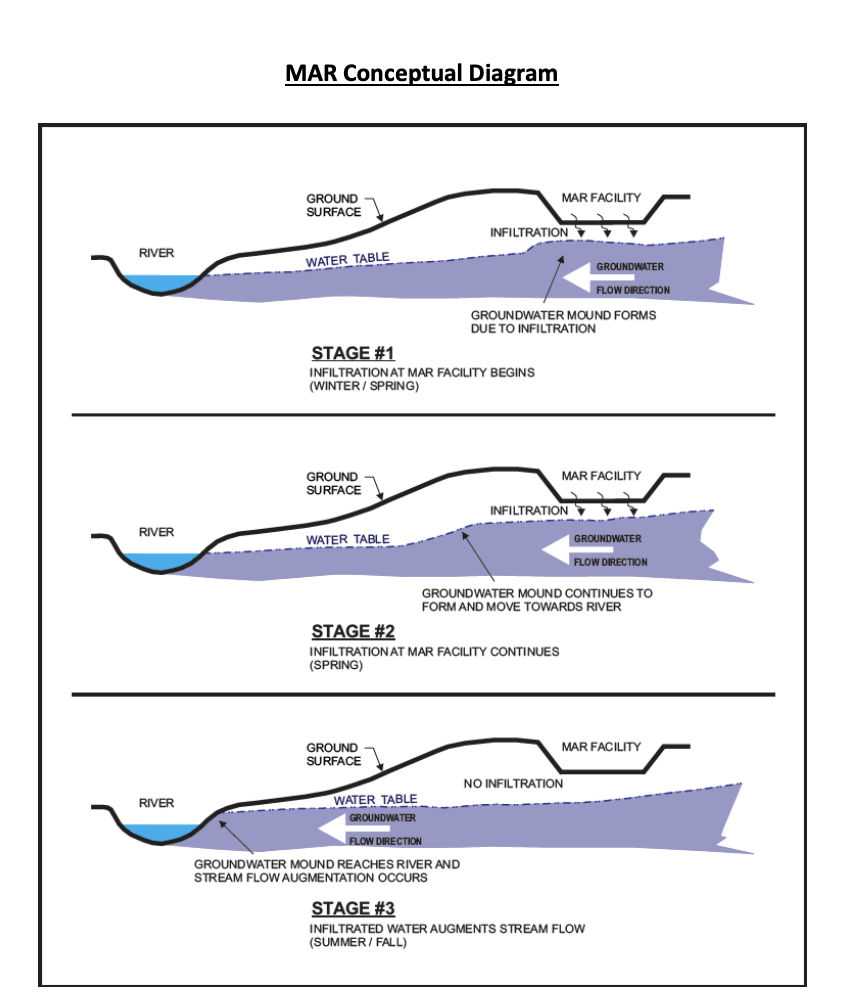
“MAR may be one-third or less of the cost of traditional surface water reservoir storage and without the evaporative loss,” according to a 2022 edition of the association’s journal. “Not only in the West, but across the United States, states and communities are addressing groundwater governance factors in water rights, availability, and access at MAR sites to respond to water supply and quality management challenges. Similar actions are taking place throughout the world.”
‘Devil in the details’
Local environmental groups say it’s too early to fully throw their weight behind the project but that it appears to be a step in the right direction.
The Whatcom Environmental Council said it supports efforts like Lynden’s that provide more water in the Nooksack during low flow periods. But it also stressed that the amount of water the project would likely add to the river is less than the amount the city will need to meet increased demand from population growth.
“The devil of course is in the details for how this is implemented, paid for and how any water right is granted from the effort, but in general we need these types of efforts, and many more, to help dig us out of the critical low flows that human overconsumption causes and climate change amplifies,” the council wrote in a statement to Salish Current.
The council added that while the project is “a laudable effort,” the Watershed Management Board needs to take action to speed up approval and implementation for similar efforts.
“There is no need to wait, as some have suggested, for the pending adjudication to better define water rights before we all act to use less water through conservation and efficiency, and by augmenting low flows through projects such as this,” the council said.
Hayes agreed that the water adjudication process has opened the door for larger discussions on the region’s water plans. While she supports investing in efforts like Lynden’s to explore water solutions, she hopes the project is one part of a multifaceted approach. That approach should include, she added, natural climate solutions or actions that leverage what the river system is or has been capable of in the past, such as restoring wetlands and historic floodplains.
“It’s not alchemy. We can’t make new water,” Hayes said. “So, while I think it’s a positive to be exploring those kinds of options, I really think ultimately the question and the conversation that we need to be having to tackle these issues on a meaningful scale is really what bigger work is this a part of?”
— By Sydnee Chapman

Also read in Salish Current:
• “Commentary: Whatcom drought: What should we do?,” July 2, 2025
• “Commentary: Time to reform our century-old Washington water law,” Sept. 30, 2024
• “You can help: Whatcom Water Week panel to focus on stewardship,” Sept. 11, 2024
• “Commentary: The complexity of water rights adjudication,” May 3, 2024
• “Nooksack water rights adjudication is on track for April filing,” Feb. 14, 2024
• “Commentary: Planning for less water in Whatcom,” Jan. 30, 2024