
Sensing, not scrolling: Animals as Natural Therapy and Salish Sea School offer unique opportunities for teenagers to practice mindfulness and trade screen time for green time.
Forget the endless scroll. Imagine leading a 1,200-pound horse with nothing but mutual trust. Or sitting silently on a bluff, observing the Salish Sea without a single notification vying for attention.
This summer, two regional programs are pulling young people away from their devices and into profound, wordless conversations with nature: Animals as Natural Therapy, based in Bellingham, and the Salish Sea School in Anacortes. Both offer programming that teaches teenagers to be present, mindful and grounded in the natural world.
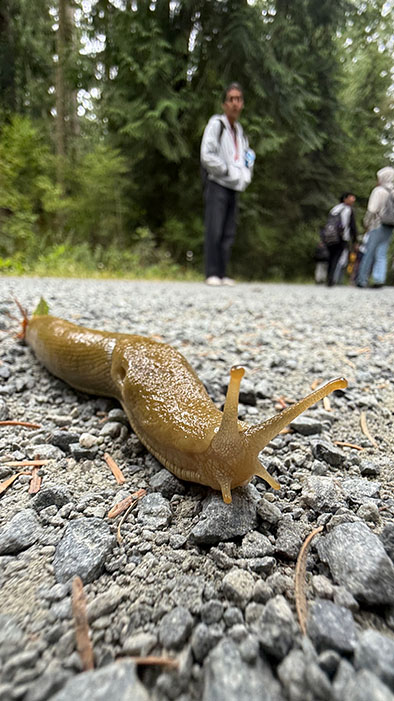
“This is something you can’t do through a cell phone,” said Elizabeth Drozda, the education coordinator at Salish Sea School. “You can’t smell the Earth. You can’t hum to a slug.”
Drozda said programs like Guardians of the Sea — and Guardianes del Mar, for Spanish-speaking students — offer opportunities for youth to build “primary connections” with the vibrant ecosystems of the San Juan Islands.
Primary connections are direct sensory experiences. There may be some reciprocation, too. For example, Drozda said humming at slugs seems to sometimes incite a relaxed response. The human’s action creates a reaction — and there might be a lesson there.
Haley Didier is a horse trainer at Animals as Natural Therapy. Through equine-assisted learning, she helps young people connect with horses and communicate without words. This work, Didier said, can help young people get grounded in their bodies.
“We’re very intentional about introducing the equine herd to the campers on day one and encouraging them to pay attention to the equines’ body language while also tuning into their own bodies and emotions,” Didier said. “What are they telling us, and how do we listen when animals are communicating to us?”
Through a process called “liberty work,” students lead horses without a rope or halter, focusing on building trust and understanding what their own body language is communicating.
“The student is asking the horse to move and influencing where they’re moving just based on their body language and energy levels,” Didier said.
Didier said the horses are responsive to the slightest shifts in the campers’ emotions and demeanor. Sometimes the horse’s body language can help reveal information about the camper’s own internal state.
“That’s where a lot of powerful learning moments happen,” she said.
To effectively glean these lessons from nature, it helps to be observant. At Students Training as Research Scientists, or STaRS — a Salish Sea School program — Olivia Fross teaches students to cultivate an “observational mindset.”
Part of that work is good old-fashioned scientific observation. On their first day at STaRS, students visit an island with an old-growth forest and perform a moss transect survey. “Zooming in” on a specific patch of the forest, Fross said, gives students the opportunity to look at the world on a different scale.
From there, campers also participate in activities that focus on finding comfort in nature through mindfulness and somatics, focusing one’s place in nature and the mind-body connection.
“We do something called ‘belly botany,’ where we lay down on our bellies and look at the ground and all the organisms that we see,” Drozda said. Then, they flip over and do the same thing, this time observing the canopy.
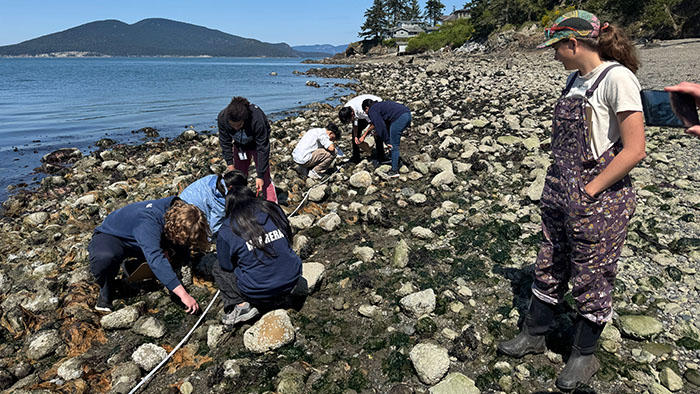
Drozda said this type of observation helps students relax.
“Sometimes at the beginning, they’re a little resistant to it,” Drozda said. “Like, ‘What are we doing? We’re just gonna sit here?’”
But after sitting on a scenic bluff and doing some deep breathing, Drozda said that most students find a sense of calm.
For Didier, this reaction makes perfect sense.
“Being outside is healing in and of itself,” Didier said. “It’s our natural place of existence.”
At Animals as Natural Therapy, Didier and other camp staff help students find peace in the present moment by doing grounding techniques with farm animals, from horses to rabbits.
“We really encourage being present,” Didier said. “Let’s be here now. Let’s not be on our phones. That’s how all the animals on the farm show up.”
The horses especially, Didier said, show an incredible sense of intuition.
“One of our horses, Scotty, always sensed when someone was kind of in a dissociative state or just really out of their body,” Didier said. “He would nip them — not hard — but he would just grab their shirt and nip them, almost as if he was pulling them back into their body.”
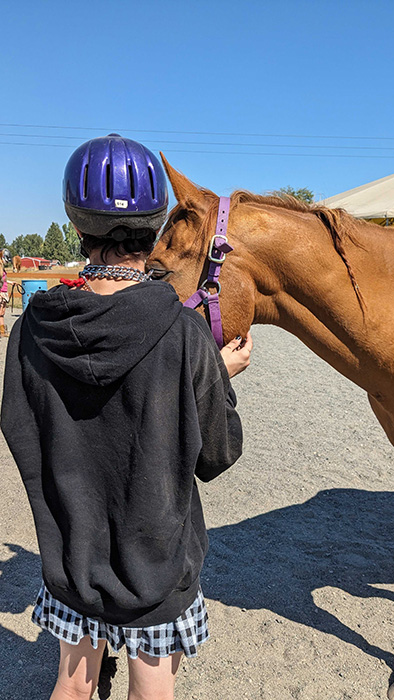
The animals also encourage authentic expression, Didier said. At Pride on the Farm and other programs, campers are encouraged to tap into their feelings through daily check-ins and creative expression.
“When we are being congruent with how we’re presenting and how we’re actually feeling on the inside, (the animals) trust us more,” Didier said.
Much of their camp curriculum is similar, but Pride on the Farm — scheduled for Aug. 11 to 15 this year — specifically focuses on creating community for LGBTQ youth from ages 13 to 18.
“We want to provide a space for queer youth to come and feel seen, heard, accepted and welcomed, where they can be their authentic selves,” Didier said.
All of Animals as Natural Therapy’s programming seeks to meet students where they are. Keeping at least two instructors per group allows them to be flexible and meet individual needs.
“If someone says, ‘Hey, I am feeling really overwhelmed and anxious today, I need some rabbit energy,’ we have the capacity to help them advocate for what they need,” Didier said.
Working with different animals gives students unique opportunities to get grounded and better understand themselves — but teenagers aren’t the only ones who can benefit from these interspecies connections. Both Animals as Natural Therapy and Salish Sea School offer experiences for people of all ages.
At Barnyard Break events, Animals as Natural Therapy opens up the farm to the general public for “intentional, animal-guided therapeutic time.” Salish Sea School offers a variety of adult programming, including visits to the San Juan islands and wildlife experiences.
Even without these guided experiences, however, people can reap the benefits of being one with the natural world. Just the act of breathing, Drozda said, reminds us of how we are deeply intertwined with our ecosystem and all the living beings around us.
“We are all part of nature,” Drozda said. “When we’re breathing intentionally, we’re recognizing that all the photosynthesizers are releasing oxygen, and we’re releasing carbon dioxide.”
Through breath, humans fuel the plants that create the oxygen needed to survive.
“Breathing is a reciprocal activity,” Drozda said. “We belong. That’s it.”
— By Oren Roberts
Also read in Salish Current:
• “Animal owners step up action against threat of bird flu,” Feb. 24, 2025
• “First-time voters and last-minute ballots,” Nov. 26, 2024
• “WWU community grapples with post-election uncertainty in a new Trump era,” Nov. 15, 2024