
New scholarship program will support respite care for home caregivers.
Hospice of the San Juans — or HSJ — is celebrating its 40th anniversary this year, and its newest mission is to establish a scholarship program to place a hospice care recipient at the only assisted living facility on San Juan Island, Village at the Harbor.
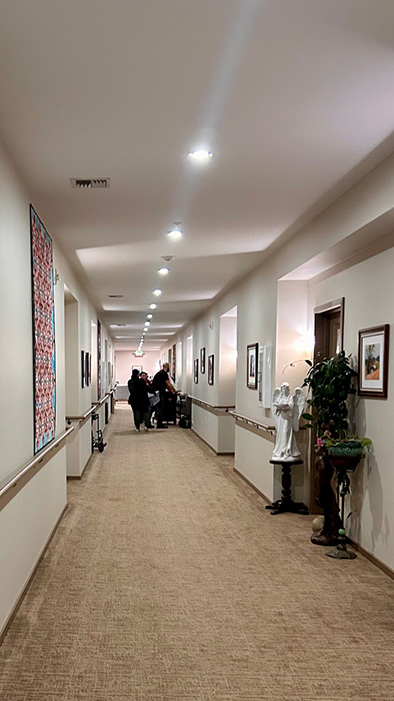
Village at the Harbor started as a private facility in 2008 and was acquired by San Juan County Public Hospital District No. 1 in 2022. It provides meals, housekeeping and some assistance, but no skilled nursing care. Residents who can afford to can hire additional nursing care if needed.
One need that has been particularly hard to meet is respite care, for a few days or a few weeks, so that home caregivers can get a break or take care of other emergencies.
Currently, Village at the Harbor does not have a designated, furnished respite apartment, according to executive director Tina Smith. “When there is a waitlist with 12–15 seniors desperately needing assistance and housing,” it did not make sense to keep an apartment open for respite care that would sit vacant part of the time, she said.
“We have respite available with availability,” Smith said, “meaning, if we have an open apartment when someone calls to reserve a short stay, we can accommodate it.”
Building a fund for respite care
The San Juan Community Foundation selected HSJ’s scholarship program as one the local nonprofits in its “San Juan Island Cares” project to increase support for caregivers, matching the first $1,000 raised at the San Juan County Fair. In total, $5,653 was raised.
Care recipients in the SJH program will be able to access these funds to help pay for a stay at the Village, giving their caregiver a break, if the level of care needed is a good fit for the Village and a room can be made available. Currently, no such help is available on the island.
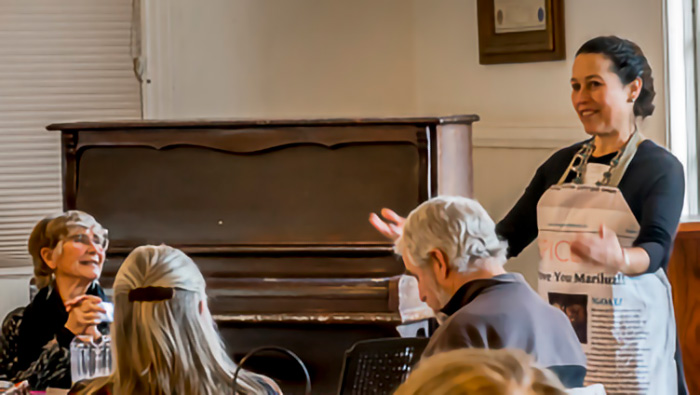
According to Mariluz Villa, also known as the “MOM” or Main Operations Manager, HSJ will continue to raise money for the scholarship. “For this coming year, our goal is a modest $10,000 for a trial period. We want to collect information about community demand, how much assistance will be needed on average and how space allocation within the Village affects availability for respite stays. These all are unknowns,” she said.
When the Village tried keeping one room reserved for respite care, it could be rented for $275 per day. But it turned out that the room was only used for 22 days out of 365, Smith said. Additionally, the process of onboarding a patient for just a few days was time consuming, and Smith said for that amount of time it might “almost be easier to get care at home.”
The Village’s policy now is to enter into a four-week lease agreement for a base rate of $5,100, with three levels of additional care available for an extra charge. “This does limit us in helping caregivers who just need a weekend away,” she said, and the Village will continue to provide shorter respite services when a room is available.
All the services of HSJ are free, and the organization is one of very few all-volunteer hospices in the nation. It was begun in 1985 by some nurses on San Juan Island, with the mission to improve the quality of life of those with life-limiting illness, to provide guidance and warm, loving, supportive help to a dying person and family and to keep intact the dignity, integrity and personal choices of the individual.
In-home caregiver respite is one of the main services provided by HSJ. Hospice volunteers typically stay with a care recipient, often for around two hours a day, several times a week. Villa said this is often far short of what is truly needed for a caregiver who provides around-the-clock care.
A different sort of hospice
HSJ differs from most hospice programs, which were created after Hospice Medicare benefit was passed in 1982. Hospice of the Northwest, located in Skagit County and serving Skagit, Island and San Juan counties, is the Medicare-certified hospice, allowing Medicare or Medicaid to pay for services including doctors, nursing care, medical equipment, medical supplies and drugs for symptom control and pain relief.
HSJ does not provide medical services or drugs but does provide hands-on caregiving such as repositioning a patient. According to Villa, Medicare-funded hospices regulate the level of touch allowed by its volunteers.
To be accepted into a Medicare program, two doctors must state that the patient has a life expectancy of six months or fewer. Villa said that as an all-volunteer organization, HSJ is not bound by Medicare regulations and can serve patients with less limited life expectations, such as with dementia or Parkinson’s disease.
Respite care at the Village can be covered through a Medicare hospice, but for patients in the HSJ program, this scholarship fund will provide a much-needed service.
The Village has 36 apartments and no vacancies at this time. After it was purchased by the public in 2022, five Medicaid rooms became available. Smith said that there are “around 15” Medicaid-eligible applicants in the pool who are waiting for the next open apartment. The hospital district has a long-term care committee that selects the Medicaid recipient from the pool of applicants as apartments become available, Smith said.
Growing needs for an aging population
The percentage of older adults in the San Juans is growing. Washington has a median age of 38.6 years, while San Juan County’s median age is 56.7 By comparison, the median age in Whatcom County is 38.2 and in Skagit, 42.8 years.
Between 2010 and 2023, the fastest-growing segment of San Juan County’s population was age 65 and older, which increased by a whopping 81%.
“Aging in place” is the term used to for staying at home as long as possible, and may be highly desired, but moving to the mainland for health reasons is often the only choice.
For many islanders, having to frequently travel by ferry to the mainland for doctor appointments, and finding regular care by a caregiver is difficult and often prohibitively expensive, especially if 24-hour care or skilled nursing care is needed.
On San Juan Island, the Islands Convalescent Center closed in 2017, and all adult family homes that previously offered care have also closed. There are no skilled nursing facilities, and private caregivers are in short supply.
Often, it is a spouse or other family member who is the caregiver. There are over 850,000 unpaid family caregivers in Washington.
One of these hidden heroes on San Juan Island is Steve Porten. He first cared for his wife through a 10-year fight with cancer. Then three years ago she had a major stroke and is now wheelchair-bound. Porten is her primary caregiver. He has also been a volunteer in the San Juan Hospice program for the past decade and served as board president for the past three years.
“I know burnout is rampant” among caregivers, Porten said. “Here on the Island, there is no nursing care, and no day care for elders. It’s difficult.”
San Juan Island resident Louisa Keys not only has family living on the island to care for her late husband, but the hospice program helped to care for him at home recently during his final months and weeks.
“He wanted to be carried out feet first,” she said, “and he got to do so.”
San Juan County and Northwest Regional Council are offering a free six-week course for unpaid family and friend caregivers on San Juan Island. Classes start Oct. 2 and will be held every Thursday from 1 to 2:30 p.m. at the Mullis Senior Center, 589 Nash Street, Friday Harbor.
— By Nancy DeVaux
Also read in Salish Current:
• “How local chaplains attend to patient care,” Sept. 18, 2025
• “Local hospice stands out in shift away from nonprofits,” June 25, 2025
• “Hidden heroes: when family members serve as caregivers,” Oct. 23, 2023
• “Proposed changes to state’s Death with Dignity Act spark debate,” Feb. 16, 2023
• “Commentary: The coronavirus pandemic adds new twists to the ‘good death’,” June 4, 2020