
Because sharks don’t have bones like other fish, researchers must find creative ways to determine how old they are.
Currently, scientists with the Washington Department of Fish and Wildlife are refining their methods for aging spiny dogfish in preparation for a scientific review in 2026 to be implemented into the 2027 stock assessment.
The stock assessment, led by the National Oceanic and Atmospheric Administration in partnership with Fish and Wildlife and the Pacific Fishery Management Council, provides data to estimate abundance and population trends of fish stocks to make decisions on annual harvest limits, conservation strategies, fishery regulations and long-term management plans.
Spiny dogfish are small, brown-gray sharks that migrate into the Salish Sea in springtime and linger until fall.
Properly determining ages can reveal all kinds of population information, said Fish and Wildlife researcher Lisa Hillier. It can suggest if a population is dying of natural causes or unnatural ones, how many babies they can have and how frequently they have them. New aging techniques help provide a complete picture of population size, turnover, growth and how many members can be removed for the population to be sustainable.
“Spiny dogfish are very, very essential in the ecosystem,” she said. “They eat smaller fish, forage fish, smaller vertebrates, they eat crabs, so they’re definitely a part of the system, and they also feed other animals in the system. They feed seals and sea lions. They also feed other shark species.”
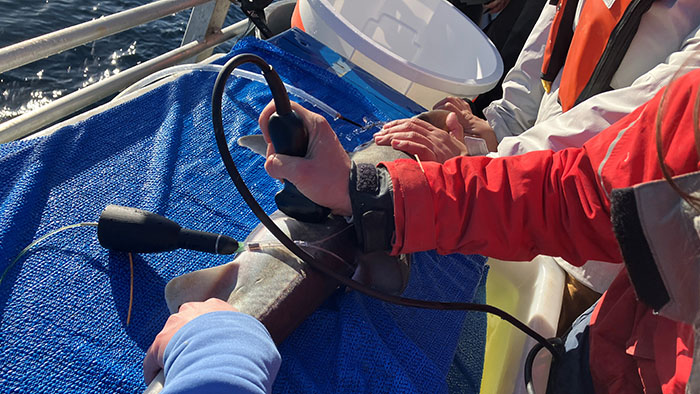
In the past, studies have estimated the age of a dogfish by assessing its vertebrae, she said, which develop rings like a tree trunk as the fish grows. By cutting a vertebra, researchers can count the annual rings and estimate an age.
This year, Hillier is confirming these estimates by marking the spines, releasing the dogfish back into the wild and recapturing them, and then seeing where the mark moves as the fish ages.
In the dogfish world, the “spine” refers to the two sharp, venomous, thornlike spines at the front of each dorsal fin — separate from the vertebrae. These spines protrude on the outside of the shark, defending them against predators.
“We are trying to get a more information to really hone in on how old these animals are,” she said. “We think we have a good idea, but the science is a test and retest to make sure that what you assume is accurate.”
Hillier then compares the rings on the vertebrae to the marks on the spine to see if they correlate.
“This is more of a modeling technique to model what’s going on with the vertebrae and modeling what’s going on with the spine as they’re associated with each other,” she said.
Comparing data
Meanwhile, the Northwest Fisheries Science Center in Alaska is working on a third method to confirm the ages of the sharks — through their eyes.
This research began with Pacific sleeper sharks, large deep-water sharks found commonly in Alaska and rarely in the Salish Sea. While sleeper sharks don’t have spines like dogfish, researchers can glean similar aging information by radiocarbon dating the protein from their eye lenses. In Alaska, NOAA researchers are replicating this work with dogfish.
“It’s a little bit different than the work that we’re doing with the vertebrae and the spines here at WDFW,” Hillier said, “but it’s all going to come hopefully together to help validate in several ways with the eyeballs, with the spines and with the vertebrae.”
Off the Oregon coast, Oregon State University research associate Alexandra McInturf has 13 more satellite tags to deploy to study dogfish migration patterns. Her main goal is reducing bycatch.
While the Puget Sound stock of dogfish is managed by a separate entity, it remains to be seen if they are actually distinct populations or the same ones migrating along the coast.
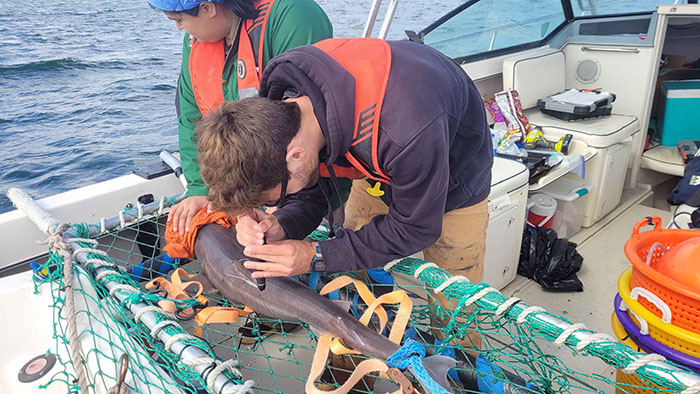
Dogfish are accidentally caught by commercial fishers at a higher rate than other sharks because they school, McInturf said. Surveys only occur in a single season, so they fail to provide a comprehensive look at the population.
By satellite tagging, McInturf can track large-scale movements throughout the year.
Unlike the acoustic tags applied to sevengill sharks in Puget Sound this summer — which emit signals to underwater receivers — satellite tags transmit to a satellite when the dogfish nears the surface. This allows scientists to see data for thousands of miles, without range limits.
While acoustic tags are inserted surgically, satellite tags are often put on the dorsal fin outside of the shark, McInturf said. This data will tell her which environmental conditions they occupy.
She already has more than 50 sharks tagged, she said.
Aging and migration research may seem distinct, but “one day it could all come together beautifully,” Hillier said. Filling in these gaps about where they go and when, and some of the factors that contribute to their mortality, can give an all-encompassing view of the dogfish life cycle.
Dogfish have been left in the dark for a lot of research so far because they aren’t highly sought after like a salmon, Hillier said. Lack of demand means lack of research funding.
Also, because the spines wear and break as dogfish age, getting a proper reading isn’t as easy as it is with fish with harder bone structures.
“Because sharks don’t have bones, the spine on spiny dogfish is the best proxy that we have for that,” she said. This is why the cross-referencing work with vertebrae, spines and eyeballs is so important.
Hillier hopes to publish her research next year. McInturf’s deadline is January 2027, with both projects aiming to inform the 2027 stock assessment.
— By Sam Fletcher
Also read in Salish Current:
• “Tagging nearly complete on most-elusive Salish sharks,” July 15, 2025