
Commentary: Legal drugs target kids at gas stations and corner convenience stores.
Ed.: The essays, analyses and opinions presented as Community Voices express the perspectives of their authors on topics of interest and importance to the community, and are not intended to reflect perspectives on behalf of Salish Current.

If you’ve recently stopped at a gas station or convenience store, you’ve probably noticed just how much is packed into those small shelves. Generally, we don’t have time to contemplate a product unless it’s something we already came in for.
But recently I took some time to really look at the signs outside my local convenience stores up and down Northwest Avenue. I saw advertisements for sweet candy and fruit flavored vape/e-cigarette juice, space gas, and Kratom — all legal drugs sold at local stores.
These products seem to have a handful of things in common: they’re easy to get, cheap, taste good, come in eye-catching packaging, and produce some form of a high for consumers. These qualities make them especially appealing to young people — and that is not an accident. They are purposely targeting youth.
Vaping has been on the radar of parents in Washington for some time now. Learning from the success of the tobacco-free campaigns of the late ’90s and early ’00s, Washington state has fiercely opposed vaping products. The state has sued and taxed companies, and legislated to make it harder for kids to purchase vape products. However, local authorities lack the ability to act locally because the tobacco industry has used state preemption laws for years as a way to take power away from local communities and shift it to state governments — where their lobbyists have more sway.
There is much work to be done. According to the advocacy group, Flavors Hook Kids: Washington “over 1.6 million kids use e-cigarettes, and the vast majority of them say flavors are the reason they do it.” Washington legislators proposed to ban flavored tobacco products with House Bill 1203, but it did not make it out of committee this year. State legislators did pass Senate Bill 5814, to increase taxes on Zyn nicotine pouches and other nicotine products, but our local government cannot protect our children and/or increase local tax revenue because of preemption laws. Preemption is a policy choice and in Washington state, it can be changed. State lawmakers have the power to restore local control.
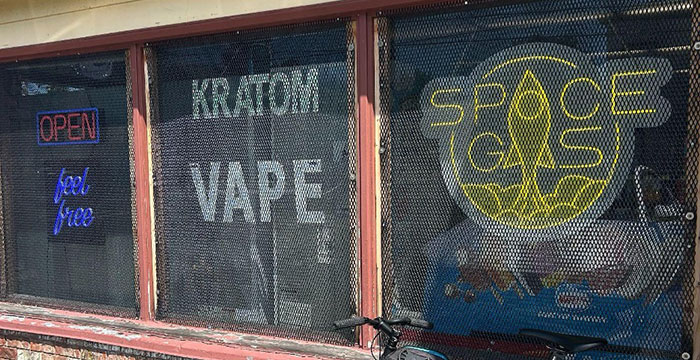
Kratom is a plant-based substance that can act like a stimulant or have opioid-like effects. It’s still legal and easy to find in a lot of places like tobacco stores, glass shops, and convenience stores. The FDA hasn’t approved it for any medical use, but some people say they use it to deal with opioid withdrawal, manage pain or fatigue, or help with mental health struggles.
The Washington State Pharmacy Quality Assurance Commission considered a rule change that would classify some forms of kratom and its active compounds as Schedule I substances. Schedule 1 drugs are controlled substances that have a high potential for misuse or abuse. This review failed to move forward and has ended with no rules put in place on the sales and use of this supplement. Supporters insist the supplements meet a real community demand. Critics say the problem isn’t the plant itself, but the synthetic versions — far more potent and far easier to abuse.
Space Gas and Galaxy Gas are new names for a product also known as Whip-its. These are brand names and slang names for nitrous oxide or laughing gas. Nitrous oxide has very legitimate use in dentistry and in the culinary markets. But inhaling nitrous oxide can cause effects like lightheadedness and euphoria within seconds. The high is short-lived — usually just a few minutes — so people often take multiple hits in a row to keep the feeling going. The company that makes Space Gas advertises the product for whipped cream canisters. But it is often sold with balloons and marketed using tactics meant to attract the youth market.
There are short- and long-term effects of abusing nitrous oxide: lack of oxygen can lead to loss of motor control, hypoxia, neurological issues, and even death. The one limiting factor has been the small canisters used to dispense the gas. But this too is changing. Recent reports show increase in sales and use of larger canisters. These are sold in 10-pound to 20-pound containers — compared to the 8-gram cream canisters. Large containers increase the risk of adverse health effects and death. Between 2019 and 2023, deaths in the U.S. linked to nitrous oxide abuse more than doubled, and over a five-year span, related emergency room visits increased as well. (There are 453 grams in one pound. A 10-pound canister of gas is equal to 566 cream canisters.)
It’s time to act.
The marketing of nitrous oxide — and other legal drugs — is most visible in lower-income neighborhoods and often where immigrant, Black, Asian, and Hispanic children are disproportionately exposed. We need locally originated, common-sense measures — like taxing retail sales, restricting access to large size canisters, and regulating marketing tactics — to reduce harm and prevent predatory marketing in communities already facing systemic health disparities.
Let’s put public health and safety first and prioritize it in our local government. Urge your state legislators to take action during the 2026 legislative session.
— By Leah Wainman
• • •
We welcome letters to the editor responding to or amplifying subjects addressed in Community Voices. If you wish to contribute to Community Voices, please send an email with a subject proposal to Executive Editor Mike Sato and he will respond with guidelines.
Help keep the local news flowing — support nonpartisan, fact-based, no-paywall local journalism
with a donation to Salish Current — news for people, not for profit.