
How a local tragedy spawned a national public interest watchdog group.
Updated May 22, 2026
Remember this number: 3.3 million. That’s the total length of oil, gas and hazardous materials pipelines crisscrossing the United States, a figure greater than the length of paved roads in the country. On average, one of those pipelines has an incident every day, sometimes resulting in injury or death. Now remember this figure: One. That’s the number of nongovernmental watchdog groups in the U.S. dedicated to improving the safety of all that pipe, and it’s located on Bellingham’s Cornwall Avenue, in a nondescript building tucked between an antiques store and a bird feed purveyor.
At the entrance to the offices of the Pipeline Safety Trust stands a plastic reptilian monster towering over a small, wide-eyed figurine of a fawn. The diorama is an inside joke among the organization’s staff, who like to say that their efforts to monitor and improve the safety of the nation’s spaghetti-like network of pipelines resembles a faceoff between Bambi and Godzilla. The oil and gas industry is, infamously, one of the largest, wealthiest and most powerful economic forces in human history. And Pipeline Safety Trust? It’s a 10-person outfit with an annual budget of about $1.4 million.
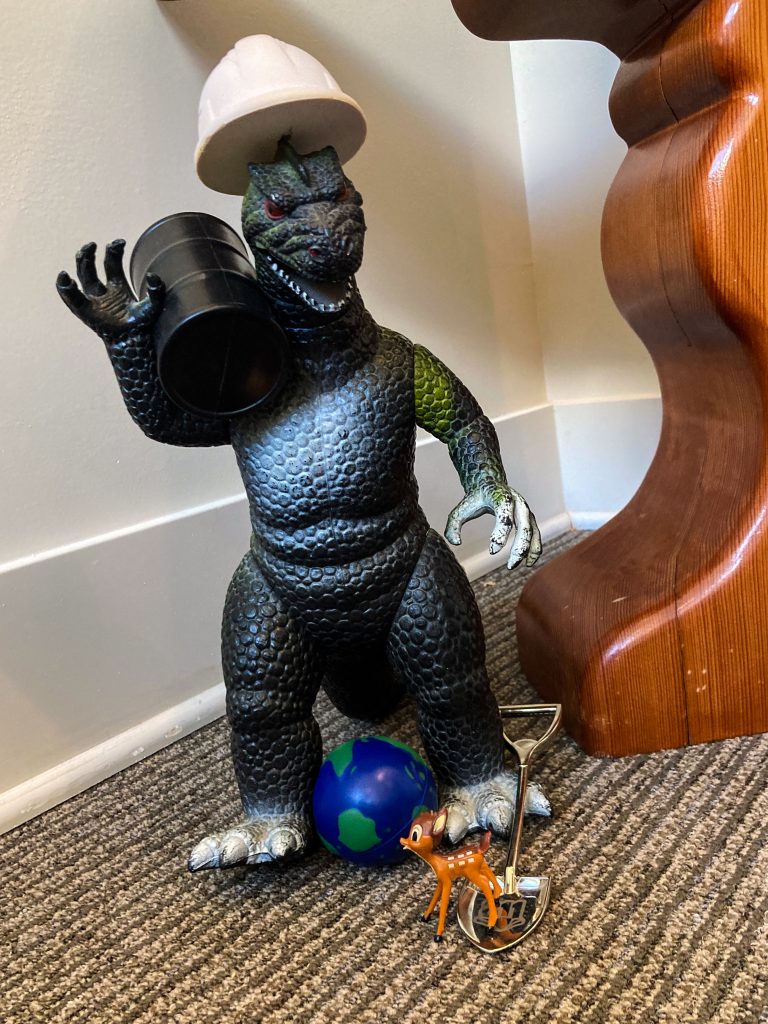
“We advocate for protecting the public from the risks posed by oil and gas pipelines, and we do that by encouraging public engagement, educating the public and fighting for stronger laws and regulations,” said Bill Caram, PST’s executive director. “When it comes to pipelines, the public engagement process is the problem, the trust is broken.”
Longtime Bellingham residents know about this broken trust better than many other communities in the country. Evidence of that broken trust is visible in the very middle of the city, at Whatcom Falls Park, the site of the tragedy that led to the creation of the Pipeline Safety Trust.
On the afternoon of June 10, 1999, an underground pipeline that was carrying gasoline from Ferndale to Olympia ruptured in the park. For several hours, the leak spewed as much as 7,000 gallons of gasoline per minute into the creek until, at around 5 p.m., the gas and its vapors exploded in a vast fireball. The gasoline was likely accidentally by two boys, Wade King and Stephen Tsiorvas, who were playing at the creek edge. Both died, as did a local teenager, Liam Wood, who was fishing downstream. The explosion ripped through the park and sent a satanic cloud of black smoke billowing above the city.
Carl Weimer remembers it all too well. At the time, he was the executive director of RE Sources, and on the afternoon of the explosion he was at the organization’s ReStore, which was then located right on the creek, where it passes beneath State Street.
“A customer came running in and said, ‘Downtown Bellingham just blew up,’” Weimer recalled. “So we rushed around, got everybody out of the store, evacuated, locked things up and headed out of the town.”
Driving back to his home in Ferndale, Weimer could see the smoke cloud in his rearview mirror. It was so frightening that he had to pull the car to the side of the road. “My legs had gone wobbly on me,” he said.
That likely could’ve been the end of this story — many industrial accidents, after all, leave no trace on the world except for the scars of the victims. But just days after the Olympic Pipeline explosion, Weimer got together with a group of local environmentalists, neighborhood advocates and lawyers at Old Town Cafe to discuss what to do next. The pipeline operators were demanding that the conduit be immediately be put back in operation to supply jet fuel to Sea-Tac. Weimer and others felt the line should stay closed to force some accountability for the accident, as a way of preventing similar accidents in the future. The ad-hoc group decided to form an organization called Safe Bellingham, the precursor to PST, that would agitate for justice and stronger pipeline standards.
“Why did the citizens of Bellingham stand up and push back?” asked Weimer, who was PST’s executive director until 2020. He points to worse tragedies that have occurred—like a 2010 gas explosion in San Bruno, California, that killed eight people and leveled dozens of houses—but have not sparked similar community organizing. “I think Bellingham is more of an activist community. But maybe it was just luck that some of us radicals got together and decided this wasn’t going to stand.”
Safe Bellingham succeeded in getting legislators in Olympia to strengthen Washington’s pipeline regulations and played a crucial role in convincing Congress to approve the Pipeline Safety Improvement Act, which did the same at the federal level while also providing new protections for whistleblowers. Ultimately, the Olympic Pipeline operators paid a total of $187 million to settle the criminal and civil cases against it, and two executives were sentenced to jail time. A judge ordered a small portion of that, $4 million, set aside to establish the Pipeline Safety Trust.
In the decades since PST was founded, the challenges of its mission have grown more complex. The number of pipelines subject to federal oversight has more than doubled—largely a consequence of methane-gas fracking and the shale boom, which has made the United States the global leader in gas production. The country has also seen an increase in pipelines carrying carbon dioxide—which can be used to wring the last dregs from aging oil wells or to sequester carbon pollution as a climate strategy—a relatively new development that has sparked community opposition nationwide. The potential risks of CO2 pipelines were illustrated by a 2020 pipeline leak in Satartia, Mississippi, that sent 45 people to the hospital. “We may not see a lot of CO2 pipelines built for carbon capture and storage, but we’re probably going to see a lot built for enhanced oil recovery,” said Caram. “So that’s not going away.”
In recent years, PST has experienced a growth spurt. For most of its existence, the organization’s staff was a scant two or three full-time employee —what the group could afford from the annual income off its original $4 million fund. The organization has long struggled with fundraising, since the types of environmental funders who would naturally be drawn to its work are more interested in ramping down oil and gas infrastructure than in making it safer.
“Funders are like, ‘You guys are great, but we have this box of what we fund, and you don’t fit,” Caram said. “The funders are focused on decarbonization, and we are just really focused on the pipelines that are already here and making sure they don’t blow up.”
PST got a big break in 2020, when U.S. Sen. Maria Cantwell, a Democrat, helped the organization secure federal funds for its work. “Cantwell’s staff was like, ‘This is so unfair,’” Caram remembers of the conversations that led to the group’s federal appropriations. “The other side has got these hundreds and hundreds of high-paid oil and gas attorneys that are just throwing everything into the woodchipper, and we’re relying on this tiny organization in Bellingham with two employees.”
In that year’s regular appropriations for the Department of Transportation’s Pipeline and Hazardous Materials Safety Administration or PHMSA, Cantwell included a roughly $1 million line item that allowed PST to quintuple its staff size. When the Trump administration sought to eliminate PST’s funding in early 2025, Senator Cantwell and Rep. Rick Larsen, the Democrat who represents Bellingham in the House, fought to preserve the funding.
“The need for PST’s work is greater than ever—2023 and 2024 were the deadliest two years due to pipeline accidents in more than a decade,” the elected officials wrote to the administration. “PST is the only national education and advocacy organization in the country dedicated to advancing all aspects of pipeline safety and protecting the public.” The Trump administration backed down, and PST’s federal funding was preserved.
With more resources and staff, PST has been able to expand its work. While a federal policy adviser keeps an eye on happenings in the nation’s capital, a state policy staffer works in statehouses across the country to develop and pass state legislation to raise pipeline standards. Every year, PST puts on a conference in New Orleans that includes community groups, tribal nations, environmental and public safety organizations, and representatives from the oil, gas and chemical industries.
There have been some important victories over the years. Thanks to the work of PST, excess flow valves are required on every gas distribution line. PST worked with federal officials to establish stronger rules for CO2 pipelines—though those standards were revoked by the Trump administration in 2025. And the organization played a role in expanding a program in New York City under which the local utility, ConEdison, has put methane detectors into millions of properties to prevent gas explosions. PST is now working to pilot similar programs in communities nationwide.
“I can say that lives have been saved because of the Pipeline Safety Trust,” Caram said.
Along the way, PST has earned a glowing reputation among the grassroots groups it partners with. “Those guys are fantastic,” said Cynthia Robertson, founder of Micah 6:8 Mission, a community organization in Sulphur, Louisiana. The town sits in the heart of Louisiana’s industrial corridor and, according to Robertson, is surrounded by 17 oil and gas or petrochemical facilities. “You can hardly drive a block without going over a pipeline,” she said.
Robertson said the state regulators there are worthless, and that federal regulators at PHMSA often move slowly. “The agencies don’t give us any information,” she said. “They don’t say, ‘Here’s how you find out where the pipelines are and here’s what you do if something happens.’ Nobody wants to tell us stuff like that, but Pipeline Safety Trust does.”
Caram says the organization’s ultimate goal is to reach zero pipeline incidents. He recognizes what a bold aspiration that is. The nation’s lattice of pipelines is aging, making accidents more likely. And the primary federal watchdog, PHMSA, has long had a cozy relationship with the industry it’s supposed to regulate; even President Obama’s pick to head the agency was a former ExxonMobil attorney.
But Caram insists it’s an ambition worth pursuing. “There are people who think that’s impossible, that it’s an aspirational goal, but it is possible. It’s not like something you achieve and then it’s done. It takes vigilance. We saw it with the airline industry, where there was a long stretch with zero accidents.”
Even as PST has grown into an organization with a national outlook and a nationwide mission, its work all comes back to Bellingham and that awful day in June 1999. Skip Williams, the stepfather of Stephen Tsiorvas who died in the fire, formerly sat on the organization’s board. Caram’s office is appointed with reminders of the Olympic Pipeline disaster: a special edition of the WWU student publication The Planet covering the explosion and a photo of the soot-black cloud of smoke rising, tsunami-like, above an average Bellingham neighborhood.
“Whenever we are at a question of, ‘Is this within our mission or not?’ I really just think about the families (who lost loved ones in the fire),” he said. “There’s more to do, but it really all comes back to those families. That’s our moral bedrock. That’s what guides the work that we do.”
—By Jason Dove Mark