
Intertribal Canoe Journey connects Indigenous people to an ancient lifeway — and calls the diaspora home
The Samish Nation canoe Eshas cut through the calm waters of Fidalgo Bay on July 25 en route to the shores of the Swinomish Indian Tribal Community.
Emma Kortuem and her fellow pullers made each paddle stroke in time to a travel song sung by the skipper. Kortuem grew up in Southern California separated by distance from her Samish heritage, and now here she was on her ancestral waters, traveling the way of her ancestors and reconnecting to her heritage in a deeply meaningful way.
“I think the part that connects me the most is spending time with relatives and knowing that the strength in our relationships is what our ancestors wanted for us,” Kortuem said. “They wanted us to feel strong in our identity and in our relationships with our family members and to continue these sorts of practices.”
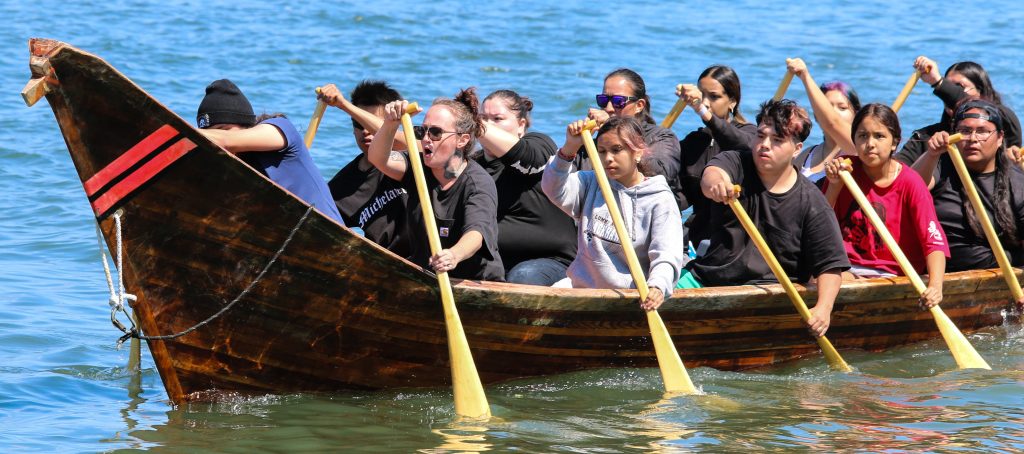
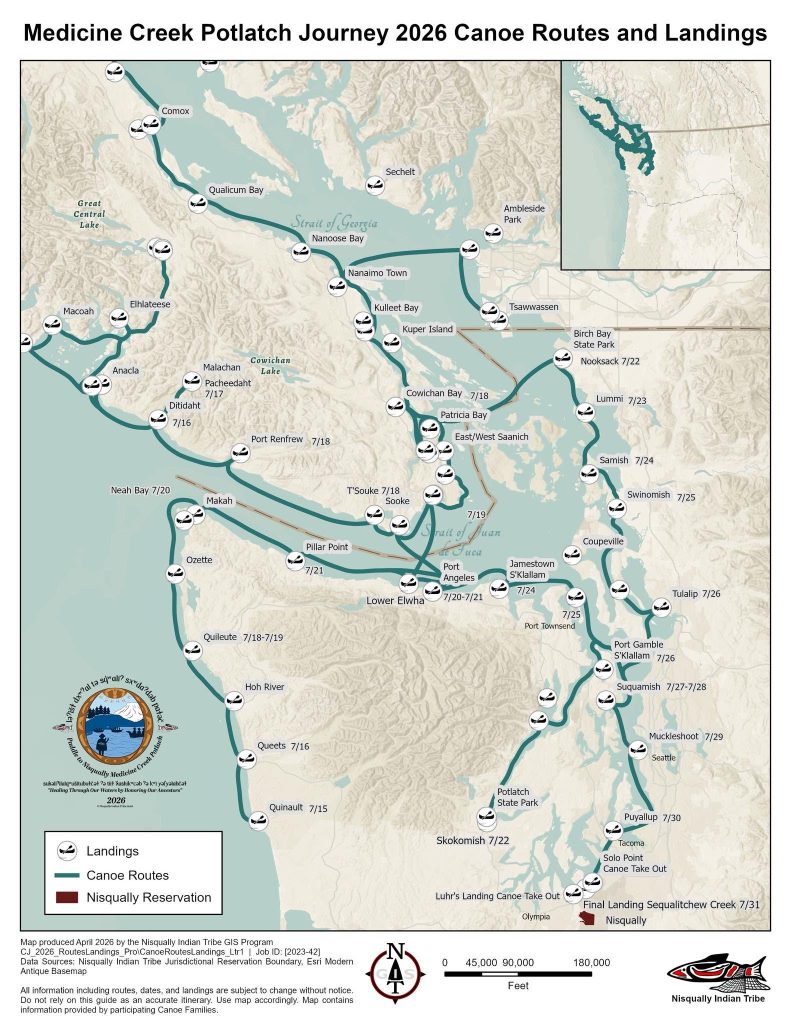
This is the annual Intertribal Canoe Journey, a gathering of Indigenous peoples from the Pacific Northwest. This year’s event concluded Aug. 5 on the homelands of the Nisqually Tribe, in southern Puget Sound near Olympia. More than 100 canoes landed on Nisqually shores on July 31 for a weeklong cultural celebration.
The journey was marked by the news that Nisqually’s chair, Ellery “Ken” Choke, passed away Aug. 4. His family was given privacy and lifted up in prayer. And the journey continued on.
“Ken was happy to know that all of the Canoe Families had arrived safely and that protocol had begun and has been progressing as we worked so hard to plan,” Vice Chair Cheebo Frazier said in a statement released by the tribal office. “Although we miss him dearly and remain committed to honoring the loss of our loved one, we are working to finish the work of the Canoe Journey as hosts for the 2026 Paddle. This has only been possible through the generous help of all of you in attendance, holding us up and carrying us through. This was Ken’s way; to put community first and it has been an honor to help complete his work.”
This is the 32nd Canoe Journey since the first annual event in 1993. The event was sidelined in 2020 and 2021 by the COVID-19 pandemic. But it endured, like the participating Indigenous cultures that gather from Alaska, Washington, Oregon and British Columbia.
Indigenous leaders signed treaties in the 1850s ceding millions of acres of land to the federal government, but they didn’t cede their sovereignty nor their identity. Their descendants would fend off efforts of the federal government to assimilate them and extinguish their languages and lifeways.
The event has been a powerful force for cultural renewal.
“Canoe Journey brings everyone closer together,” Kortuem said. “It’s a time where you can share stories and language and songs, and it’s an uninterrupted time together, and that just feels good to me. I hope (the ancestors) feel proud and can rest a little easier knowing that our language and our culture are going to carry on and our family’s still together.”
The Canoe Journey spawned from the 1989 Paddle to Seattle, which took place as part of Washington’s centennial celebration. Quinault Nation culture bearer Emmett Oliver, a retired Coast Guard officer and member of the state’s centennial commission, organized the Paddle to Seattle to ensure the First Peoples of the state were represented — Native history is Washington history, he said.
The event unleashed long-suppressed cultural practices, among them canoe carving, gifting ceremonies, regalia making and language. The first Canoe Journey took place four years later.
A different Indigenous nation hosts each year’s Canoe Journey; the 2025 journey was hosted by the Lower Elwha Klallam Tribe on the Olympic Peninsula. Canoe families travel to the final destination — some over great distances — stopping at Indigenous territories along the way.
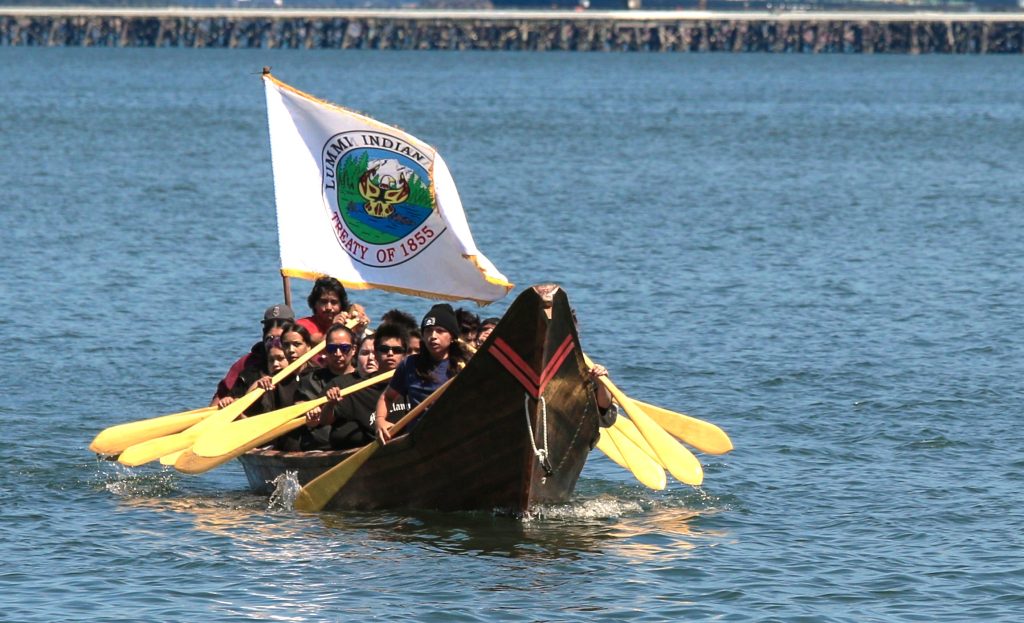
Canoes, some of them carved of cedar and bearing names and artistry unique to their nations, arrive preceded by pullers’ singing that can be heard as the canoes come into view. When each canoe arrives, the skipper stands and asks in his or her language for permission to come ashore. The host nation provides meals and other necessities, and the evening is followed by traditional foods, songs, dances and gifting. Many participants wear traditional clothing items woven of cedar and featuring elaborate beadwork.
Doug Chilton, a noted Tlingit artist who leads the One People Canoe Society from Alaska, told of the positive effect of the Canoe Journey on young people and their sense of identity. He was an invited guest to the Canoe Journey in 2000 and saw a girl, about 6 years old and dressed in traditional clothing — commonly called regalia — walk onto the stage and toward the microphone stand.
“I thought, ‘Oh boy, somebody’s baby girl is gonna get in trouble,’” he recalled. The girl then took the microphone. “She introduced her canoe family in their Indigenous language, and then she started drumming and singing and her canoe family danced in. I’m telling you, when I saw it — it still gives me chills to this day. I looked at my son and I said, ‘This is what we need back in Alaska.’ So from that moment on, we started pushing to build (participation) in Alaska, and it’s now grown enough to take it on a life of its own.”
Chilton now has two canoes and up to 100 people participating as pullers and support crew.
“We have been traveling for 26 years, traveling all around Southeast Alaska and up into interior Alaska, doing workshops and educating them on the Journey and the way of the water, and working with displaced Alaskans all the way from Washington to California, to bring the next generation forward. I was one of the skippers 26 years ago and now I’m on the beach, and the generation that I taught is on the safety boat, and the third generation is in the canoes.”
Calling the displaced home
The Canoe Journey has also been a call home for the Indigenous diaspora — those who moved to find work, those who were relocated by government policy, those who were born away from the ancestral lands.
Chilton told of an Alaska Native woman in her late ‘70s who had heard Chilton had a canoe in the Journey. The woman lived in California.
“When she was a young girl, her dad was in the military, and they had to move away. So she had never been back to Alaska,” Chilton said. “She had started making her regalia that year, but after she moved, she put it away and she never touched it again. When she found out we had a canoe in the Journey, she and her husband drove up from California, and she finished it on the way up. When she showed up, she had it on and she walked over and introduced herself and she told me the story and she danced with us. She traveled with us for a couple of Journeys in a row and then one year she didn’t show up. We questioned why and learned she had passed. But she got to reconnect home.”
Chilton added, “The Canoe Journey is not just for the next generation or the generation after that. It’s also for the ones ahead of us that got disconnected. We’ve been reconnecting people from all over Alaska with who they are, introducing them to their families, introducing them to their culture, and it’s growing like wildfire up there.”
This Canoe Journey was the first for SoloWomon, whose name is a take on her surname, Solomon. She is Lummi and a student at Northwest Indian College. She’s found that pulling in a canoe is a lot like life, and you’ve got to have discipline and endurance to ride out the rough seas.
“The canoe family I came here with broke up. So that has been a challenge and a heartbreak and a disappointment,” she said. Then, another canoe family invited her to join them.
“I’m trying to focus more on the positives than the negatives,” she said. “I mean, these kind people took me in and that’s been a really awesome experience.” She danced at a coastal jam the night before in the longhouse at Swinomish. “That was really healing,” she said.
The 2026 Canoe Journey coincides with several significant benchmarks for Kortuem. Her 30th birthday is this year, as is Samish’s 30th anniversary of its re-recognition by the United States. She is a member of the Samish Nation’s Cultural Committee. And she is executive assistant of the Coast Salish Youth Coalition. She has traveled in the coalition’s canoe in the San Juan Islands and in the waters around Cypress and Guemes islands.
“In certain spots, I would feel that connection more,” she said. “Like, I know that my ancestors were here. They were tending this prairie. They were fishing in these waters. I get chills when I think about it sometimes. On Cypress Island, I really felt that presence, especially knowing that my great-grandma was born there.”
She added, “Knowing that my great-grandma, my grandfather and my aunt served on the council, I’m feeling like it’s my responsibility to carry it forward so that my kids are the next generation that are going to be involved in their culture. It moves me forward, for sure.”
—By Richard Arlin Walker