
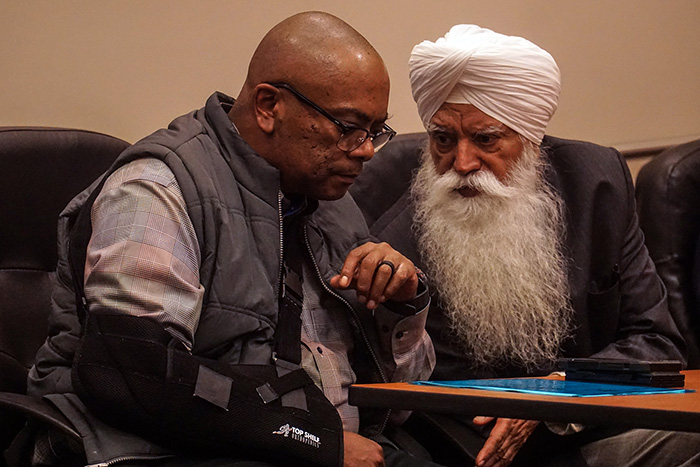
Community members shared opinions at a community engagement session in Lynden on March 19.
Whatcom County Deputy Executive Kayla Schott-Bresler told attendees at a Lynden community engagement session for the Justice Project last week that the county’s capacity needs assessment for a new jail will be delivered within two weeks.
The conversation was a bit of tug-of-war between behavioral health services and jail capacity. The ballot initiative passed in 2023 promised 50% of tax funds would go to each.
“There’s certainly tension around the budget, because every dollar we invest in this jail is a dollar we’re not investing into the community and community-based services,” Schott-Bresler said.
The conversation will continue at a presentation by Salish Current and the Riveters Collective at the Squalicum Boathouse in Bellingham April 7 from 6-8 p.m. Keynote speaker Washington Supreme Court judge Raquel Montoya-Lewis will address Alternatives to Incarceration alongside a panel of community representatives.
In January, Whatcom County Sheriff Donnell Tanksley submitted a memo that the current jail is outdated and often overcrowded. It lacks sufficient rehabilitation and education programming, which has been identified as a critical need for the county. He proposed 650 beds for the new jail, of which 540 would be the main beds used with a 20% buffer for expansion and programming.
“What we have here is I think from everyone the will to build a jail, the will to bring rehabilitative programs; we have the will to reintegrate people back into society. What we have is a lack of money, and where we land, I’m not sure,” he said.
The county secured $11.2 million from a state grant for an out-of-custody behavioral health facility and has applied for federal grants alongside local and Justice Project funding. The goal is to break ground on the new campus next year and for the facility to be operational before the new jail is complete.
An initial interlocal agreement outlined a $155 million budget for the new jail, with a commitment from cities to contribute 75% of their sales tax for four to six years.
Since these initial projections, construction costs have risen while tax revenue has stagnated. Sales tax receipts in 2025 were down 9% from 2023 projections, Schott-Bresler said.
Now, Tanksley is defending 480 beds for the new facility because of budget restrictions.
Julie Jansen, a Bellingham resident, said at the Lynden session that the discussion is too focused on criminals and not enough on victims.
“I have recently been a victim of a violent crime,” she said. “He was a 19-time offender. He had four knives, a gun, multiple other weapons, and Whatcom County saw fit to plea him down to felony harassment, let him out after 27 days. He is now back in the homeless encampment that is in my area. I have a 1,000-foot protective order, which is really great and makes me sleep really good at night. I hear a lot about what the incarcerated need. I do not hear a whole lot about what the public safety features are. I would like to hear what the victims need.”
Several studies have shown that incarceration rate has little effect on public safety. Stephanie Moore, a Bellingham resident, urged the county to uphold the 2023 ballot initiative.
“We were promised this 50-50 split that funds will go to behavioral health care,” she said. “That’s why so many people voted for it, and we can’t not do that. That’s what was promised, and that is the kind of thing that erodes trust in government.”
Tanksley said the number of beds is not a compromise to the services provided, and the county should provide both as promised.
Lyle Sorenson of Bellingham repeated that both Tanksley and other public officials have stated that 480 beds is not enough for the growing community.
“I hear a lot of ‘we can’t afford to.’ What I would say is we can’t afford not to,” he said. “The cost to community and to public safety is too high to not build a right-sized facility.”
Jeff Hindman, a recently retired corrections deputy for Whatcom County jail, also focused on public safety.
“There’s a lot of people that don’t deserve to be on the streets no matter how nice you want to be to them,” he said. “You’ve got truly evil people in jail.”
For Tanksley, it’s not a matter of what the county will deliver, but a matter of cost.
“If you don’t build it to where you can expand, if you don’t build it to where you have all those different services that I mentioned, we don’t build it to where we have opportunities for job growth, we don’t have opportunities for financial literacy and all those different things, building the jail is a failure,” he said. “We need it all. The question is how do we pay for it?”
— By Sam Fletcher

Also read in Salish Current:
• “Commentary: Whatcom County jail is on the wrong path,” Feb. 17, 2026
• “How big should Whatcom County’s new jail be? Part 2,” Feb. 11, 2026
• “How big should Whatcom County’s new jail be? Part 1,” Feb. 10, 2026
• “New Whatcom County jail could face decreased funding,” May 27, 2025
• “Jail needs to change, community agrees; but how?,” Jan. 3, 2023