
WTA service changes have started ahead of September fare increase
This summer, Whatcom Transportation Authority implemented its 2026 service changes, aiming to simplify routes, improve reliability and better match service to actual demand.
The most significant changes center on routes serving Western Washington University. Previously, the Blue Line consisted of six overlapping routes that funneled through campus, often creating confusion and inefficiency. Now, Route 190 serves as the main backbone, running every 15 minutes through campus, with reduced frequency during low-demand summer months.
New routes 97 and 98, dubbed the Campus Circulator, will help handle peak demand during the school year while providing a simpler, more consistent connection from Bill McDonald Parkway at Samish Way to Billy Frank Jr. Street at Holly Street.
Western students make up a substantial share of WTA’s ridership — about 40% of all rides, according to Andrea Reiter, Western’s associate director of active transportation. Transit use to and from campus also exceeds personal vehicle trips, with Western ridership on WTA more than 10 times the number of vehicles traveling to and from campus.
“As you can imagine, we heavily rely on WTA’s expertise for moving our community around,” Reiter said. “The new service changes will help more off-campus students get to and from campus easily by riding the bus.”
WTA also introduced three new routes — 5, 6 and 7 — that largely replaced the old overlapping campus routes, along with new timed transfer points at key locations.
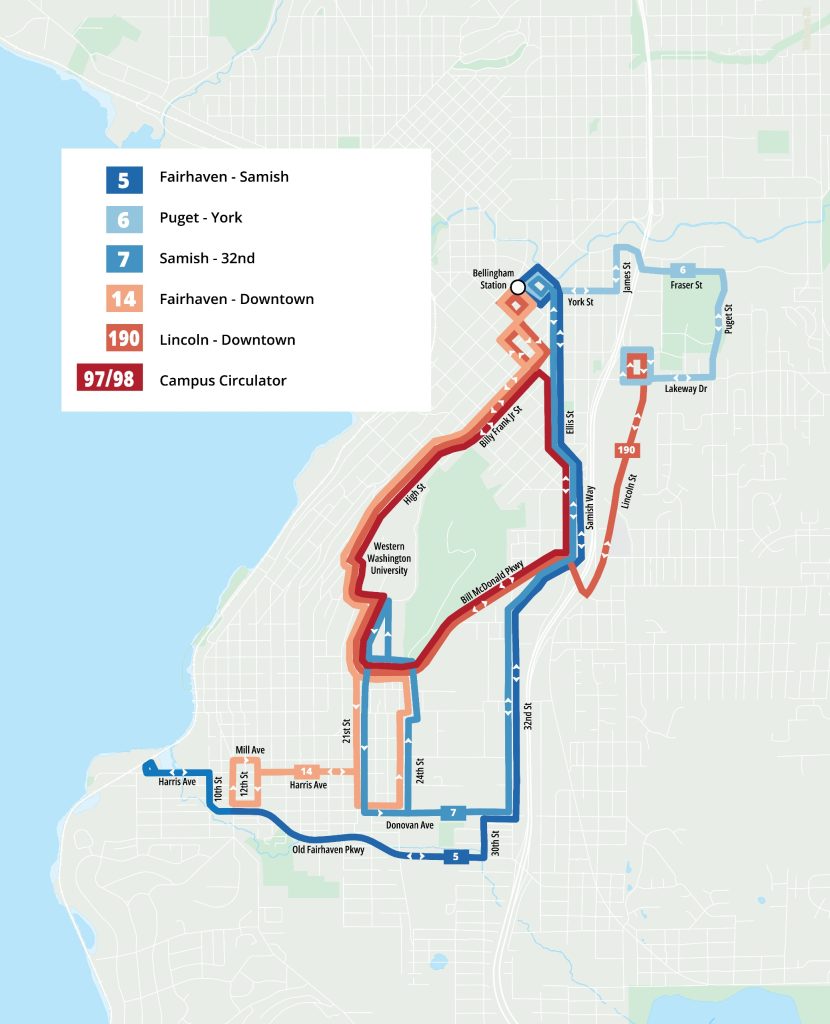
Route 5 replaces Route 105 and provides a more direct connection between downtown and Fairhaven via Samish Way, with transfers to Route 190 at Bill McDonald Parkway and Samish Way.
Route 6 connects the Puget and York neighborhoods to downtown, cutting out the portions of routes 196 and 197 that served Western’s campus. Transfers to Route 190 occur at Bellingham Station.
Route 7 offers a new service to south campus and Happy Valley, replacing parts of routes 107 and 108, as well as some shuttles, with transfers to Route 190 at Western’s Rec Center bus stop.
Minor adjustments were also made to Route 14, reducing frequency from two buses per hour to one, with Route 14S providing additional service.
While Western is optimistic about the changes, WTA officials say it is still too early to fully evaluate the success of the service changes. WTA planning director Tim Wilder noted that the real test comes in September, when fall quarter begins at Western and ridership spikes.
Reiter expects that returning students will face a learning curve with the new system. However, she said many students who live in nearby neighborhoods, such as Happy Valley or along Samish Way, will benefit from improved access to WTA routes, making their bus commutes easier.
Kea Lani Diamond, a Western student who lives in Happy Valley, expressed concern that the new routes serving the neighborhood could become overcrowded once fall quarter begins
“I don’t think they will (help),” she said. “I’m kind of worried that the Happy Valley routes are going to be more crowded.”
Though it’s still early to judge the redesign, other students have begun noticing how the changes affect their daily commutes. Matteo Nocco, a Western student, described one of the noticeable changes on Route 7.
“The 7 used to go straight past Birnam Wood, but now it does the whole loop down around (Happy Valley),” Nocco said. “That adds a couple of minutes, but it’s not that bad.”
Keilahni Pelton, another Western student who usually takes Routes 190 and 14, said the new system has been “about the same” for them so far. Pelton noted that the old Routes 196 and 197 that went through Western were replaced as part of the simplification effort. They also pointed out that only Route 190 now serves Birnam Wood, an off-campus student housing area where they plan on living next quarter.
These service changes come as WTA plans to increase bus fares on fixed routes from $1 to $2 in September. In April, Western secured a one-year extension on its deal with WTA that provides students with a universal bus pass, largely shielding them from the price increase. The agreement runs through September 2027.
“As we work with WTA, we will keep in mind both parties’ needs for affordability,” Reiter said. “Western wants a low price so we do not need to raise the fees for students too much, while WTA has increasing expenses running their current level of service in our community.”
WTA’s service changes are also part of a growing regional trend to improve transit efficiency. Skagit Transit recently approved its 2026-2031 Transit Development Plan, which similarly emphasizes route simplification, frequency improvements on key routes and better alignment with ridership demands.
“Skagit Transit is reviewing options that would simplify routes, which will hopefully allow us to focus resources on frequency improvements, similar to what WTA is doing,” said Maleah Kuzminsky, Skagit Transit’s planning and outreach manager.
Reiter added that the new routing is already generating positive feedback from nonstudent commuters.
“What I have heard from the community is excitement about being able to ride a bus that doesn’t go through Western’s campus,” Reiter said.
This sentiment echoes language on WTA’s own service changes page, which noted that under the old system, “Riders whose destination is somewhere other than the campus are forced to travel through campus on buses, which at times are standing room only.”
As fall quarter approaches and ridership increases, WTA and Western will be watching to see how the new systems perform. For now, summer has offered a test run, with the real test still to come.
—By Bodey Mitchell