
Community, commissioners disagree about best use for sprawling real estate holdings
The Port of Bellingham, Washington’s second biggest port by acreage next to the Port of Tacoma, will soon be stepping up its cargo traffic as well.
A new rail line — which will connect the Bellingham Shipping Terminal, or BST, to the BNSF line within three years — is expected to mean a stronger regional supply chain, a reduced environmental impact from trucking, increased cargo traffic and longer operation hours.
According to Port commissioner Ken Bell, the shipping terminal modernization also means a “WT(F) moment” for the surrounding neighborhoods like Fairhaven and South Hill.
Because the shipping terminal had no activity on it for 20 years, he said, the impacts of the Georgia Pacific site cleanup and new industrial activity have led to disgruntled neighbors over legal battles with Harcourt Developments, terminating a deal with ABC Recycling over failing to meet environmental standards and rejecting earlier community-driven waterfront plans.
“Admittedly the Port did a horrific job of trying to communicate how that was going to roll out, what that was going to look like and what that process was going to be,” Bell said at a recent Bellingham City Club meeting. “Having stumbled the first time, we are going to correct that going forward.”
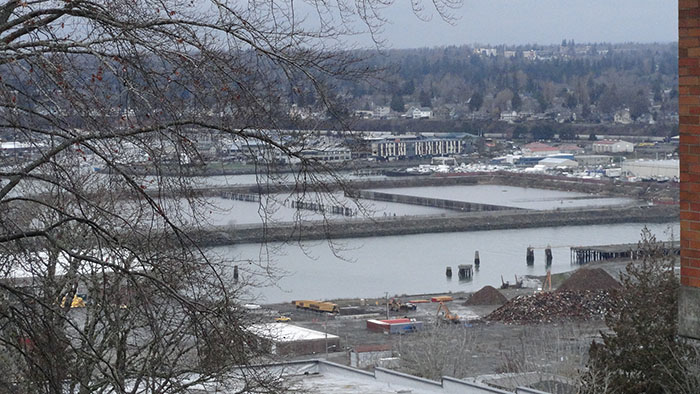
While the Port’s “working waterfront” is a key aspect of its existence, the organization’s Real Estate Division oversees a portfolio that includes a significant number of countywide properties that it owns, manages and develops. Some of these, such as the Marine Drive industrial complex and the Millworks affordable housing project, have brought disagreement of how the land could best serve the community.
Industry in Birchwood
The new industrial complex caught the attention of the Birchwood Neighborhood Association last month. Following the Port’s infrastructure investments, the industrial complex at 742 Marine Drive now supports advanced manufacturing businesses such as boat builders and allowed Signs Plus to expand operations.
According to Tyler Schroeder, the Port’s director of economic development, these investments help local businesses grow and expand. The Marine Drive industrial complex now supports 50 high-paying jobs, he said.
Leasing to low-impact industrial tenants is good news to surrounding neighborhoods like Birchwood, as most work occurs inside and there are limited noise, odor, pollution and traffic impacts, Schroeder said.
Part of the comprehensive plan update process with Bellingham, due in June, seeks to protect neighborhoods by ensuring these new developments are well-planned, sustainable and compatible with existing residential areas through zoning and environmental regulations.
The Port’s history breeds skepticism. According to Deborah Wessell of the Columbia neighborhood southeast of the industrial complex, the Port has a poor track record of taking neighborhood concerns into account.
“I’m hopeful that ‘low-impact’ tenants really will be low-impact,” she wrote in an email.
Housing or industry?
Schroeder said that business recruitment efforts in Whatcom County have been challenged by a lack of industrial land, and the Port is examining what infrastructure investments are needed and where rezoning can support sites so industries with high-paying jobs can choose Whatcom County over other communities.
While affordable housing has been an ongoing community concern, the Port’s foremost mission is economic development.

Bell said one of his pet peeves is subsidizing housing while fighting industrial activity on the waterfront. The Millworks Project, an 84-unit affordable housing complex on Port-provided land, is supported by public and nonprofit entities such as Mercy Housing Northwest, the Whatcom Community Foundation and the Washington State Housing Finance Commission.
“The way we subsidize housing is to give people a job,” he said.
A big port
The Port oversees 1,700 acres of real estate, spread across multiple areas of Whatcom County. In total, its properties encompass 1.4 million square feet of office, commercial and industrial building space, providing home to about 250 tenants. Port properties hold about 300 leases or other rental, license and permitting agreements.
“The Port of Bellingham has more shoreline than the Port of Seattle, because we go from Blaine at the border down to Fairhaven, so just inch-for-inch shoreline, the Port of Bellingham is a bigger port,” Bell said. “If I could drop the mic I could. That’s really the only point of pride we got.”
In Bellingham, Port-owned property includes Squalicum Harbor, the Marine Drive Industrial Park and the Bellwether on the Bay development. The latter includes a luxury hotel, restaurants, office space and a 1.6-acre public park.
In Fairhaven, the Port manages two marine terminals: the Bellingham Cruise Terminal, or BCT — home to the southern connection of the Alaska Marine Highway System — and the BST. These terminals brought in nearly $1.4 million in space and land rental revenue in 2024.
The latter, located at 625 Cornwall Avenue, serves as the primary industrial facility for moving bulk and non-bulk or “breakbulk” cargo in Whatcom County. It includes multiple warehouses and three operating piers with about 1,800 linear feet of space. BST is continuing power upgrades and a rail spur project design in 2025, along with the construction of a portable barge ramp.
In addition to the BCT, the Port also owns the Fairhaven Station, where Amtrak trains and Greyhound buses shuttle residents and visitors between Bellingham and bigger hubs like Portland, Seattle and Vancouver, B.C.
Among the Port’s more recent assets is the 137 acres of waterfront land formerly owned and operated by the Georgia-Pacific pulp mill. The Port acquired the land in 2005 and spent years cleaning it of toxic materials. It is now home to the popular container village, featuring local businesses, a pump track for bicycles and more.
The Port gains revenue in many ways, not the least of which is property taxes. In 2024, property owners were charged 13 cents per $1,000 of valued property. The Port’s 2025 budget of $36.7 million includes $12.4 million in state and federal grants. The mill’s cleanup efforts were paid for half by the State Department of Ecology and half by the City of Bellingham and the Port.
Affordable housing, and more
The pulp mill site is also home to multimillion-dollar condos and Phase 1 of The Millworks project. The Port sold the property to Mercy Housing Northwest in 2022. Phase 1 also includes a six-classroom early childhood education center capable of supporting around 100 children, through a partnership with the YMCA of Whatcom County.
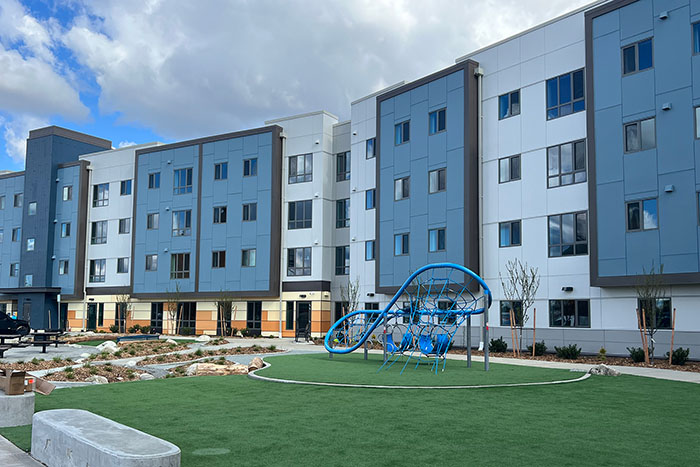
Phase 2, spearheaded by the Whatcom Community Foundation, will feature at least another 80 units of affording housing, in addition to a two-story local food production campus, rooftop event space and terrace.
Mauri Ingram, WCF president and CEO, said in an email that the Port was immediately onboard with the original concept when it was presented and worked with other agencies to accelerate timelines on Phase 1 to make sure critical financing deadlines were met.
“It’s been incredibly helpful to work with a public sector partner that was not only open to affordable housing but saw the benefit of having housing opportunities for a wide range of income levels as a way to strengthen the redevelopment of the downtown waterfront,” Ingram said.
She is encouraged, she added, that the Port is encouraging other developers to include varying price points for affordability in their projects.
“I take (that) as further evidence that affordable housing has been incorporated into their goals for the waterfront beyond what’s required by the intermodal agreement with the City of Bellingham,” she said. “What that looks like for the waterfront district as a whole or any of the Port’s other land holdings, I couldn’t say.”
Outside of Bellingham, northern waterfront properties include Blaine Harbor and Hilton Harbor. Away from the water, the Port is known for developing an international cargo terminal on 52 acres outside of Sumas back in the mid-1980s.
One of the Port’s jewels is the Bellingham International Airport, which it purchased from Whatcom County in 1957 for the price of just $1. Its current airport-area holdings include the airport itself, the surrounding industrial park and 132 acres of land east of the runway and outside its perimeter security fence. The land is designated for aeronautical, commercial and light industrial uses compatible with aviation, but is also subject to future annexation by the City of Bellingham due to its location within an urban growth area.
On the horizon
In 2025, several areas are slated to see improvements. Those include a new 40-foot-by-60-foot building costing approximately $450,000, and continuing stormwater improvements at the Fairhaven Marine Industrial Park. The latter will cost approximately $3.5 million, with $1.5 million of that covered by a federal grant.
Led by its Regional Economic Partnership, or REP, team, the Port is Whatcom County’s designated Associate Development Organization, or a lead agency for economic development activities as defined by the Washington State Department of Commerce.
Guy Occhiogrosso, president of the Bellingham Regional Chamber of Commerce, said the REP team is not only working to get better jobs at Port-owned facilities, but are working to get better jobs to Whatcom County in general.
“They may help Lynden in some of the commercial property that Lynden has, to fill that (need),” he said. “They may work with the state Department of Commerce, and send out an email to our commercial real estate brokers saying, ‘hey, we have a company that’s in need of this type of infrastructure; is there a listing that meets these qualifications?’”
In a place like Whatcom County — with an ever-rising cost of living — the Port’s work is important, he added.
“Having a public agency to help facilitate that, I think, is really vital,” Occhiogrosso said. “If we did not have them, we would probably have even fewer of the well-paying jobs that we do have.”
— By Matt Benoit and Sam Fletcher
Also read in Salish Current:
• “Bellingham port hearing set for issuing bonds for modernization,” June 14, 2024
• “Tyler Schroeder to lead Port of Bellingham economic development,” Feb. 29, 2024
• “Developer Harcourt in contract default on Bellingham waterfront,” Nov. 2, 2023
• “Expectations are high, questions remain as waterfront neighborhood takes shape,” April 28, 2023
• “Candidates vie to drive the engine of Whatcom County’s economic development,” Oct. 8, 2021