
How green burials return us to the Earth
It was a small gathering, not more than 20 people around the empty hole in the ground. It was raining, but a funeral attendee was protected under an umbrella; the fresh scent of the surrounding woods clearing any heaviness in the air. Soon they walked toward the group, wicker basket in hand. That is when they saw her, the person in the ground. She was wrapped in nothing but a muslin shroud, her face clearly visible.
“She wasn’t in a casket. She wasn’t air-dried to make her look beautiful, like she was alive, sleeping in a casket. She was wrapped, and she was dead. And that had a powerful impact on me,” said Beth White, 75, who told me she had attended a green funeral in late 2024 for the first time, for her friend Ronnie, who had been her neighbor at her residence on Vashon Island.
Gently, Ronnie was lowered into the ground in the Vashon Cemetery last winter. Final words were spoken above the now-occupied resting place. White, rose in hand, tossed it into the grave. It lay atop the body. Those in attendance followed suit, wishing their final goodbyes. The body lay to rest in a green burial designated area.
“Her dead body brought me closer to feeling her death and her loss, and obviously that impacts my grieving process. It was just made real in a tender, bare way. There was nakedness about it,” White said.
Brian Flowers, owner of Wildflower Funeral Concepts in Ferndale, would agree with that sentiment. He conducts green burials with a similar approach to the one White had experienced. After spending nearly 17 years in the funeral industry — including a period as president of the Green Burial Council — Flowers opened his own funeral home in April 2024.
Reconnecting with closure
In doing so, he hoped to reconnect people with the type of closure White described — a vulnerability when faced with death. He specializes in more eco-conscious burial options that he believes can better reconnect people with the concept of death and healthy coping with grief.
“When you wash your hands, do you wash your right hand first? Or your left hand first? You don’t — you wash them together,” Flowers said. “Just like to heal our relationships with the natural world and heal our relationships with death and grief, we need to do those in conjunction together — that’s what drives this work.”
Not many people can say they have seen a dead body in this modern era, and many choose not to, according to Flowers. I have never gotten a glimpse of a deceased loved one — this puts into question: How might the distancing of death be impacting us?
“We deny death in our culture. We wrap all of our animals in plastic, and they’re all cleaned up, and the blood’s gone, and death is so distant. And this made my grieving process real. It just made my awareness more real,” White said.
Wildflower Funeral Concepts isn’t the kind of traditional funeral parlor I was used to. Instead of the heavy formality and somber atmosphere I had come to expect, it offered something more personal and deeply connected to nature. The decor is bright, with open sunlight beaming through its skylight windows. It’s lively, with large-scale houseplants that build onto the surrounding green accent chairs. There are no heavy, bedded caskets on display, no long stretches of pews in the chapel room.
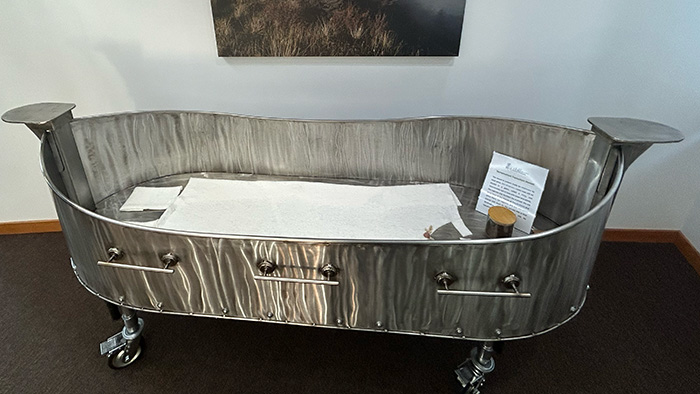
What does lie in the chapel is a large metal terramation vessel. Inside is a parchment note reading, “Hold my heart close to thee or plant the seeds in loving memory,” alongside an inconspicuous glass container full of soil.
Only after I had opened the jar and tested the soil with my fingers did Flowers explain that the very soil in my hands was that of a trial run — a composted body of a pig that looked nothing short of potting soil. Terramation is that very same process but for human remains. This soil can be taken home by loved ones and is nutrient-rich enough to be used for garden enrichment of any kind.
Terramation is only one of many options that Flowers offers, alongside green burial, aquamation and conventional burial and cremation. Though Flowers is passionate about sustainability, he will work with clients to meet their needs.
The leading force for sustainable options is green burial, a process that utilizes only a biodegradable casket and no chemical embalming. This method — the one that White got to bear witness to — is what inspired Flowers to pursue his interest in sustainable funeral practices 16 years ago.
This form of burial can also be used as a vehicle for ecological restoration and landscape-level conservation, according to Flowers. That means these burials can be used to restore habitats. Since the nutrients from this form of decomposition are natural, they are beneficial to the land surrounding it.
White said she has often considered what kind of burial site she will want as she has gotten older. Green burial has been one of the main options at the forefront of her mind.
“Part of me wants to be cremated so that my ashes can go into Puget Sound or Mount Rainier. The downside of cremation is that it pollutes a lot of the air, and I call myself an environmentalist, so I still haven’t decided if I want to have a green burial or cremation,” White explained.
When it comes to environmental impact, White would be more than right to say that cremation packs a punch. One cremation alone produces around 600 pounds of carbon, nitrous oxides and mercury, alongside around 56 gallons of natural gas. This is equivalent to a 470-mile car journey in an average-sized car.
Cremation is also one of the most popular methods of disposition due to its lower costs and the nomadic culture of this side of the country, according to Flowers. Wildflower utilizes containers made of pine and cardboard to limit chemicals burned during the process. After each cremation, Wildflower makes a donation to Forterra’s tree-planting program.
About 80% of people in Western Washington choose cremation, and some places along the West Coast are as high as 99%, Flowers said.
“2017 was the first year in the United States that more than 50% of the general population chose cremation. So that was kind of a benchmark year in the funeral industry,” he said.
Since Wildflower opened in 2024, Whatcom County now has its second funeral parlor offering aquamation. Moles Farewell Tributes also offers the option. Flowers said he himself played a key role in legalizing both terramation and aquamation in Washington, testifying before a Senate committee in 2019.
Aquamation uses water, heat and an alkaline environment, relying on electricity instead of natural gas, said Flowers. It requires 90% less energy than cremation with zero emissions.
The process produces a similar product to cremation — a bone material that is stark, powdery white that can be used in the same way cremation remains can, whether that means placing it in a traditional urn, scattering it in the wilderness or planting it in a garden.
Though death can be a difficult topic, it is one that deserves thorough care, which is what Flowers said he strives for through his work.
“We need to learn to be comfortable with that discomfort, engage it and heal it. And when we do, we deepen our humanity so much. We develop such a depth of compassion, empathy and understanding,” Flowers said.
Stepping back to engage with life and death, with nature and soil, helps make sense of grief and make it meaningful, Flowers said. Eventually, natural burial options give people a way to return to the Earth’s soil.
— By Jase Picanso
Also read in Salish Current:
• “New options change choices for that final resting place” Dec. 1, 2022
• “Paradise full: finding space to rest at Lopez Island cemetery,” Jan. 18, 2022