
It’s possible for nearly everyone to help keep honeybees busy in their vital role as agricultural, garden and wildland pollinators.
For Rob Rienstra, an artisan honey producer and owner of BeeWorks Farm in Whatcom County, the best part of spring is watching his hives come alive.
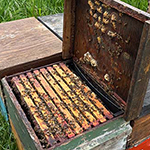
When he takes the bee box lids off, “it’s like, ‘Whoa, these are really exploding,” he said.
To Rienstra, bees aren’t all that different from people.
“When they’re well-fed and the temperature’s nice, they’re quite easy to get along with,” he said. “They’re like people. Right now, there’s not a lot of food, so their economy’s not very good.”
When food is scarce — whether due to early spring frosts or broader climate shifts — the bees get, as Rienstra puts it, a little “bratty.” Mood swings, it turns out, are not exclusive to humans.
‘When food is scarce the bees get a little “bratty.”
Mood swings, it turns out, are not exclusive to humans.’
“They’re responding to their daily economy in real time all the time,” Rienstra said.
During leaner times, bees are more defensive, and Rienstra is much more likely to get stung. He estimates he takes about 500 stings a year.
He’s learned how to tell when the bees are agitated. When he pulls up to a site to tend to the hives, he’ll stand about 15 feet away from the boxes. When they’re grumpy, they greet him by flying at and bouncing off his face. That’s his cue to suit up.
Despite the challenges and unpredictability, Rienstra said it’s the mix of adventure, nature and constant problem-solving that makes it worth it.
“It’s constant problem-solving, and I think it is with all farming — we’re all subject to the weather and just trying to deal as best we can,” he said.“It’s fun to a certain point, and then there’s a point where it goes beyond the fun. It’s like, that’s not fun anymore, but you have a good story later.”
With the threat of mites and other dangers to honey bees emerging over the past few decades, beekeepers have gotten good at learning how to replace their losses by splitting colonies and creating new ones. However, it’s becoming less sustainable.
“The problem is, when you start to get where you have to produce 35% to 40% of your colonies every year, you’re at a point where you can’t make a profit,” said Jeffrey Harris, insect physiologist at Mississippi State University.
Bees aren’t the only ones threatened by the varroa mite.
“If you talk to the general public, they think honey bees are dying from the planet because of this mite, and they’re really not,” Harris said. “What’s dying is commercial beekeeping as a way of life because the cost of trying to keep healthy bee colonies is so much higher and so much more effort labor-wise than it ever was before.”

As a result, more beekeepers are leaving the industry, putting the traditionally multigenerational career at risk.
How to help
Harris’ advice is simple: buy from local suppliers.
Many nationwide big box and chain grocers buy honey internationally where they can get it for much cheaper than in the U.S.
“They might buy honey from China, Argentina, Brazil, any other country you can think of, and they often get a very cheap price for foreign imported honey,” Harris said. “The problem with that is it undercuts our domestic honey production.”
To stay competitive, U.S. beekeepers are often forced to keep their prices low — sometimes unsustainably so. And even then, honey alone typically doesn’t generate enough income to support a full-time operation. Like Rienstra and BeeWorks, most commercial beekeepers supplement their income by selling starter colonies, breeding queen bees and offering pollination services to farms.
“I just encourage people to pay more for it,” Harris said. “Be willing to pay more for local product, because you’re helping out local producers.”
Bees and blooms
Individuals can make a difference — especially when it comes to improving bees’ nutrition, agrees Priyadarshini Chakrabarti Basu, professor of apiculture at Washington State University.
“There is a multitude of stressors that impact honey bees and actually all these species. I would probably call poor nutrition as one of the most important stressors that we as individuals can help counteract,” Basu said.
A healthy forage habitat for bees depends on three key elements: abundant bloom, diverse bloom and staggered bloom, she said. “Abundant … so bees have access to a lot of flowers in the landscape. Diverse, meaning diversity in the flower types, which will also make sure that there is a diversity in macro- and micronutrients, in the pollen and nectar, and then staggered bloom, meaning that something or the other is constantly blooming in the landscape, especially during the times in the year when there is nothing else blooming in the landscape.”
Even small-scale efforts can make an impact.
“Even if it’s just one pot on a balcony, a handful of plants in a backyard, or a patch of land where forage can be planted — every flower counts,” she said.
— By Sophie Cadran
Also read in Salish Current:
• “The bee beat — Part 1: Threats to our bees,” June 26, 2025
• “World buzzes over Lynden honeybee accident,” May 6, 2025
• “Invasive ‘murder hornets’ found in Washington have been eradicated, officials say,” Dec. 19, 2024
• “Giant hornet effort approaches milestone as another pest shows up,” Feb. 26, 2024
• “‘No Mow May’ keeps pollinators in mind,” May 12, 2023