
Community agriculture is flourishing at a land bank preserve that has transformed a hayfield into a thriving community gardening hub on San Juan Island.

San Juan Island Grange president Roger Ellison said “a lot was accomplished” during its first year of agricultural use at the Overmarsh Farm Commons.
The commons, part of a 20-year lease approved by the county council this year with the goal of reinvigorating the agriculture industry in the San Juans, is a part of the San Juan County Conservation Land Bank preserves designated for community growers.
The project has attracted plenty of volunteer participation, perhaps not surprising for the largest grange organization in Washington. Approximately 30 participants “grew a lot of good vegetables” this year, Ellison said.
The total size of the leased land is currently 35 acres. For a nominal fee of $30, participants can be assigned their own row or block to use.
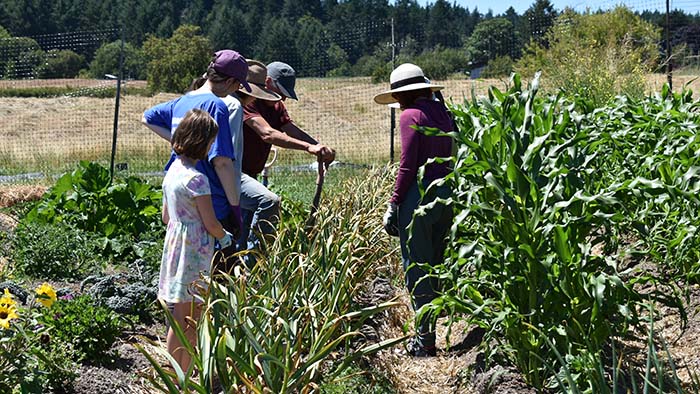
The once low-quality hayfield is gradually being transformed into a thriving hub of community garden plots, with a heritage orchard, blueberry patch, grazing area and plenty of room for new ideas.
Transforming a field
Ellison said the soil was initially prepared by covering the ground with large tarps that had served as billboard covers. One side still has a sign on it, but the other side, facing up, is black. Four quarter-acre blocks are now ready to plant; two were used this past summer.
“One of the best things to happen,” Ellison said, “was hiring a manager for the project.” Amanda Zee, who is also the primary farmer at Sweet Earth Farm on San Juan Island, began managing Overmarsh Farm last spring.
In the 1930s, the Grange had a store on Spring Street, and it still owns the property, where Lugnut Automotive is now, Ellison said. This rental income has allowed the grange to hire two independent contractors in addition to Zee: one runs the Grange booth at the farmers market and one is a rental agent for the Grange Hall.
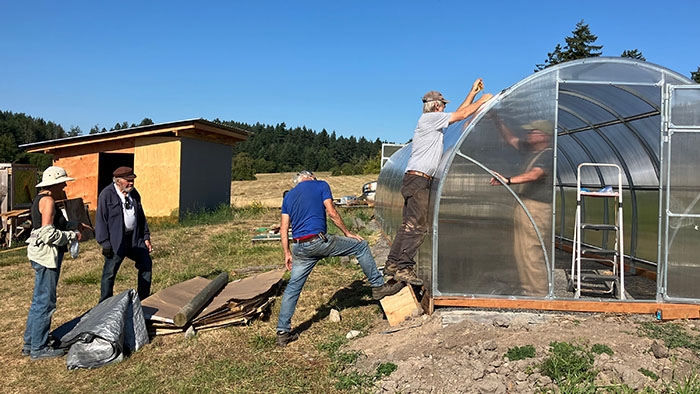
The land bank constructed a deer fence around the five acres. The lease agreement allows for up to 5,000 gallons of water per day for irrigation and livestock at a rate of $2 per 1,000 gallons.
“Water conservation is a key priority, so we’re closely monitoring both the well and overall usage,” Zee said.
An additional 2,500-gallon water storage tank will be added in the spring. The project received cost-share funding from the conservation district to cover half the cost.
Commodities + community
The soil is not known for being great, Zee said, “but everything did really well.”
One participant was able to grow food from her native country, the Philippines, that she is not able to get in local stores.
“She experimented with mung beans, bitter gourd melons, sweet potatoes, peppers, and all did really well.” Zee said.
Several group projects are underway. One involves planting an orchard of heritage apples. Ellison said that trees with historical importance in island history have been selected that are resistant to root rot, are drought tolerant and have good anchorage. Funding for this project was generated in part through the San Juan Island Community Foundation’s “Community Cares” fundraiser at the San Juan County Fair.
One of the participants in the project, Max Bliss, said, “my partner and I hadn’t really done much gardening before. We learned a lot.”
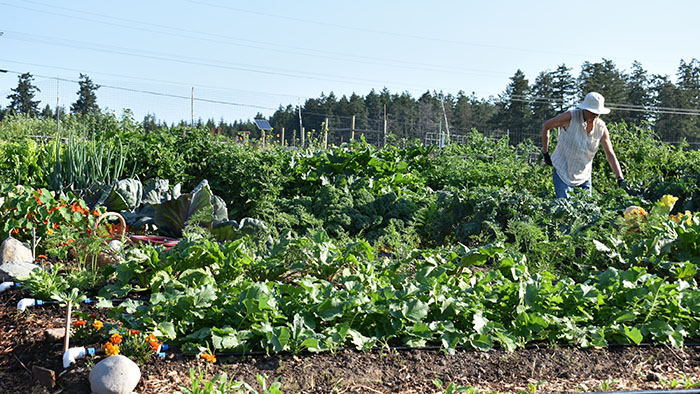
The two had a great yield of tomatoes and yellow squash, as well as cucumbers, carrots, beets and arugula, and took the surplus to the food bank. Bliss said he had good luck with garlic and onions and grew “some of the biggest onions I’ve ever seen.”
It was “not only for food but community and the friendships that resulted from working together,” Bliss said, and it was great for people who don’t have the space to grow things at home. Being able to farm with others “is an incredible experience.”
Other common area work done included creating pathways, setting up composting and drip irrigation.
A winter garden including onions, garlic, kale and other leafy greens has been initiated under the leadership of Bruce Robinson.
Robinson sees potential for the model to expand. “Overmarsh Farm Commons provides a wonderful opportunity for people to develop a greater sense of food security,” he said. “With the price of land and the cost of farming infrastructure, this project may become an important model for agricultural development in San Juan County‘s future.”
By Nancy DeVaux

Also read in Salish Current:
• “Small farmers seek Skagit’s big magic,” Sept. 16, 2025
• “Farm models land stewardship, animal welfare,” Aug. 14, 2025
• “Farming leases renew ag efforts in the islands,” Feb. 18, 2025
• “Back to the land in the islands — Part 2: Women who farm,” March 31, 2023
• “Back to the land in the islands — Part 1: Locally growing,” March 24, 2023