
The Whatcom County Planning Commission has urged the cities of Bellingham and Blaine to adopt measures to meet their urban growth requirements, claiming they have failed to do as yet.
Whatcom County is currently in the process of supporting cities’ urban growth area proposals to accommodate housing and employment growth for the next 20 years. The final approval of the comprehensive plan is tentatively slotted for May 12.
However, a letter submitted by the planning commission urges county council members to require Bellingham and Blaine to adopt “reasonable measures” to meet their urban growth requirements, which commissioners claim they failed to do.
According to county council member Jessica Rienstra, despite the letter and while final decisions have yet to be made, the council has shown preliminary support for the most recent revisions of the Urban Growth Area proposals for both Bellingham and Blaine.
“For me the real goal is to find that central area where (both the council and the cities) see the best support right now while ensuring we’re not creating massive safety risks in 20–30 years,” she said in an interview.
The conversation about Nooksack’s UGA proposal, for example, has addressed urban growth near flood zones.
In Bellingham
According to its preliminary draft, Bellingham estimates a need of $133 million per year between 2025 and 2045 to fund about 220 additional affordable housing units annually.

The letter states that Bellingham proposed to meet its Growth Management Act obligations by raising $233 million in new taxes — about $3,000 per household per year — to subsidize the expense of new housing, instead of addressing the root cause of the problem, which is cost.
The planning commission claims Bellingham has no legal authority to raise taxes by $3,000 per household, and even if it could, that figure would push many city homeowners into poverty. Landlords would pass the tax on as a $250 increase to renters per month. Additional taxes would drive more growth to rural areas, which contradicts the goal of the act.
“We need to push back on the City of Bellingham and say, ‘you’ve got to get a grip on cost’ not just keep saying, we’ll raise taxes, just raise taxes,’” commissioner Rud Browne said at a recent planning commission meeting.
According to Chris Behee, Bellingham’s planning division manager, the $3,000 figure identifies the gap in funds — officials are not necessarily proposing a tax.
Kitsap County’s and Mercer Island’s plans were appealed earlier this month because they proposed affordable housing solutions but did not provide any funding for it. [Ed.: Removed incorrect appellant]
“When we saw that Mercer Island case confer (with the Department of Commerce), we felt like identification of that funding gap is critical,” Behee said at the meeting.
Local, state and federal tax will continue at current funding levels, he said at a recent planning commission meeting. There is also a multifamily tax incentive, encouraging density for private builders to help with the solution.
“We never even contemplated that $3,000 per household, the idea of covering that with a local tax or something, we just know that’s not possible,” Behee said. “We are just being perfectly honest in saying we don’t anticipate fully satisfying that need as most communities in Washington I think are doing because nobody has those resources.”
Members of the planning commission did not find that answer satisfactory.
“We have the issue raised, and you’ve admitted you don’t have the funding, and I think that’s where we’re at,” Browne said.
At a committee of the whole meeting on Jan. 27, the Whatcom County Council approved support for House Bill 2442, which provides additional flexibility for cities and counties for revenue mechanisms such as taxes. Council members have advocated for this for the last two years in Olympia, which would allow a real estate excise tax that can go toward affordable housing.
The bill states that .5% of the home selling price can be taxed for affordable housing. [Ed.: percentage updated for accuracy]
“Our state is one of the most regressive revenue states in the country in that the majority of the revenue that comes in hits low- and middle-income households,” said council member Jon Scanlon.
The bill brings in a mechanism that hits high-income households more than low-income households. “To me,” Scanlon said, “that’s a positive thing.”
If the bill passes, there is a potential to lower property tax, he said.
At a committee of the whole meeting on Feb. 10, council member Kaylee Galloway said that identifying that gap in funding for Bellingham’s UGA may provide leverage for state-level funding asks.
In Blaine
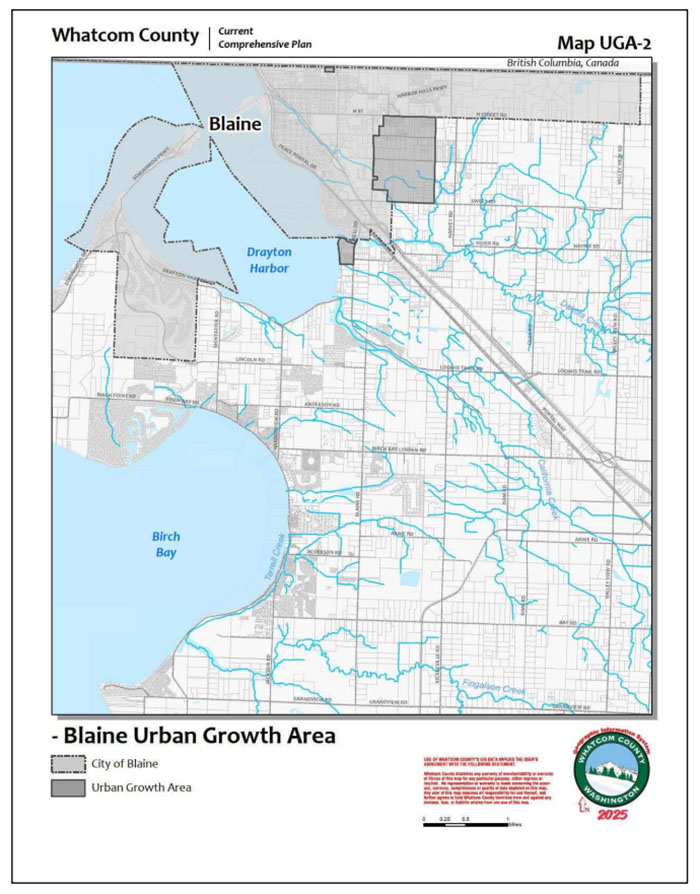
Blaine’s plan, according to the planning commission, also lacked vital details.
“They have not identified any source of wetlands mitigation, what it’s going to cost, how much is involved, who’s going to pay for it and whether the cost actually makes the land affordable or unaffordable at the end of it,” Browne said. “Blaine has to be held to account for saying how is this economically viable, how is it going to be funded?”
However, prior to receiving this letter, the council showed support for Blaine’s proposal. According to Blaine Community Development Services Director Alex Wenger, the planning commission’s assessment is incorrect.
“Our land capacity analysis has already accounted for all wetlands and their maximum buffers remove that area from our land capacity analysis so we can accommodate 20 years of industrial and commercial job growth and not impact any wetlands whatsoever,” he said in an interview. “There is zero wetland mitigation required to meet our employment allocations, and it will cost us that same figure, zero.”
The council will review these findings with the county legal team and hold a public hearing prior to approval of the final comprehensive plan.
— By Sam Fletcher
Also read in Salish Current:
• “Candidates talk affordable housing solutions,” Oct. 13, 2025
• “Commentary: Steps to a comprehensive housing strategy,” Aug. 18, 2025
• “Uphill climb to housing affordability,” Dec. 10, 2024
• “Public has its say in comprehensive planning,” July 9, 2024
• “Commentary: Meeting the housing need: four suggestions for planning,” May 21, 2024