
Everson’s Alluvial Farms serves as a model for protecting vital farmland
The stream that runs along Alluvial Farms — a 45-acre pig farm in Everson — is swift this spring as it makes its way around willows toward the Sumas River and, eventually, the Fraser River in British Columbia. Its muddy waters might not look like much, but Dale Creek is important as a salmon-bearing stream.
For years the land was farmed right up to the creek, until Alluvial Farms and Whatcom County Land Trust saw the opportunity to do something different.
The creek and the riparian area around it presented a win-win opportunity for the two. In essence, their plan would permanently protect the land around the creek while also helping Alluvial Farms afford to purchase it.
Now, the land trust is using a similar model, acquire-protect-transfer, with the Cloud Mountain Farm Center just down Goodwin Road from Alluvial Farms. In December 2025 the previous owners — Sustainable Connections — directly transferred the center to the land trust, which is serving as the interim owner and placing it into a conservation easement.
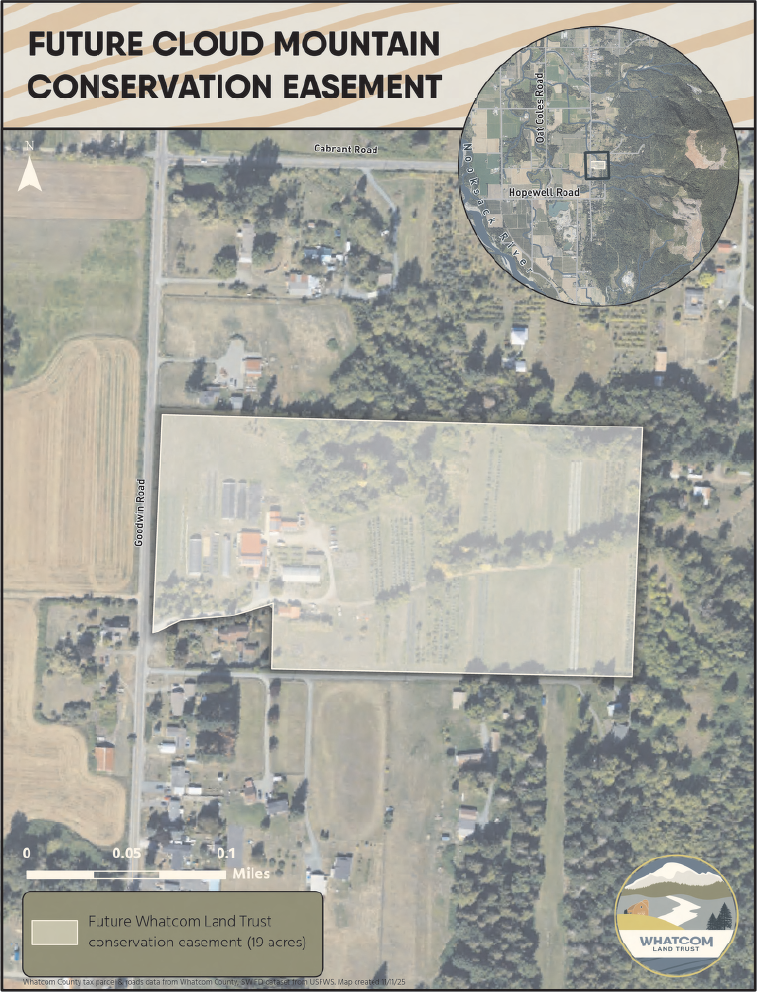
Whatcom Land Trust Executive Director Rachel Vasak said the hope is to have an owner to transfer the land to in place by early 2027.
“I wish I had a better crystal ball. To us, it’s more important to find kind of the right owner, and there’s so many different variables between here and there that we have to work through,” she said. “Our work as interim owners is to put the conservation easement in place so that the land is utilized into the future.”
Whatcom Land Trust partnered with the county to create a conservation easement program that compensates agricultural landowners who give up their residential development rights. The trust holds the conservation easement associated with those properties, ensuring the land stays available for farming over generations.
“Once it’s converted, in most circumstances, it’s never going to be able to be converted back to good, productive farmland,” Whatcom Land Trust Conservation Director Alex Jeffers said.
He said the Alluvial Farm project “checked all the boxes” for both the trust and the farm. That was in 2018. Eight years later, both the land trust and the farm say the project was a success.
“They wanted a property that had wildlife benefits but also had agricultural benefits that they could do small-scale organic farming in a way that was sustainable, both for their business but also really honored the ecology of the area,” Jeffers said. “But they were running into the issue of agricultural land prices in Whatcom County being really, really high.”
Agricultural land preservation is nothing new for Whatcom Land Trust. In fact, its first project in 1986 was a 160-acre conservation easement on the Herman and Diane Miller farm on Ten Mile Road north of Bellingham. Since then, the trust has expanded to incorporate ecological and habitat work.
The partnership with Alluvial Farms is part of a recent shift, however, in how the land trust is approaching agricultural land conservation in a way that opens the door for a new generation of farmers as farmland prices continue to jump.
“Protecting farmland isn’t just about making sure that it remains farmable but making sure that people are able to continue farming and they can afford to get on that land,” Jeffers said. “As we have the older generation starting to think about retirement and starting to think about transferring their farms, we want to make sure that the newer generation of farmers are able to afford to access that land as well.”
For Alluvial Farms owner Matt McDermott, partnering on a conservation easement with the land trust made a huge financial difference, especially as a first-generation farmer.
On the other end of the bargain, the land trust granted the farm a bridge loan, equal to the value of the 10 acres, to help purchase the property and, if they held up their end of the bargain, eventually forgive the loan and place the 10 acres into a permanent conservation easement that prohibits farming or development. At the time of the sale, McDermott said the loan was about 20% of the overall cost of the land.
“It wasn’t insignificant,” he said. “For new farmers or people trying to acquire land, the idea of easements and partnerships with the land trust make a real great move financially, and it can be super beneficial to help folks who might need that little extra bit of resources.”
Partnerships in practice
In neighboring Skagit County, a similar conservation easement program is called Farmland Legacy. To date, the program has protected 15,400 acres and enrolled approximately 170 farmers whose activities range from dairy and cattle operations to berries, flowers and crops, according to Skagit County Agricultural Lands coordinator Sarah Stoner.
She said because the primary value on farmland comes from residential development rights, removing the ability to build a house through a conservation easement lowers the value of the land and makes it more affordable — or at least it should in theory.
“What we’ve seen in reality is that the finite farmland that’s available in our county is in such high demand that easement-protected land and unprotected land do not vary that much,” Stoner said. “The other challenging reality is that even reduced land costs today are financially extremely difficult for our beginning and even established mid-career farmers to access. It’s a tough time for the new farming generation.”
That doesn’t mean the program, which is going on almost three decades in action, hasn’t helped future generations access working land. Stoner pointed to a 100-acre family farm in south Mount Vernon that was able to use the funds from the conservation easement program to buy out family members who were no longer interested in owning and managing the farmland instead of having to sell the land outright.
Another success story from the program is a series of properties owned by the Houser family, who have protected 600 acres of Skagit farmland since 2020, including most recently land used by Thulen Farms.
“I want to see farmland set aside for my kids and for our farmers,” Mark Houser said in the program’s recent report. “We need our working lands for our working farmers.”
Both Skagit and Whatcom Land Trusts also use a buy-protect-sell model to preserve agricultural land in the region.
In Skagit, the trust purchased 140 acres of farmland, protected it with an agricultural easement and then sold it to a local dairy farmer at a reduced, more accessible price, Stoner said.
“This model can take years and work and risk for the purchasing entity, to take on the debt and ownership and protection process,” she added. “(It) helps out the incoming farmer access land — not only because it reduces the price but also because it buys them time to line up financing.”
Striking a balance
Land conservation and agriculture are often in conflict. But organizations in Northwest Washington prove the two can coexist.
“The folks that are out working on farms know their land really, really well. It’s their livelihood, everything they’re doing is centered around that relationship that they have with their land,” Jeffers said. “And so there’s a lot of opportunity for farmers to be able to balance that wildlife habitat and environmental goals with their agricultural practices.”
He added that while there’s always an opportunity to manage land in a way that centers the different values associated with it, having examples to point to can make those possibilities more tangible.
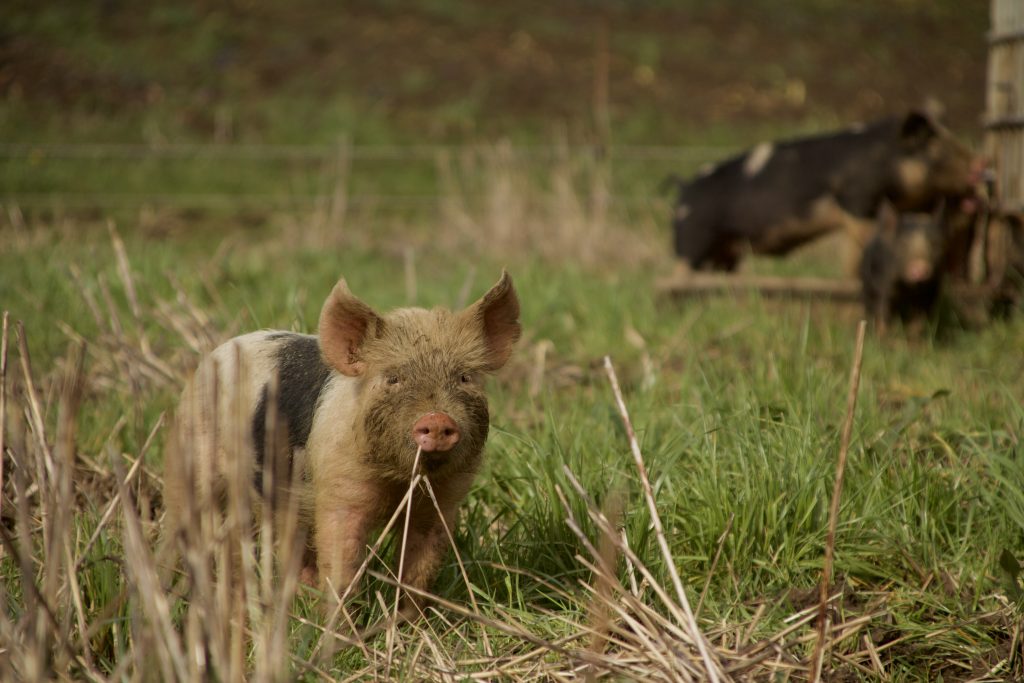
“It’s hard to believe something is possible or sort of conceptualize what it looks like before you can see examples of it,” he said. “And there’s lots of examples around Whatcom County of people balancing these uses on their properties.”
In Alluvial Farms’ case, owner McDermott agreed not to farm 10 acres along the creek that went into the conservation easement, instead restoring the riparian area by replanting native trees and plants as part of the agreement.
Those 10 acres make up almost a quarter of the farm’s overall 45 acres. But for McDermott, the value goes beyond just numbers.
“We need a balance in the community. The idea of just farming every possible acre, I don’t know if that’s worked out so well for us,” McDermott said. “Maybe there is a healthy balance between land preservation and production agriculture that is benefiting all of the living things that are in our systems, humans included.”
—By Sydnee Chapman